
A Unified Namespace is a single, real-time data structure. Every plant system — SCADA, MES, CMMS, ERP — publishes and subscribes to the same data. No system has to pull data through its own custom connection. For maintenance teams, that means asset condition data reaches your Computerized Maintenance Management System the moment it changes. No one has to build a one-off integration to fetch it first. This guide breaks down what a Unified Namespace actually is. It covers how UNS differs from the plant architecture most facilities run today, and what changes for the people who keep equipment running.
Key Takeaways
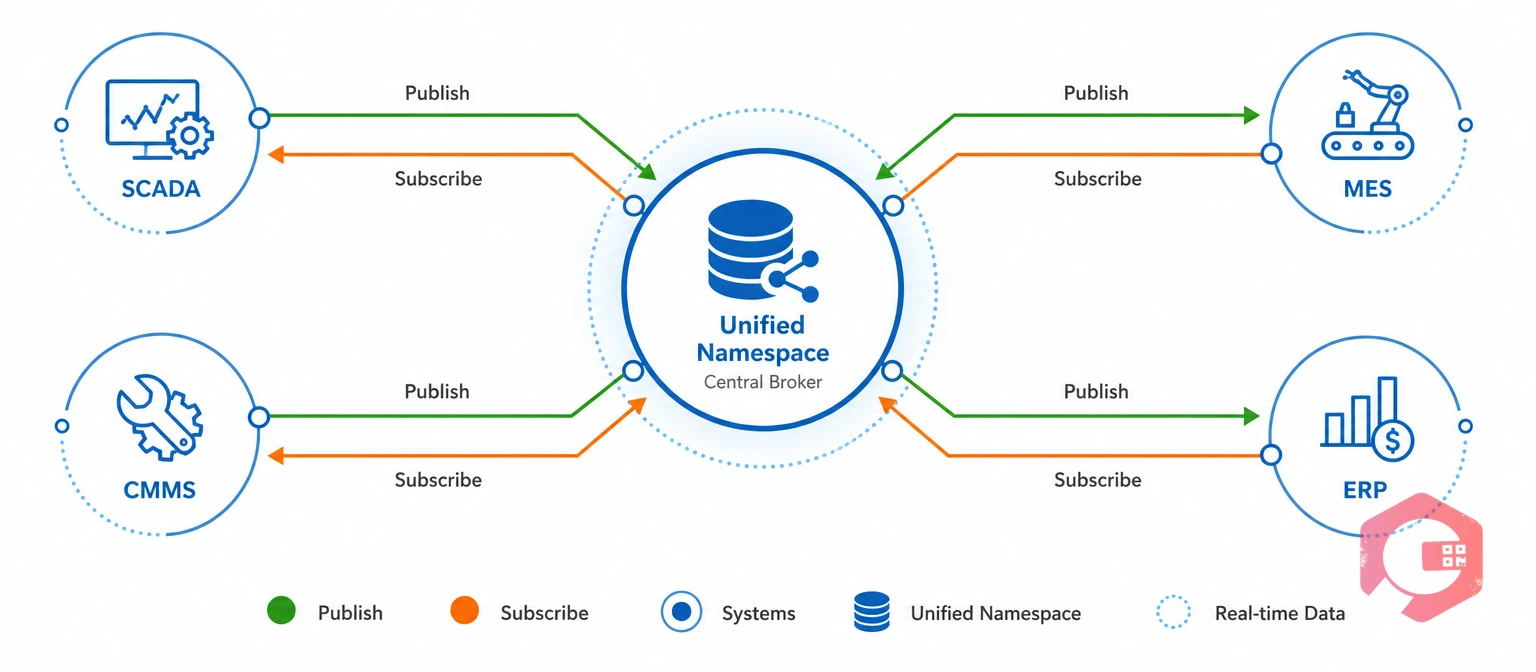
A Unified Namespace is a real-time data model. Every plant and business system reads from and writes to one shared source of truth. Traditional plants wire this differently. Your SCADA system sends data to your historian. The historian sends a separate feed to your CMMS. Meanwhile, your CMMS separately polls your ERP. A Unified Namespace replaces all of that with one central broker. Every system connects to it once. Each one publishes what it knows and subscribes to what it needs.
The term comes from the manufacturing and industrial automation community. It became popular alongside MQTT, a lightweight messaging protocol built for this kind of many-to-many data sharing. A Unified Namespace typically organizes data using the ISA-95 standard hierarchy — enterprise, site, area, line, and equipment. That gives every reading a predictable, human-readable address, instead of a cryptic tag number only one engineer understands.
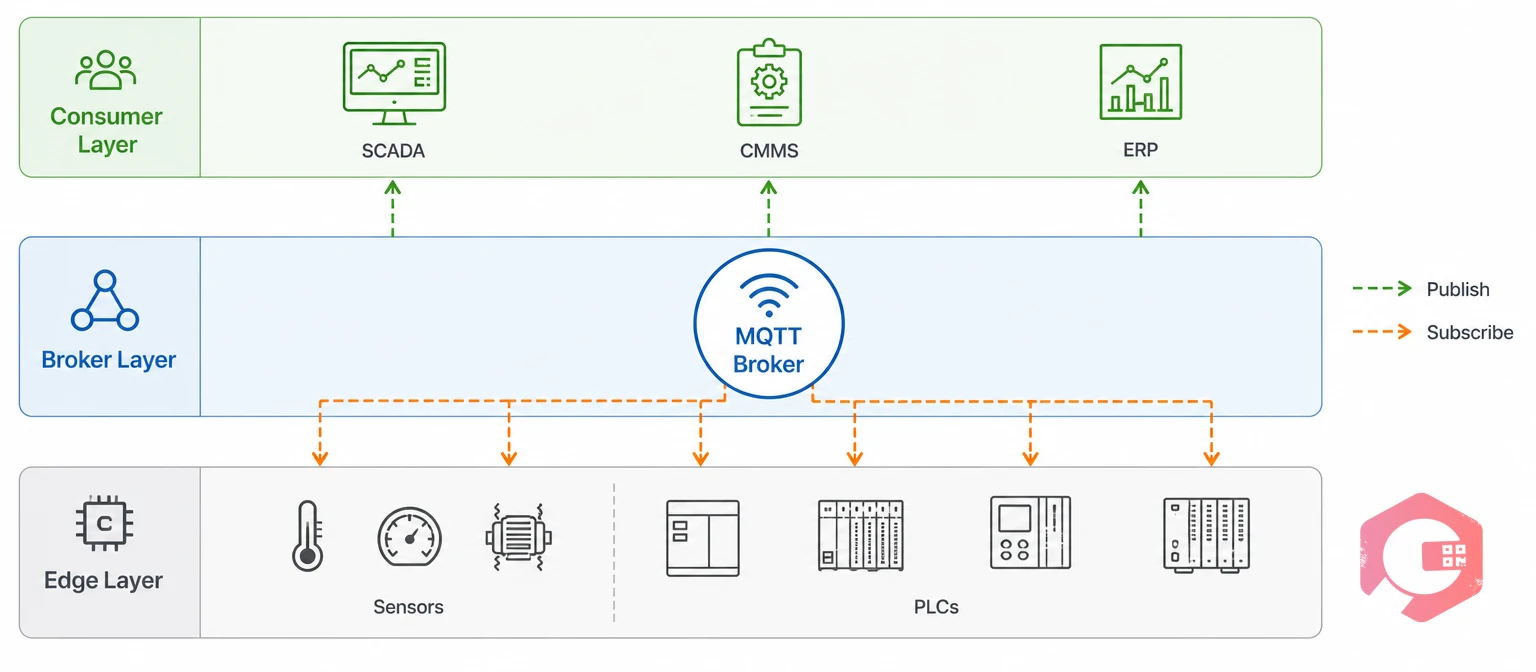
A Unified Namespace is built from three layers that work together. Understanding each one helps you see where a CMMS fits into the picture.
The Three-Layer UNS Stack:
MQTT is a lightweight publish-subscribe protocol built for low-bandwidth industrial networks. A device publishes a message to a named "topic" — for example, Plant1/Line3/Pump4/Vibration. Any system subscribed to that topic receives the update instantly. No system has to ask another system for data on a schedule. It just arrives.
Publish-subscribe is a messaging pattern where senders publish data without knowing who will use it. Receivers subscribe to only the topics they care about. This is the opposite of the traditional model, where a developer builds one specific connection between exactly two systems. That connection breaks the moment either system changes.
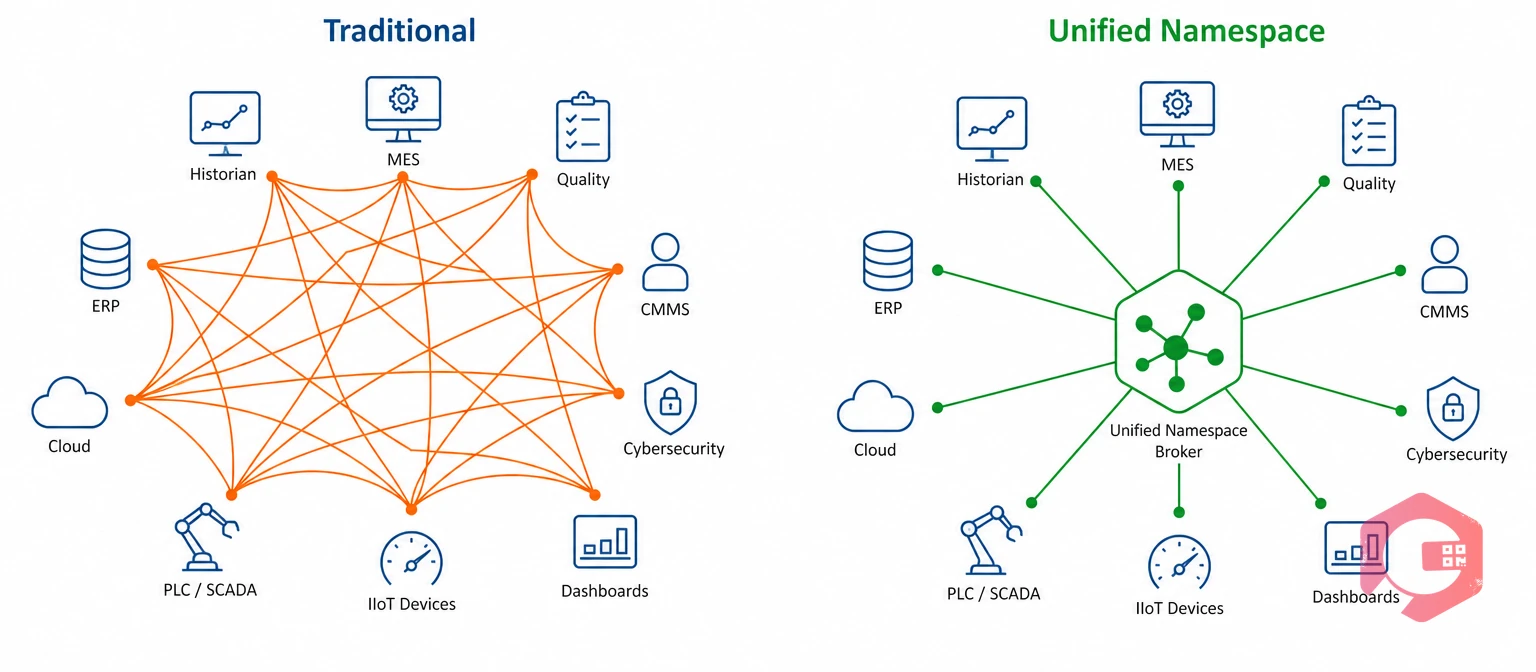
Most facilities today run what's sometimes called "spaghetti architecture." It's a web of one-off connections between each pair of systems that need to talk. A Unified Namespace replaces that web with a single hub every system connects to once.
| Factor | Traditional (Point-to-Point) | Unified Namespace |
|---|---|---|
| New system integration | Custom connection built per system pair | Connect once to the broker, subscribe to needed topics |
| Data freshness | Often polled on a schedule (minutes to hours) | Real time, the moment a value changes |
| Source of truth | Varies by system, often conflicting | One shared, structured data source |
| Adding a new consumer | Requires a new point-to-point build | Subscribes to existing topics, no new build |
| Failure impact | One broken link can silently cut off a whole feed | Broker stays up even if one consumer goes offline |
Curious how much unplanned downtime a disconnected system is already costing you? Try the OEE calculator to see where fragmented data is hiding losses.
A Unified Namespace matters for maintenance because it removes a step. It cuts out the custom integration project that usually sits between a sensor reading and a work order. Without one, connecting a new vibration sensor to your CMMS means asking IT to build a dedicated pipeline. With a UNS in place, that sensor already publishes to the broker, and your CMMS just subscribes to the relevant topic.
Maintenance teams that adopt a UNS-connected CMMS typically see the biggest gains in two areas. Alert-to-work-order time drops. And there are fewer "which system has the real number" arguments between maintenance, operations, and IT. Cryotos customers running IoT-connected work orders have reported up to 30% reduction in unplanned downtime and 25% faster repair turnaround compared to manual data pulls.
Most maintenance teams don't need to understand the full ISA-95 hierarchy to benefit from this. What matters practically is simpler. IoT meter reading and condition data reach the CMMS on their own. No developer has to get involved every time a new asset gets instrumented. This lines up with the broader ISO 55000 approach to asset management. It treats reliable, timely asset data as a foundation for good maintenance decisions, not a nice-to-have.
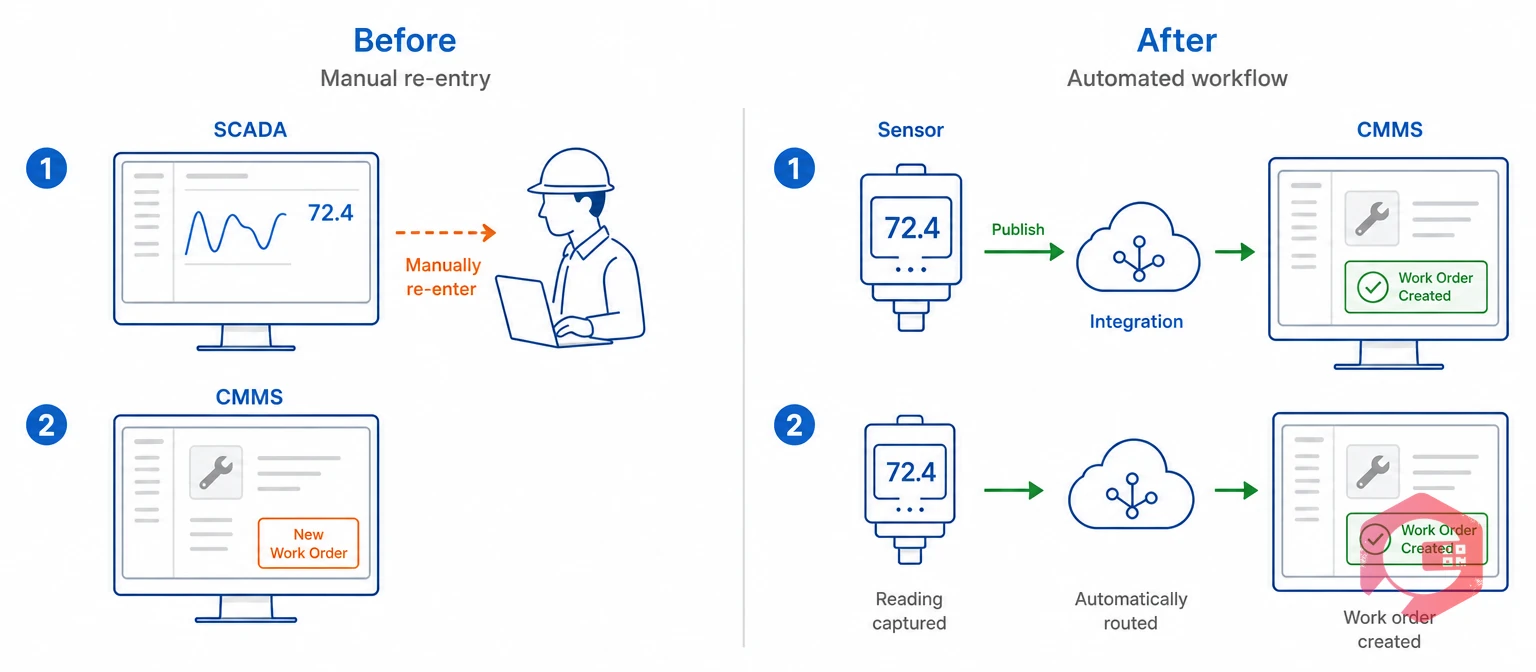
The practical shift shows up in daily workflows, not architecture diagrams. Here's what changes once maintenance data flows through a Unified Namespace instead of a manual pull.
A Unified Namespace gets misunderstood often. A few myths are worth clearing up before you evaluate one for your plant.
In a Unified Namespace, Cryotos sits in the consumer layer. Your SCADA HMI and historian sit there too. Rather than requiring a custom feed, Cryotos subscribes to the relevant broker topics through its IoT meter reading connections. Asset condition data flows straight into work orders and PM schedules, with no separate integration project for each sensor.
For plants running SAP or Microsoft Dynamics 365 alongside their maintenance system, Cryotos's ERP integration can also read from the same namespace. Cost data and completed work orders flow back to the enterprise layer without duplicate entry. This is the same closed-loop idea behind broader IIoT and SCADA integrations. A UNS just makes the connection point standard instead of custom-built every time.
No. A Unified Namespace sits alongside your existing SCADA system rather than replacing it. Most rollouts add a broker and connect SCADA, historians, and other systems to it gradually, without ripping out working infrastructure.
No. Industry 4.0 is the broader movement toward connected, data-driven manufacturing. A Unified Namespace is one specific pattern, built on publish-subscribe messaging. Many facilities use it as part of an Industry 4.0 strategy. It is not the strategy itself. You can adopt a Unified Namespace without calling the rest of your program "Industry 4.0," and plenty of facilities do exactly that.
Most Unified Namespace deployments use MQTT, a lightweight publish-subscribe messaging protocol built for industrial networks with limited bandwidth. Some deployments also use Sparkplug B, an MQTT extension that standardizes how industrial data gets structured on top of the base protocol.
A CMMS connects as a subscriber, reading relevant topics from the broker instead of requiring a dedicated point-to-point integration. Cryotos does this through its IoT meter reading connections. Asset data flows into work orders and PM schedules automatically, as soon as it's published.
No. The pattern scales down as well as up. A single-site plant with a handful of systems can benefit just as much from a shared broker as a multi-site enterprise, as long as those systems currently need custom integrations. The core problem — one-off connections that break and don't scale — exists at any size. A small plant often feels the pain of a missing integration just as sharply as a large one does.
A Unified Namespace changes how data reaches your maintenance team, not what your team does with it once it arrives. Schedule a free demo to see how Cryotos subscribes to real-time plant data and turns it into automated work orders.


Cryotos AI predicts failures, automates work orders, and simplifies maintenance—before problems slow you down.