

A CMMS helps you improve customer experience by giving your maintenance team the structure, data, and documentation that ISO 9000's quality management principles demand. When equipment fails unexpectedly, customers feel it — in late deliveries, inconsistent products, and broken service commitments. ISO 9000 was written to prevent exactly that. A well-configured CMMS is the operational system that makes those quality commitments executable, measurable, and auditable every single day.
According to the ISO, more than one million organisations in 170 countries hold ISO 9001 certification — the certifiable standard within the ISO 9000 family. The ones that sustain that certification over time do it by embedding quality into their operations, not by treating it as a documentation exercise. For maintenance teams, that means using a CMMS not just to track work orders, but to actively support the quality outcomes their customers depend on.
ISO 9000 is a family of international quality management standards. The most widely adopted is ISO 9001:2015, which builds its entire framework around seven quality management principles — and the very first one is customer focus. That is not an accident. ISO's position is that every quality decision, every process improvement, and every investment in the business must ultimately trace back to meeting or exceeding what customers need.
For maintenance teams, the connection to customer experience is more direct than it might appear. Your customers never see your maintenance schedule or your work order queue. What they see is whether the product arrived on time, whether the service was consistent, and whether your team could trace a quality problem back to its source and fix it. All of that depends on how well your assets are maintained.
ISO 9000 creates the framework. A CMMS creates the system that makes the framework real. Together, they give your customers something they can feel — reliability.
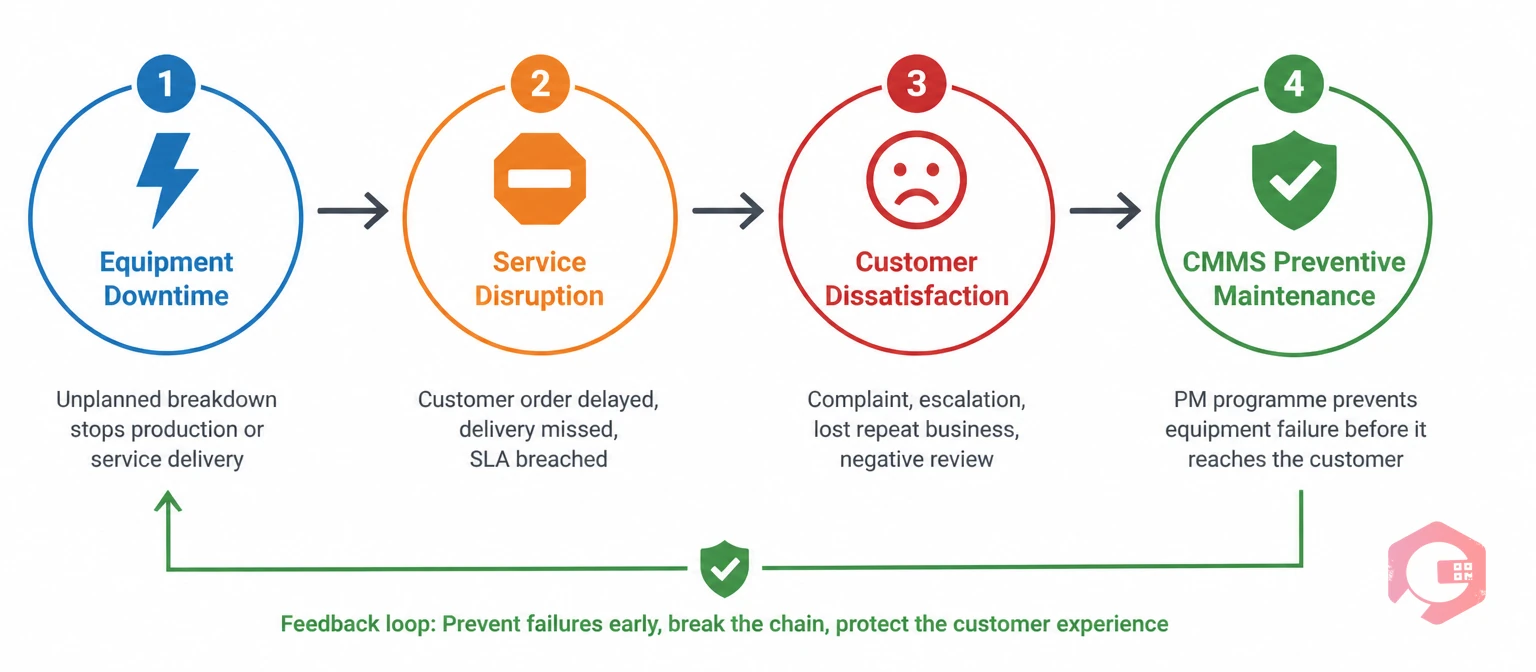
Most organisations treat maintenance and customer experience as entirely separate functions. ISO 9000 says they are not. Clause 8.5 of ISO 9001:2015 requires that production and service provision take place under controlled conditions — including the maintenance of suitable infrastructure and equipment. When that maintenance is reactive rather than planned, controlled conditions become impossible to guarantee.
The customer-facing consequences are predictable. A production line that stops unexpectedly pushes back delivery dates. A calibration instrument that has drifted out of tolerance produces batches that fail specification. A facility whose assets are failing faster than the team can repair them sends inconsistent quality to customers week after week. None of these are quality strategy failures — they are maintenance failures with customer-facing consequences.
Research from Aberdeen Group puts the average cost of unplanned downtime at $260,000 per hour for manufacturers. But the reputational cost of a missed delivery commitment or a batch recall often compounds far beyond that figure. ISO 9000 addresses this by requiring organisations to manage infrastructure proactively. A CMMS is the practical tool that makes proactive management possible — through preventive maintenance scheduling, calibration tracking, and real-time asset performance data.
Three specific failure modes turn maintenance gaps into customer problems:

ISO 9000 defines seven principles that underpin every effective Quality Management System. For maintenance teams, each principle translates into a specific set of practices — and each one maps directly to a capability your CMMS should be delivering.
ISO 9000 defines customer focus as understanding current and future customer needs, meeting requirements, and working to exceed expectations. In maintenance, that means keeping the assets that support product quality and service delivery running reliably. Cryotos's downtime tracking module gives managers real-time visibility into which assets are trending toward failure before they get there — so the team can act before customers feel the impact. Teams using Cryotos report 25% faster repair turnaround, which directly protects the delivery commitments that define what customers experience.
ISO 9000 requires leadership to establish a clear direction and create the conditions where quality is actively supported throughout the organisation. For maintenance, that means management must commit to planned budgets, use performance data to make decisions, and hold the team accountable to PM compliance targets rather than just reactive response times. A CMMS gives leadership the reporting layer that makes accountability concrete. Dashboards showing PM compliance rates, overdue work orders, and mean time between failures give management the numbers they need to justify maintenance investment before something fails — rather than after it does.
ISO 9000 requires organisations to ensure their people are competent, empowered, and engaged in delivering quality. For maintenance teams, this means technicians who understand their equipment, follow standardised procedures, and log their work accurately. A CMMS supports this through maintenance checklists that guide technicians step by step, digital signatures that confirm task completion, and a mobile-first interface that lets field teams complete and log work without returning to a desk. Every completed checklist in Cryotos is timestamped and attributed to the individual who completed it — building accountability without adding administrative overhead.
ISO 9000 defines the process approach as understanding and managing interrelated activities as a system rather than in isolation. In maintenance, that means treating work orders, PM schedules, inventory, asset records, and KPI reporting as parts of a single connected system — not separate spreadsheets, paper forms, and verbal handoffs. A CMMS operationalises this principle by connecting every maintenance activity to an asset, a work order type, a cost code, and a measurable outcome. When a technician closes a work order in Cryotos, the part consumption updates inventory, the asset history updates, and the relevant dashboards update — in real time, without any manual entry. That integrated process view is exactly what ISO 9000 auditors look for when assessing whether a QMS is operational rather than merely documented.
Continuous improvement is not optional under ISO 9000 — organisations must not just maintain quality but actively improve it over time. In maintenance, this means analysing failure data, running root cause analysis on recurring breakdowns, and updating PM frequencies based on what the asset history actually shows. Cryotos includes a built-in 5 Whys RCA tool that links directly to work orders, so when the same equipment fails twice, the team can investigate the root cause at the source and document the corrective action in the same system. The BI dashboard then tracks whether that intervention improved MTBF in the months that follow — closing the improvement loop with data rather than assumption.
ISO 9000 requires that decisions be grounded in analysis and evaluation of data. This is where maintenance teams without a CMMS struggle most. They have experience and intuition about which assets are unreliable and which technicians are their strongest performers — but no data to back up budget requests, replacement decisions, or staffing changes. Cryotos's report builder generates 50+ standard reports and custom exports covering OEE, asset availability, MTTR, MTBF, and maintenance cost per asset. When a maintenance manager needs to justify a capital replacement request to leadership, or demonstrate to an ISO auditor that maintenance decisions are evidence-based, these reports are the foundation that makes the conversation credible.
The seventh ISO 9000 principle requires organisations to manage their relationships with interested parties — including suppliers — to sustain long-term performance. In maintenance, that means managing equipment vendors, spare parts suppliers, and contract maintenance providers as part of your quality system rather than outside it. A CMMS supports this by documenting contractor work in the same work order system as your internal team, linking purchase orders to inventory replenishment, and tracking spare parts consumption against assets. Cryotos's spare parts inventory module manages stock with LIFO, FIFO, and average cost valuation and sends automated alerts when stock falls below minimum thresholds — preventing the supply chain gaps that cause maintenance delays and, ultimately, customer impact.
Beyond the seven principles, ISO 9001:2015 contains specific clauses that maintenance operations must address. A well-configured CMMS covers each of them without requiring a separate compliance system. Here is how the key clauses map to what a CMMS actually does:
One Cryotos customer in food and beverage manufacturing had zero documentation findings in their first ISO 9001 surveillance audit after implementing a structured preventive maintenance programme — because every maintenance action was already captured, timestamped, and searchable the moment an auditor asked for it.
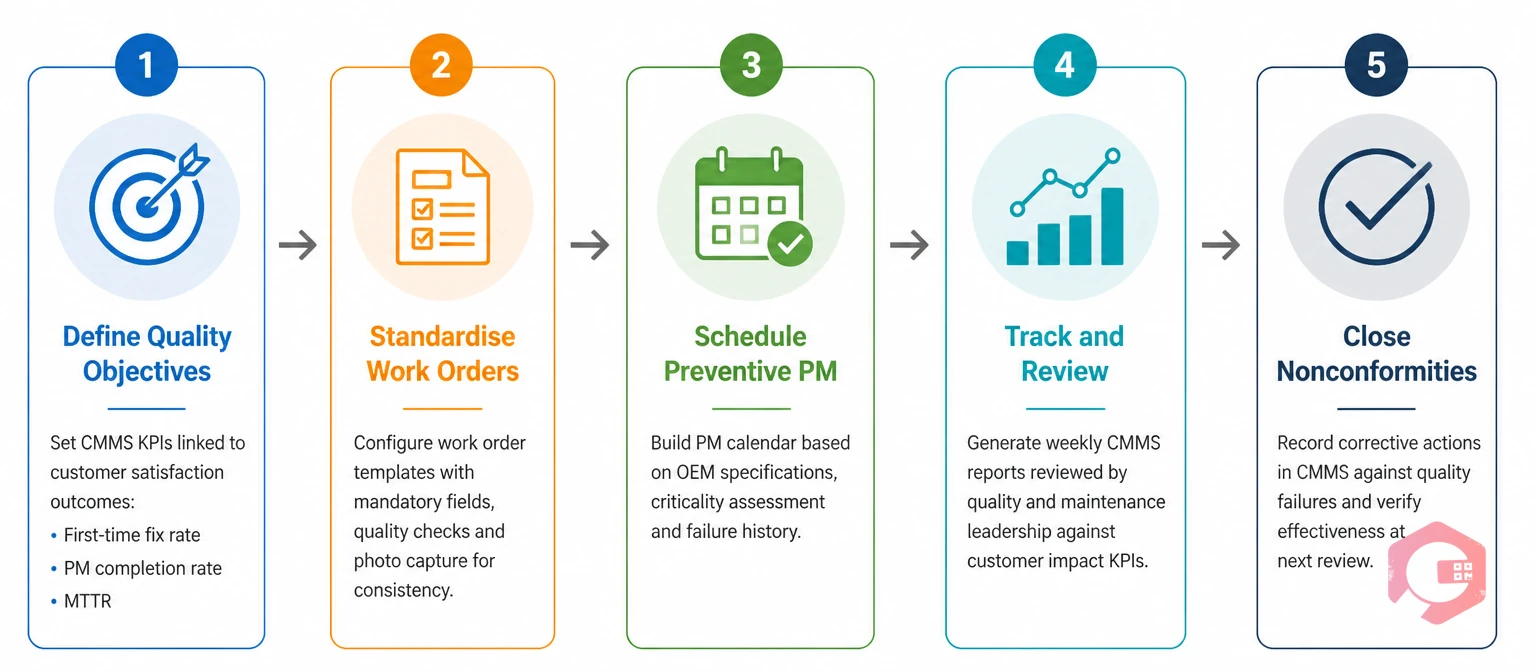
Moving from a reactive maintenance environment to one that actively supports ISO 9000 and improves customer experience does not happen overnight. But the path is straightforward when you follow it in order. Here are the five steps that maintenance managers who have done this successfully consistently describe:
The maintenance audit checklist from Cryotos gives you a ready-made starting point for the internal review cycle that ISO 9000 expects you to run regularly.
ISO 9000 improves customer experience by requiring organisations to identify customer needs, build processes that consistently meet those needs, and use data to verify that performance is being maintained over time. In maintenance, this means preventing the equipment failures, calibration drift, and process inconsistencies that cause the delivery delays, quality defects, and service failures that customers feel. A CMMS is the operational system that makes ISO 9000's quality commitments executable on a day-to-day basis.
ISO 9001 does not name a CMMS as a specific requirement, but it does require documented evidence of infrastructure maintenance (Clause 7.1.3), calibration records (Clause 7.1.5), controlled processes (Clause 8.5), and performance monitoring data (Clause 9.1). A CMMS is the most practical and auditable way to satisfy all of these requirements simultaneously. Without one, maintenance teams typically rely on spreadsheets and paper records that are harder to search, harder to verify, and harder to present to an ISO auditor.
The process approach principle has the most direct operational impact. It requires treating work orders, asset records, PM schedules, inventory, and reporting as an integrated system rather than isolated activities. A CMMS delivers this integration automatically — when a technician closes a work order, every connected system updates in real time. Without that integration, the data gaps between functions are where ISO 9000 compliance typically breaks down.
Preventive maintenance directly supports ISO 9001 Clause 7.1.3 (infrastructure) by providing documented evidence that equipment is maintained under controlled conditions. It also supports Clause 9.1 by generating the performance data — PM completion rates, MTBF trends, downtime hours — that management review meetings require. Organisations using Cryotos have reported a 30% reduction in unplanned downtime after implementing structured PM programmes, which directly protects the delivery and quality commitments that ISO 9001 is designed to sustain.
Yes — CMMS data is among the most auditor-friendly evidence available because every record is timestamped, attributed to a named user, and searchable by asset, date, or work order type. Work order histories satisfy Clause 7.5 (documented information), calibration records satisfy Clause 7.1.5, and corrective action logs satisfy Clause 10.2. When an auditor asks for evidence of infrastructure maintenance or corrective action effectiveness, your CMMS can produce it in minutes rather than days.
If your maintenance team is working toward ISO 9000 alignment — or simply trying to give customers a more consistent, reliable experience — Cryotos CMMS gives you the operational infrastructure to make it happen. From preventive maintenance scheduling and calibration tracking to 5 Whys RCA and live BI dashboards, Cryotos connects every maintenance action to the quality outcomes your customers depend on. See how manufacturing, facilities, and service teams use Cryotos to build maintenance programmes that sustain ISO certification and earn lasting customer trust.



Cryotos AI predicts failures, automates work orders, and simplifies maintenance—before problems slow you down.



