Downtime in tyre manufacturing plants is one of the most expensive operational challenges in the industry. A single hour of unplanned downtime on a vulcanization press line can cost a mid-sized tyre plant anywhere from $50,000 to $150,000 in lost production, emergency repairs, and missed delivery deadlines. With global demand for tyres rising steadily — the tyre market is projected to exceed $300 billion by 2030 — manufacturers can no longer afford reactive maintenance strategies.
This guide covers the root causes of downtime in tyre manufacturing, proven strategies to reduce it, and how modern maintenance management systems can help your plant run at peak efficiency.
Downtime in tyre manufacturing refers to any period when production equipment — such as vulcanization presses, Banbury mixers, calendering machines, or bead winding units — is not operating as intended. This results in halted or reduced output, directly impacting throughput, delivery schedules, and profitability. According to a McKinsey report on manufacturing operations, unplanned equipment downtime accounts for an estimated 5–20% of productive capacity loss in process-heavy industries like tyre production.
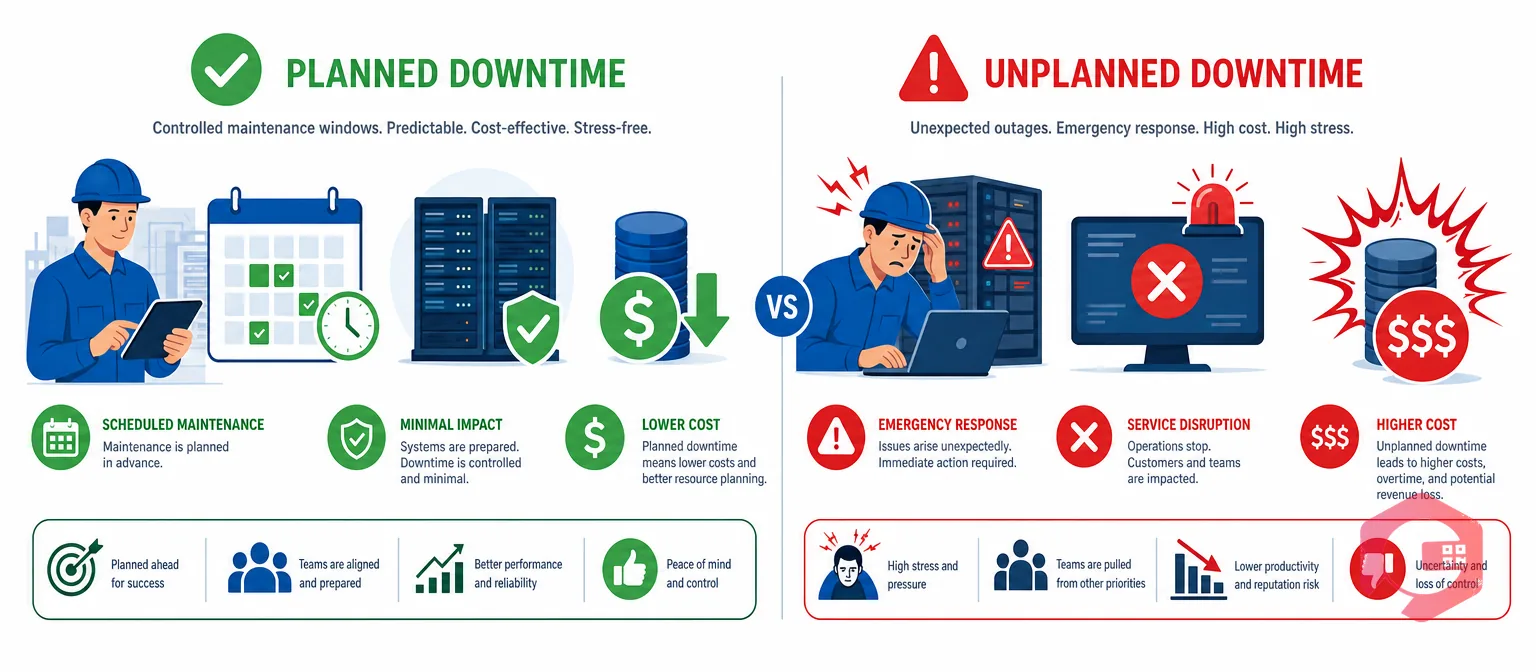
There are two primary types of downtime in tyre plants:
Planned downtime is scheduled, controlled, and expected — it includes preventive maintenance windows, mold changeovers on curing presses, tooling calibration, and scheduled cleaning of mixing lines. While it temporarily pauses production, planned downtime is a necessary investment that prevents far costlier failures.
Unplanned downtime is the real enemy of tyre plant productivity. It occurs without warning — a hydraulic system failure on a curing press, a Banbury mixer rotor wearing down prematurely, or a temperature sensor giving a false reading that triggers an emergency shutdown. Unplanned downtime is typically 3–5 times more expensive than planned downtime because it requires emergency response, expedited spare parts, and often results in scrapped batches of rubber compound.
The cost of downtime in tyre manufacturing varies by plant size, product mix, and process stage, but industry estimates point to significant financial exposure. A single vulcanization press running a high-volume passenger car tyre program can produce 300–600 tyre cures per shift. A two-hour unplanned shutdown on that press translates directly to hundreds of uncured tyres, wasted raw materials, and potential delays to OEM customers who operate on just-in-time schedules.
Beyond direct production loss, hidden costs include overtime labor for catch-up production, quality escapes from rushed setups, and contractual penalties from automotive OEM customers. A Plant Engineering study found that manufacturers with reactive maintenance strategies spend up to 3–5 times more annually on maintenance versus those with structured preventive programs.
Understanding the specific failure modes in tyre manufacturing is the first step toward reducing unplanned stoppages. Tyre plants operate highly specialized, high-stress equipment that experiences unique wear patterns compared to general manufacturing.
The vulcanization (curing) press is the most critical and breakdown-prone piece of equipment in a tyre plant. These machines operate at high temperatures (150–200°C) and pressures for hours at a time, cycling continuously across multiple shifts. Common failure points include hydraulic system leaks, bladder deterioration, mold misalignment, steam trap failures, and platen heating element burnout.
Bladder failures are particularly costly — a ruptured bladder requires immediate shutdown, cured tyre scrapping, and a bladder replacement that can take 2–4 hours per press. Multiply that across a curing department with 30–100 presses, and you can see how bladder management alone justifies a dedicated preventive maintenance program.
Banbury internal mixers process raw rubber compounds under extreme mechanical and thermal stress. Rotor tip wear, dump door seal failures, cooling system blockages, and drive gearbox issues are the most frequent causes of mixer downtime. A Banbury mixer shutdown does not just stop mixing — it creates a cascade effect across the compound preparation and downstream tyre building lines.
Calendering lines, which coat fabric or steel cord with rubber to form plies and belts, are equally sensitive. Roll misalignment, bearing failures, and hydraulic pressure inconsistencies all cause product quality deviations that can force a full line stop. These machines are expensive to restart due to the time required to re-establish temperature uniformity and compound viscosity.
Tyre plants rely on complex conveyor systems to move uncured tyre components from building machines to curing areas. Belt wear, roller bearing failures, guide rail misalignment, and sensor malfunctions are common causes of material flow interruptions. While individual conveyor failures may seem minor, they act as bottlenecks that shut down entire production cells in a matter of minutes.
Additional downtime contributors include tyre building machine spindle failures, bead winding unit tension inconsistencies, and extruder screen pack blockages. Each of these has predictable failure patterns that can be monitored and managed with the right maintenance strategy.
Reducing downtime in a tyre plant requires a systematic, multi-layered approach. The following seven strategies address both the technical and operational dimensions of maintenance excellence.
Preventive maintenance (PM) is the foundation of downtime reduction in any manufacturing environment — but in tyre plants, it must be tailored to the specific failure modes of each equipment type. A generic PM schedule will miss critical wear points unique to rubber processing machinery.
For curing presses, PM schedules should include bladder inspection every 500–800 cycles, hydraulic fluid analysis every 30 days, and steam trap testing weekly. For Banbury mixers, rotor tip clearance measurement, cooling water flow checks, and drop door seal inspection should be standardized tasks tied to tonnage processed rather than calendar time alone. Research from Reliable Plant shows that plants with formalized PM programs achieve 25–30% fewer unplanned breakdowns than those relying on reactive strategies.
Predictive maintenance (PdM) uses real-time condition data — vibration, temperature, pressure, oil quality — to detect equipment degradation before it causes a failure. In a tyre plant context, IoT sensors mounted on mixer drive gearboxes can detect bearing wear weeks before failure through vibration signatures. Temperature sensors on press platens can identify heating element degradation that would otherwise only reveal itself during a mid-production breakdown.
A tyre plant in India that deployed IoT-based vibration monitoring on its curing press hydraulic systems reported a 37% reduction in unplanned hydraulic-related shutdowns within the first year of implementation. The investment in sensors paid back within eight months through avoided emergency repair costs and recovered production time. Integrating these IoT data streams into a CMMS platform allows automatic work order generation when thresholds are exceeded, eliminating the delay between anomaly detection and maintenance response.
A Computerized Maintenance Management System (CMMS) is essential for organizing, scheduling, and tracking all maintenance activities across a tyre plant's equipment landscape. Without a CMMS, maintenance teams operate reactively — responding to breakdowns rather than preventing them.
A CMMS brings structured visibility to the maintenance function: every asset has a maintenance history, every work order has a status, and every spare part has a tracked quantity. Managers can see at a glance which presses are overdue for PM, which machines have recurring failure patterns, and where maintenance labor is being consumed. This data turns maintenance from a cost center into a strategic function that protects production output. A well-implemented work order management system can reduce the average time from fault detection to repair completion by 20–35%.
In tyre manufacturing, waiting for a spare part is often as damaging as the failure itself. A curing press that's down for six hours while a replacement hydraulic seal is shipped from a distant supplier loses more production than would have been saved by stocking that $15 seal.
Critical spare parts for tyre plants — bladders, hydraulic seals, mixer rotor tips, platen heating elements, calender roll bearings — should be stocked based on failure frequency and lead time analysis. A CMMS with inventory management capabilities can automate reorder triggers when stock falls below minimum thresholds, ensuring that high-risk components are always available. The goal is to minimize the gap between failure detection and repair completion — and spare parts availability is one of the most controllable variables in that equation.
Generic maintenance training is insufficient for the specialized equipment found in tyre plants. Technicians who understand the specific failure mechanisms of Banbury mixers, curing presses, and calender lines are faster to diagnose, more accurate in repairs, and less likely to introduce new failure modes through incorrect reassembly.
Structured training programs should cover equipment-specific maintenance procedures, safety protocols for high-temperature and high-pressure systems, and the use of diagnostic tools like vibration analyzers and infrared thermometers. Cross-training technicians across multiple equipment types also improves maintenance flexibility — a technician who can service both press hydraulics and mixer cooling systems reduces scheduling bottlenecks when multiple breakdowns occur simultaneously. According to the Occupational Safety and Health Administration (OSHA), proper maintenance training also significantly reduces workplace injury rates associated with equipment failure and improper servicing.
Overall Equipment Effectiveness (OEE) is the most widely used metric for measuring production efficiency in manufacturing. For tyre plants, OEE = Availability × Performance × Quality. A world-class OEE score is 85% or above; many tyre plants operate in the 60–75% range, which represents significant recoverable capacity.
Breaking OEE down by machine reveals where downtime is actually happening. If a curing press has 72% availability but 95% performance and 98% quality, the problem is clearly in unplanned stops — not in speed losses or defects. This focused diagnosis allows maintenance and production teams to direct improvement resources at the actual constraint rather than spreading effort across all machines equally. Tracking OEE at the equipment level, shift level, and plant level gives tyre manufacturers the data needed to prioritize preventive investments and measure the impact of maintenance improvements over time.
Standard Operating Procedures (SOPs) for maintenance tasks eliminate variability in how equipment is serviced, inspected, and returned to operation. In a tyre plant where the same press type may be serviced by different technicians across three shifts, SOP consistency is the difference between a 30-minute preventive service and a two-hour job that introduces a new hydraulic leak.
Effective maintenance SOPs for tyre equipment should include step-by-step inspection procedures with specific acceptance criteria, torque specifications for fasteners, fluid specifications for hydraulic and lubrication systems, and clear sign-off requirements before returning equipment to production. Storing these SOPs within a CMMS or mobile maintenance app ensures that technicians always have access to the correct procedure at the point of work — without searching for paper documents or relying on memory.
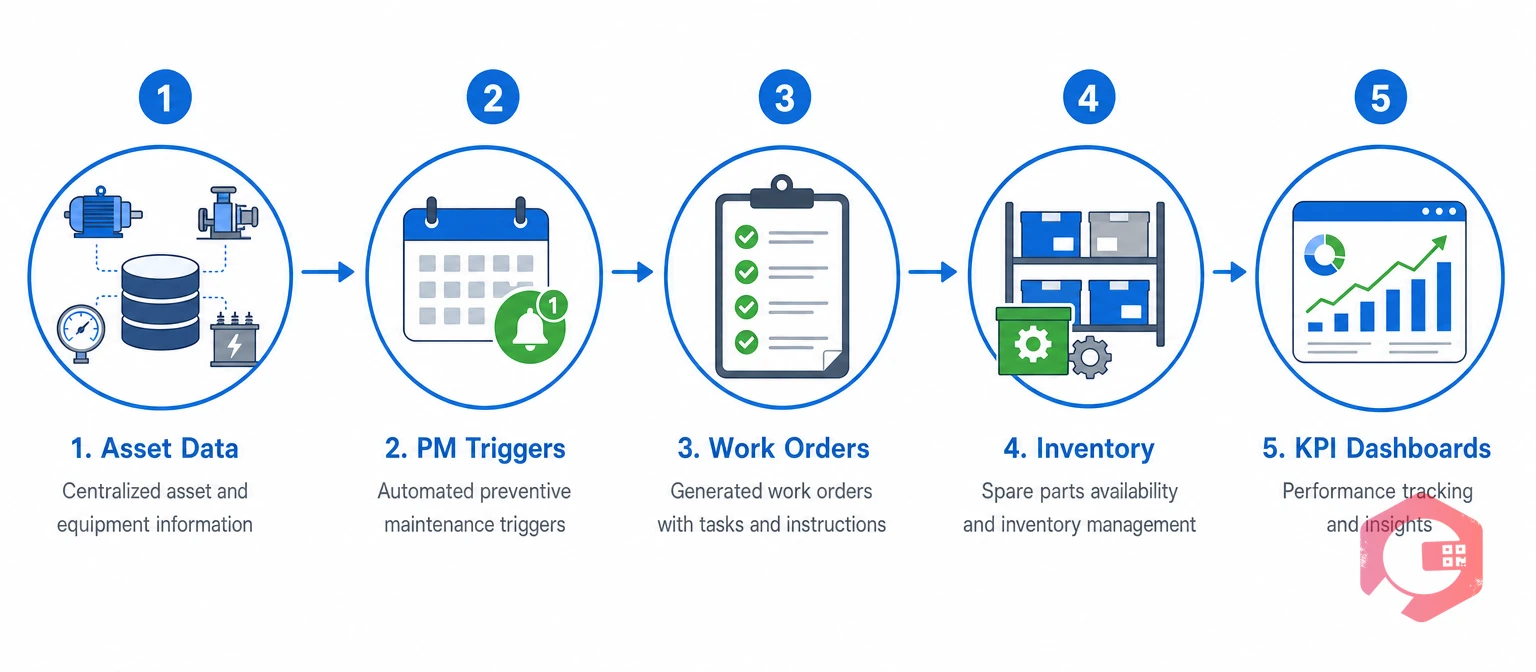
A CMMS (Computerized Maintenance Management System) like Cryotos transforms maintenance management in tyre plants by centralizing all asset, work order, inventory, and performance data in one platform. Instead of managing maintenance through spreadsheets, paper work orders, and fragmented communication channels, maintenance managers gain a single source of truth for every piece of equipment in the plant.
Here is how Cryotos CMMS specifically addresses tyre plant downtime challenges:
Tyre plants using Cryotos CMMS have reported a 30% reduction in unplanned downtime and 25% faster repair times within the first year of implementation, driven by better PM compliance, faster technician response, and data-driven prioritization of maintenance investments.
If your tyre plant is still managing maintenance reactively, a structured preventive maintenance program powered by a CMMS is the fastest path to meaningful, measurable downtime reduction. Book a demo with Cryotos to see how the platform maps to your specific tyre plant equipment and workflows.
Measuring maintenance performance with the right KPIs is essential for tracking progress and justifying investment in downtime reduction programs. The following KPIs are most relevant for tyre manufacturing maintenance teams:
Tracking these KPIs at the equipment, line, and plant level — and reviewing them weekly in maintenance team meetings — creates the accountability and data visibility needed to sustain downtime reduction gains over time. A downtime tracking module within a CMMS makes this data available automatically, without requiring manual compilation from multiple sources.
The most common causes of downtime in tyre manufacturing are vulcanization press failures (particularly hydraulic system issues and bladder deterioration), Banbury mixer mechanical failures, calender line bearing and roll failures, and conveyor system breakdowns. Equipment operating under high heat and pressure — like curing presses — experiences accelerated wear and requires the most rigorous preventive maintenance attention.
Tyre manufacturers typically track OEE (Overall Equipment Effectiveness), MTBF (Mean Time Between Failures), MTTR (Mean Time to Repair), and Planned Maintenance Percentage (PMP) as their core maintenance KPIs. Forward-looking plants also track maintenance cost as a percentage of asset replacement value and use CMMS dashboards to monitor these metrics in real-time across all production equipment.
Yes — a CMMS is one of the most impactful tools for reducing tyre plant downtime. It centralizes asset data, automates PM scheduling, manages spare parts inventory, and tracks every breakdown and repair. Tyre plants using a CMMS typically see 25–35% reductions in unplanned downtime within the first year, driven by better PM compliance, faster technician response times, and data-driven identification of recurring failure modes.
A world-class OEE target for tyre manufacturing equipment is 85% or above. Most tyre plants operate in the 60–75% OEE range, which means there is significant recoverable capacity available through maintenance improvements. Moving from 68% to 78% OEE on a high-volume curing press department, for example, can represent millions of additional tyre units per year without any capital investment in new equipment.
Reducing downtime in your tyre manufacturing plant starts with having the right systems, data, and processes in place. Cryotos CMMS is built for asset-intensive industries like tyre manufacturing, offering purpose-built tools for preventive maintenance, work order management, asset management, and downtime analysis. Book a free demo today and see how tyre plant maintenance teams are using Cryotos to achieve measurable results.
Downtime in tyre manufacturing plants is one of the most expensive operational challenges in the industry. A single hour of unplanned downtime on a vulcanization press line can cost a mid-sized tyre plant anywhere from $50,000 to $150,000 in lost production, emergency repairs, and missed delivery deadlines. With global demand for tyres rising steadily — the tyre market is projected to exceed $300 billion by 2030 — manufacturers can no longer afford reactive maintenance strategies.
This guide covers the root causes of downtime in tyre manufacturing, proven strategies to reduce it, and how modern maintenance management systems can help your plant run at peak efficiency.
Downtime in tyre manufacturing refers to any period when production equipment — such as vulcanization presses, Banbury mixers, calendering machines, or bead winding units — is not operating as intended. This results in halted or reduced output, directly impacting throughput, delivery schedules, and profitability. According to a McKinsey report on manufacturing operations, unplanned equipment downtime accounts for an estimated 5–20% of productive capacity loss in process-heavy industries like tyre production.
There are two primary types of downtime in tyre plants:
Planned downtime is scheduled, controlled, and expected — it includes preventive maintenance windows, mold changeovers on curing presses, tooling calibration, and scheduled cleaning of mixing lines. While it temporarily pauses production, planned downtime is a necessary investment that prevents far costlier failures.
Unplanned downtime is the real enemy of tyre plant productivity. It occurs without warning — a hydraulic system failure on a curing press, a Banbury mixer rotor wearing down prematurely, or a temperature sensor giving a false reading that triggers an emergency shutdown. Unplanned downtime is typically 3–5 times more expensive than planned downtime because it requires emergency response, expedited spare parts, and often results in scrapped batches of rubber compound.
The cost of downtime in tyre manufacturing varies by plant size, product mix, and process stage, but industry estimates point to significant financial exposure. A single vulcanization press running a high-volume passenger car tyre program can produce 300–600 tyre cures per shift. A two-hour unplanned shutdown on that press translates directly to hundreds of uncured tyres, wasted raw materials, and potential delays to OEM customers who operate on just-in-time schedules.
Beyond direct production loss, hidden costs include overtime labor for catch-up production, quality escapes from rushed setups, and contractual penalties from automotive OEM customers. A Plant Engineering study found that manufacturers with reactive maintenance strategies spend up to 3–5 times more annually on maintenance versus those with structured preventive programs.
Understanding the specific failure modes in tyre manufacturing is the first step toward reducing unplanned stoppages. Tyre plants operate highly specialized, high-stress equipment that experiences unique wear patterns compared to general manufacturing.
The vulcanization (curing) press is the most critical and breakdown-prone piece of equipment in a tyre plant. These machines operate at high temperatures (150–200°C) and pressures for hours at a time, cycling continuously across multiple shifts. Common failure points include hydraulic system leaks, bladder deterioration, mold misalignment, steam trap failures, and platen heating element burnout.
Bladder failures are particularly costly — a ruptured bladder requires immediate shutdown, cured tyre scrapping, and a bladder replacement that can take 2–4 hours per press. Multiply that across a curing department with 30–100 presses, and you can see how bladder management alone justifies a dedicated preventive maintenance program.
Banbury internal mixers process raw rubber compounds under extreme mechanical and thermal stress. Rotor tip wear, dump door seal failures, cooling system blockages, and drive gearbox issues are the most frequent causes of mixer downtime. A Banbury mixer shutdown does not just stop mixing — it creates a cascade effect across the compound preparation and downstream tyre building lines.
Calendering lines, which coat fabric or steel cord with rubber to form plies and belts, are equally sensitive. Roll misalignment, bearing failures, and hydraulic pressure inconsistencies all cause product quality deviations that can force a full line stop. These machines are expensive to restart due to the time required to re-establish temperature uniformity and compound viscosity.
Tyre plants rely on complex conveyor systems to move uncured tyre components from building machines to curing areas. Belt wear, roller bearing failures, guide rail misalignment, and sensor malfunctions are common causes of material flow interruptions. While individual conveyor failures may seem minor, they act as bottlenecks that shut down entire production cells in a matter of minutes.
Additional downtime contributors include tyre building machine spindle failures, bead winding unit tension inconsistencies, and extruder screen pack blockages. Each of these has predictable failure patterns that can be monitored and managed with the right maintenance strategy.
Reducing downtime in a tyre plant requires a systematic, multi-layered approach. The following seven strategies address both the technical and operational dimensions of maintenance excellence.
Preventive maintenance (PM) is the foundation of downtime reduction in any manufacturing environment — but in tyre plants, it must be tailored to the specific failure modes of each equipment type. A generic PM schedule will miss critical wear points unique to rubber processing machinery.
For curing presses, PM schedules should include bladder inspection every 500–800 cycles, hydraulic fluid analysis every 30 days, and steam trap testing weekly. For Banbury mixers, rotor tip clearance measurement, cooling water flow checks, and drop door seal inspection should be standardized tasks tied to tonnage processed rather than calendar time alone. Research from Reliable Plant shows that plants with formalized PM programs achieve 25–30% fewer unplanned breakdowns than those relying on reactive strategies.
Predictive maintenance (PdM) uses real-time condition data — vibration, temperature, pressure, oil quality — to detect equipment degradation before it causes a failure. In a tyre plant context, IoT sensors mounted on mixer drive gearboxes can detect bearing wear weeks before failure through vibration signatures. Temperature sensors on press platens can identify heating element degradation that would otherwise only reveal itself during a mid-production breakdown.
A tyre plant in India that deployed IoT-based vibration monitoring on its curing press hydraulic systems reported a 37% reduction in unplanned hydraulic-related shutdowns within the first year of implementation. The investment in sensors paid back within eight months through avoided emergency repair costs and recovered production time. Integrating these IoT data streams into a CMMS platform allows automatic work order generation when thresholds are exceeded, eliminating the delay between anomaly detection and maintenance response.
A Computerized Maintenance Management System (CMMS) is essential for organizing, scheduling, and tracking all maintenance activities across a tyre plant's equipment landscape. Without a CMMS, maintenance teams operate reactively — responding to breakdowns rather than preventing them.
A CMMS brings structured visibility to the maintenance function: every asset has a maintenance history, every work order has a status, and every spare part has a tracked quantity. Managers can see at a glance which presses are overdue for PM, which machines have recurring failure patterns, and where maintenance labor is being consumed. This data turns maintenance from a cost center into a strategic function that protects production output. A well-implemented work order management system can reduce the average time from fault detection to repair completion by 20–35%.
In tyre manufacturing, waiting for a spare part is often as damaging as the failure itself. A curing press that's down for six hours while a replacement hydraulic seal is shipped from a distant supplier loses more production than would have been saved by stocking that $15 seal.
Critical spare parts for tyre plants — bladders, hydraulic seals, mixer rotor tips, platen heating elements, calender roll bearings — should be stocked based on failure frequency and lead time analysis. A CMMS with inventory management capabilities can automate reorder triggers when stock falls below minimum thresholds, ensuring that high-risk components are always available. The goal is to minimize the gap between failure detection and repair completion — and spare parts availability is one of the most controllable variables in that equation.
Generic maintenance training is insufficient for the specialized equipment found in tyre plants. Technicians who understand the specific failure mechanisms of Banbury mixers, curing presses, and calender lines are faster to diagnose, more accurate in repairs, and less likely to introduce new failure modes through incorrect reassembly.
Structured training programs should cover equipment-specific maintenance procedures, safety protocols for high-temperature and high-pressure systems, and the use of diagnostic tools like vibration analyzers and infrared thermometers. Cross-training technicians across multiple equipment types also improves maintenance flexibility — a technician who can service both press hydraulics and mixer cooling systems reduces scheduling bottlenecks when multiple breakdowns occur simultaneously. According to the Occupational Safety and Health Administration (OSHA), proper maintenance training also significantly reduces workplace injury rates associated with equipment failure and improper servicing.
Overall Equipment Effectiveness (OEE) is the most widely used metric for measuring production efficiency in manufacturing. For tyre plants, OEE = Availability × Performance × Quality. A world-class OEE score is 85% or above; many tyre plants operate in the 60–75% range, which represents significant recoverable capacity.
Breaking OEE down by machine reveals where downtime is actually happening. If a curing press has 72% availability but 95% performance and 98% quality, the problem is clearly in unplanned stops — not in speed losses or defects. This focused diagnosis allows maintenance and production teams to direct improvement resources at the actual constraint rather than spreading effort across all machines equally. Tracking OEE at the equipment level, shift level, and plant level gives tyre manufacturers the data needed to prioritize preventive investments and measure the impact of maintenance improvements over time.
Standard Operating Procedures (SOPs) for maintenance tasks eliminate variability in how equipment is serviced, inspected, and returned to operation. In a tyre plant where the same press type may be serviced by different technicians across three shifts, SOP consistency is the difference between a 30-minute preventive service and a two-hour job that introduces a new hydraulic leak.
Effective maintenance SOPs for tyre equipment should include step-by-step inspection procedures with specific acceptance criteria, torque specifications for fasteners, fluid specifications for hydraulic and lubrication systems, and clear sign-off requirements before returning equipment to production. Storing these SOPs within a CMMS or mobile maintenance app ensures that technicians always have access to the correct procedure at the point of work — without searching for paper documents or relying on memory.
A CMMS (Computerized Maintenance Management System) like Cryotos transforms maintenance management in tyre plants by centralizing all asset, work order, inventory, and performance data in one platform. Instead of managing maintenance through spreadsheets, paper work orders, and fragmented communication channels, maintenance managers gain a single source of truth for every piece of equipment in the plant.
Here is how Cryotos CMMS specifically addresses tyre plant downtime challenges:
Tyre plants using Cryotos CMMS have reported a 30% reduction in unplanned downtime and 25% faster repair times within the first year of implementation, driven by better PM compliance, faster technician response, and data-driven prioritization of maintenance investments.
If your tyre plant is still managing maintenance reactively, a structured preventive maintenance program powered by a CMMS is the fastest path to meaningful, measurable downtime reduction. Book a demo with Cryotos to see how the platform maps to your specific tyre plant equipment and workflows.
Measuring maintenance performance with the right KPIs is essential for tracking progress and justifying investment in downtime reduction programs. The following KPIs are most relevant for tyre manufacturing maintenance teams:
Tracking these KPIs at the equipment, line, and plant level — and reviewing them weekly in maintenance team meetings — creates the accountability and data visibility needed to sustain downtime reduction gains over time. A downtime tracking module within a CMMS makes this data available automatically, without requiring manual compilation from multiple sources.
The most common causes of downtime in tyre manufacturing are vulcanization press failures (particularly hydraulic system issues and bladder deterioration), Banbury mixer mechanical failures, calender line bearing and roll failures, and conveyor system breakdowns. Equipment operating under high heat and pressure — like curing presses — experiences accelerated wear and requires the most rigorous preventive maintenance attention.
Tyre manufacturers typically track OEE (Overall Equipment Effectiveness), MTBF (Mean Time Between Failures), MTTR (Mean Time to Repair), and Planned Maintenance Percentage (PMP) as their core maintenance KPIs. Forward-looking plants also track maintenance cost as a percentage of asset replacement value and use CMMS dashboards to monitor these metrics in real-time across all production equipment.
Yes — a CMMS is one of the most impactful tools for reducing tyre plant downtime. It centralizes asset data, automates PM scheduling, manages spare parts inventory, and tracks every breakdown and repair. Tyre plants using a CMMS typically see 25–35% reductions in unplanned downtime within the first year, driven by better PM compliance, faster technician response times, and data-driven identification of recurring failure modes.
A world-class OEE target for tyre manufacturing equipment is 85% or above. Most tyre plants operate in the 60–75% OEE range, which means there is significant recoverable capacity available through maintenance improvements. Moving from 68% to 78% OEE on a high-volume curing press department, for example, can represent millions of additional tyre units per year without any capital investment in new equipment.
Reducing downtime in your tyre manufacturing plant starts with having the right systems, data, and processes in place. Cryotos CMMS is built for asset-intensive industries like tyre manufacturing, offering purpose-built tools for preventive maintenance, work order management, asset management, and downtime analysis. Book a free demo today and see how tyre plant maintenance teams are using Cryotos to achieve measurable results.
Cryotos AI predicts failures, automates work orders, and simplifies maintenance—before problems slow you down.