

Equipment downtime in leather processing plants doesn't just pause production — it can ruin an entire batch of hides. When a drum tumbler stalls mid-chrome tanning or a splitting machine breaks down during finishing, the cost isn't just the repair bill. It's the spoiled raw material, the delayed shipment, and the customer who won't come back. Reducing equipment downtime in leather processing plants requires a combination of structured preventive maintenance, real-time monitoring, and a CMMS software built for the complexity of modern tannery operations.
Studies show that unplanned downtime costs manufacturers an average of $260,000 per hour across industries — and in leather processing, where batch timing is critical, even a two-hour stoppage can mean an entire day's production is lost. The good news: most equipment failures are preventable with the right systems in place.
Most manufacturing industries lose time when equipment fails. Leather processing loses time — and material. A hide batch moves through a precise sequence of stages: soaking, liming, de-hairing, pickling, tanning, retanning, dyeing, fatliquoring, and finishing. Each stage has a narrow time and chemical window. Interrupt it, and you don't just pause the process — you risk degrading or destroying the entire batch.
Consider what happens when a drum tumbler breaks down mid-chrome tanning. The hides sitting in the chemical bath continue to react, but without the mechanical action that ensures even penetration. The result is uneven tanning, weak spots, or complete rejection of the batch. A single failure can cost thousands of dollars in raw material alone — before you factor in the labor, chemicals, and order delay.
This batch-sensitivity makes downtime reduction not just an operational priority in leather plants — it's a product quality issue. That's why preventive maintenance and real-time equipment monitoring are non-negotiable for any tannery running at scale.

Understanding why equipment fails is the first step to preventing it. In leather processing plants, the most common downtime triggers fall into a handful of recurring categories:
Drum tumblers, paddles, and beam house machinery operate under heavy load with continuous rotation. Bearings, seals, and drive belts wear out faster than in most other manufacturing environments because of the abrasive nature of wet hides and chemical exposure. Without scheduled inspections and part replacements, these components fail suddenly rather than showing gradual decline.
Tanneries use aggressive chemicals — sulfides, acids, chromium salts, enzymes — that accelerate corrosion on pumps, valves, pipework, and machine frames. Equipment designed for dry or neutral environments degrades rapidly in a tannery. Maintenance teams that don't account for chemical exposure when setting inspection intervals will consistently be caught off guard by premature failures.
Splitting machines, staking machines, and toggling frames rely on precise hydraulic or pneumatic pressure. Leaks, contamination, and seal degradation cause pressure loss that affects both machine performance and product quality — and often aren't caught until a machine stops working mid-operation.
PLC controllers, motor drives, and sensors in modern tannery equipment are vulnerable to moisture and chemical vapors. Electrical faults are one of the hardest failures to predict without condition monitoring because they often give no mechanical warning signs before failure.
Many leather plants still operate on a "fix it when it breaks" model. Without a formal work order management system, maintenance tasks get skipped, deferred, or forgotten entirely. Reactive maintenance costs 3–5x more per repair than planned maintenance — and it guarantees more frequent unplanned stoppages.
A solid preventive maintenance (PM) strategy for leather processing equipment needs to account for the unique operating environment: chemical exposure, moisture, heavy mechanical loads, and tight production schedules. Here's how to build one that actually works:
With Cryotos Preventive Maintenance software, leather plant managers can build customizable PM schedules for every asset in the tannery, set usage-based triggers, attach checklists, and receive automated alerts before maintenance is due — all from a single platform.
A Computerized Maintenance Management System (CMMS) is the operational backbone of any serious downtime reduction effort. For leather processing plants specifically, a CMMS delivers five core benefits:
Every drum tumbler, splitting machine, and hydraulic press should have a complete maintenance history — every inspection, every repair, every part replaced. Without this, your maintenance team is flying blind. A CMMS stores all of this in one place, so technicians can see what was done last, what parts are wearing out, and what's due next. Over time, this history reveals patterns: which machines fail most often, at what point in their lifecycle, and after which types of operations.
When a PM is due — or when a sensor trips an alert threshold — a CMMS automatically creates a work order, assigns it to the right technician, and sends a notification. This removes the human error of missed maintenance and ensures nothing falls through the cracks during busy production periods. Cryotos takes this further with AI-powered work order creation via voice command or photo analysis, so technicians can log a fault the moment they spot it on the floor.
Cryotos includes a dedicated downtime tracking module that logs every stoppage by asset, department, and cause — without requiring a linked work order. This gives leather plant managers a clear picture of where downtime is occurring, how long repairs take (MTTR), and how frequently equipment is failing (MTBF). These metrics are the foundation of a data-driven maintenance improvement program.
One of the most common reasons downtime extends beyond the repair itself is waiting for spare parts. A CMMS with integrated inventory management ensures that critical spares — bearings, seals, belts, hydraulic fittings — are always in stock at minimum threshold levels. When stock drops below the threshold, the system alerts the procurement team automatically.
Cryotos includes a built-in "5 Whys" root cause analysis tool within every work order. This prompts technicians to document not just what broke, but why — and what can be done to prevent the same failure from recurring. Over time, this creates an institutional knowledge base that reduces repeat failures dramatically.
Preventive maintenance gets you a long way. But the next level of downtime reduction is predictive maintenance — using real-time sensor data to detect equipment degradation before it causes a failure. For leather processing plants, IoT monitoring makes the most sense on the equipment with the highest downtime impact:
Cryotos integrates with IoT sensors via SCADA and PLC connections, pulling real-time equipment data into the CMMS dashboard. When a sensor crosses a threshold, the system automatically raises an alert and creates a work order — so your team responds before the machine stops, not after. This approach has helped manufacturers achieve up to a 30% reduction in downtime compared to calendar-only PM programs.
Effective asset management starts with knowing your numbers. These are the core maintenance KPIs every leather processing plant should be tracking consistently:
Cryotos tracks all of these KPIs automatically through its BI Dashboard, with drill-down capability from plant level all the way to individual asset level. Managers can view trends over time, compare performance across production lines, and set targets for each metric — turning raw maintenance data into actionable decisions.
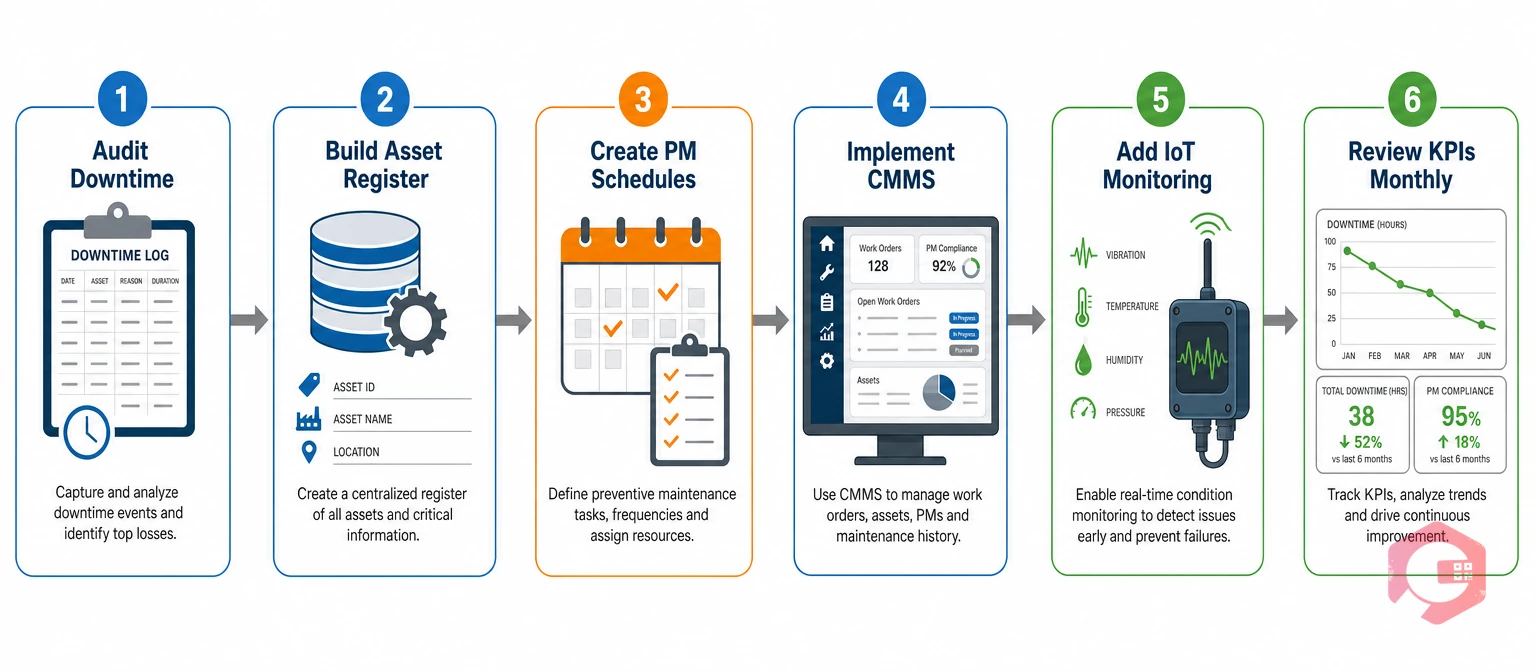
Getting from reactive maintenance to a proactive, data-driven program doesn't happen overnight — but it doesn't have to take years either. Here's a practical sequence that works for leather processing plants of any size:
The most common cause is reactive maintenance — waiting for equipment to fail before repairing it. In leather plants, this is compounded by the corrosive chemical environment, which accelerates mechanical wear on drums, pumps, and hydraulic systems faster than in most other industries. Establishing a preventive maintenance program with inspection schedules tailored to tannery conditions is the single most effective first step.
A CMMS helps leather plants by centralizing all maintenance activities: scheduling preventive maintenance for each asset, automatically creating work orders when maintenance is due, tracking spare parts inventory to prevent stockouts, and logging every failure with root cause data. Over time, this creates the asset history and performance data needed to shift from reactive to proactive maintenance — reducing unplanned stoppages and protecting batch quality.
Yes. IoT sensors (vibration, temperature, pressure) can be retrofitted to most existing machinery without replacing the equipment itself. The sensors attach externally or integrate with existing control systems, and the data feeds into a CMMS or dedicated monitoring platform. This means leather plants don't need to replace aging equipment to get the benefits of predictive maintenance — they can start monitoring the machines they already have.
The essential KPIs are MTBF (Mean Time Between Failures), MTTR (Mean Time To Repair), equipment availability percentage, planned vs. unplanned maintenance ratio, and OEE (Overall Equipment Effectiveness). A well-run tannery maintenance program should target 90%+ equipment availability and an 80/20 planned-to-reactive ratio. Tracking these monthly and comparing trends over time is how maintenance teams demonstrate improvement and justify investment in better programs and tools.
Most leather plants see measurable improvement within 3–6 months of implementing structured preventive maintenance and a CMMS. The first gains typically come from eliminating the "forgotten" maintenance tasks that were causing repeat failures on specific assets. Larger improvements in MTBF and overall availability typically follow at the 6–12 month mark as the PM program matures and the asset history database builds up enough data to identify patterns and optimize schedules.
Reducing equipment downtime in leather processing plants is fundamentally about shifting from reacting to failures to anticipating them. Every hour of unplanned downtime you eliminate is an hour of production, material, and margin saved. With the right preventive maintenance strategy, CMMS software, and real-time monitoring in place, leather manufacturers can protect their production schedule, their product quality, and their bottom line — all at the same time.
If you're ready to bring that level of control to your tannery operations, Cryotos CMMS is built for exactly this kind of manufacturing environment. From automated PM scheduling and work order management to IoT integration and downtime analytics, Cryotos gives your maintenance team the tools to stop chasing breakdowns and start preventing them. Book a free demo today and see how Cryotos can help your leather plant reduce downtime by up to 30%.



Cryotos AI predicts failures, automates work orders, and simplifies maintenance—before problems slow you down.



