

Leather manufacturing is one of the most demanding industrial environments on earth. From tanneries running rotary drums around the clock to finishing lines spraying and embossing at high speed, the machinery never stops — and neither do the maintenance challenges. Yet most leather factories still manage maintenance the same way they did twenty years ago: paper logbooks, word-of-mouth work orders, and technicians who carry critical knowledge entirely in their heads.
The result? Preventable breakdowns, costly chemical waste when a drum fails mid-tanning, compliance gaps that can trigger penalties, and maintenance teams perpetually firefighting instead of planning. A modern CMMS (Computerized Maintenance Management System) addresses every one of these problems — systematically, and with measurable results.
This post breaks down the seven most common maintenance problems in leather factories and shows exactly how CMMS software solves each one.
The rotary drum is the heart of leather manufacturing. When it goes down mid-cycle, the consequences are immediate and expensive — an entire batch of hides can be ruined, chemical processes are disrupted, and production halts until repairs are complete. In a plant running 24-hour operations, a single unplanned drum failure can cost more than a full week of planned maintenance would have.
The problem almost always traces back to the same root cause: no systematic preventive maintenance programme. Drum bearings, rotation motors, drive belts, and chemical loading valves degrade gradually — but without a schedule triggering regular inspection and lubrication, the first sign of trouble is often the breakdown itself. By then, the damage is done.
Preventive maintenance software allows plant managers to configure PM schedules for every drum in the facility — daily lubrication checks, weekly seal inspections, monthly motor assessments — and the system automatically generates work orders when each task is due. Technicians receive mobile notifications so nothing depends on anyone remembering. When a drum is due for a bearing inspection at 500 operating hours, the system triggers the work order automatically based on the runtime meter, not a calendar assumption.
Cryotos CMMS supports both time-based and usage-based scheduling, which is critical for leather operations where machines run at varying intensities depending on the production cycle. Plants using structured PM programmes report up to 30% reduction in unplanned breakdowns within the first year.
Many tanneries operate machinery that is 15 to 30 years old. Without digital records, there is no way to trace the maintenance history of a splitting machine, embossing press, or staking machine. Technicians make decisions based on memory or instinct. When a machine fails repeatedly, the plant has no data to identify whether it's a chronic design issue, a maintenance gap, or simply end-of-life equipment that should have been replaced two years ago.
This lack of history also makes it impossible to justify capital expenditure. When a plant manager asks for budget to replace an aging hydraulic press, the request needs to be backed by data — repair cost trends, downtime hours, frequency of failure. Without that evidence, the request often gets deferred, and the machine keeps limping along until it fails catastrophically.
Asset management software gives every piece of equipment in your leather plant its own permanent digital profile — complete with service history, warranty details, failure records, and cost tracking. From the moment a machine is registered, every work order, inspection, and part replacement is attached to its record. Over time, this builds an invaluable dataset.
When the splitting machine has its fourth bearing failure in eight months, the CMMS surfaces that pattern immediately. The data makes the case for investigating the root cause — whether it's inadequate lubrication intervals, oversized loads, or a design limitation. With Cryotos, you can drill down from the asset level to the individual work order, see exactly what was done and by whom, and use that evidence to make better maintenance and capital decisions.
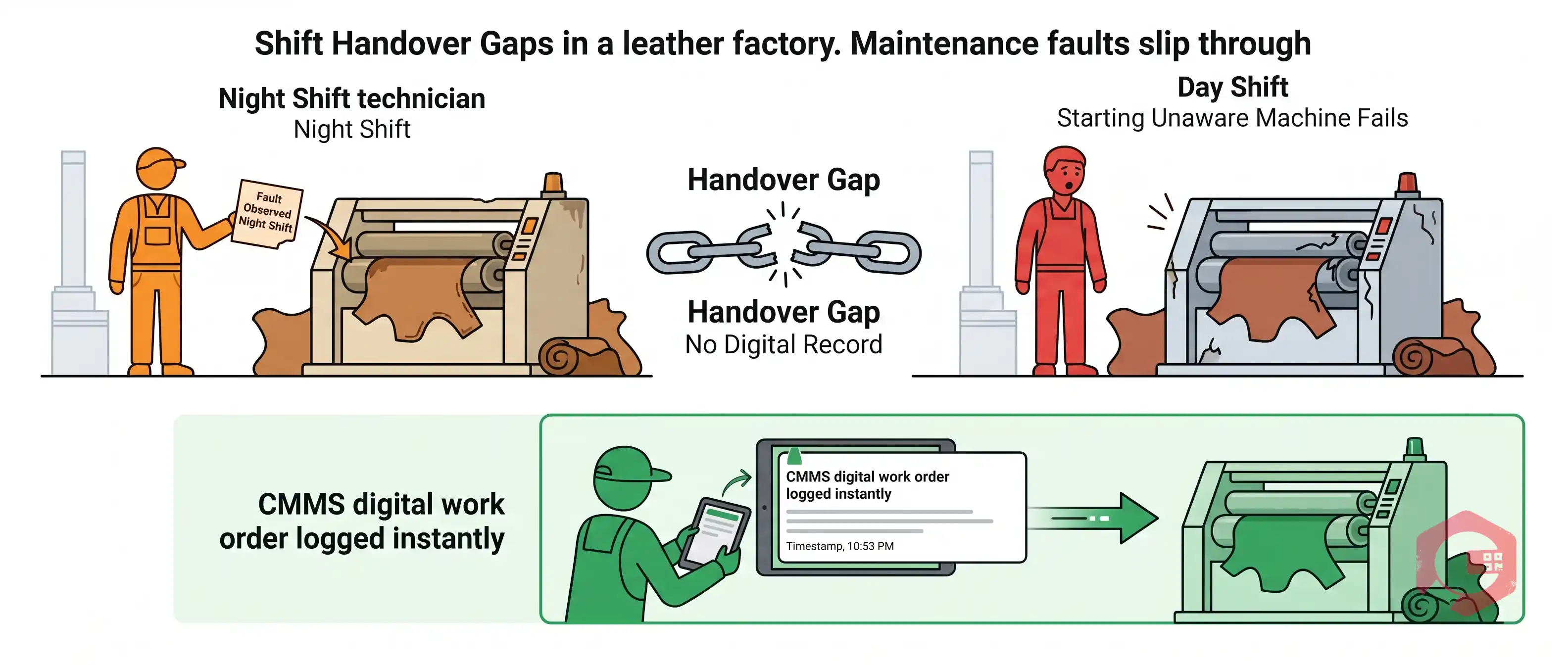
Leather plants typically run two or three shifts. When the outgoing shift ends, the only transfer of maintenance knowledge is often a brief verbal conversation — or nothing at all. The incoming team starts their shift without knowing which machine was vibrating abnormally, which belt is showing early signs of wear, or which repair was started and left half-finished because the technician ran out of time.
These handover gaps are one of the biggest drivers of repeat breakdowns. A fault that was noticed on the night shift gets forgotten by morning. A machine that was flagged as “needs checking” gets checked three days later — after it's already failed. The gap between observation and action is where most preventable failures happen.
Work order management provides a continuous, shift-independent record of every maintenance event. When a night-shift technician notices the staking machine is running louder than usual, they raise a work order on their mobile phone in under a minute — with a photo attached, a description of the issue, and the machine's asset ID linked automatically. The incoming day-shift team sees it on their dashboard the moment they log in.
Cryotos also supports real-time notifications via WhatsApp and mobile alerts, so supervisors can flag critical issues across shift boundaries without relying on someone physically being there to pass the message. Every piece of maintenance information lives in the system, not in anyone's head — and that continuity is what keeps faults from slipping through the cracks between shifts.
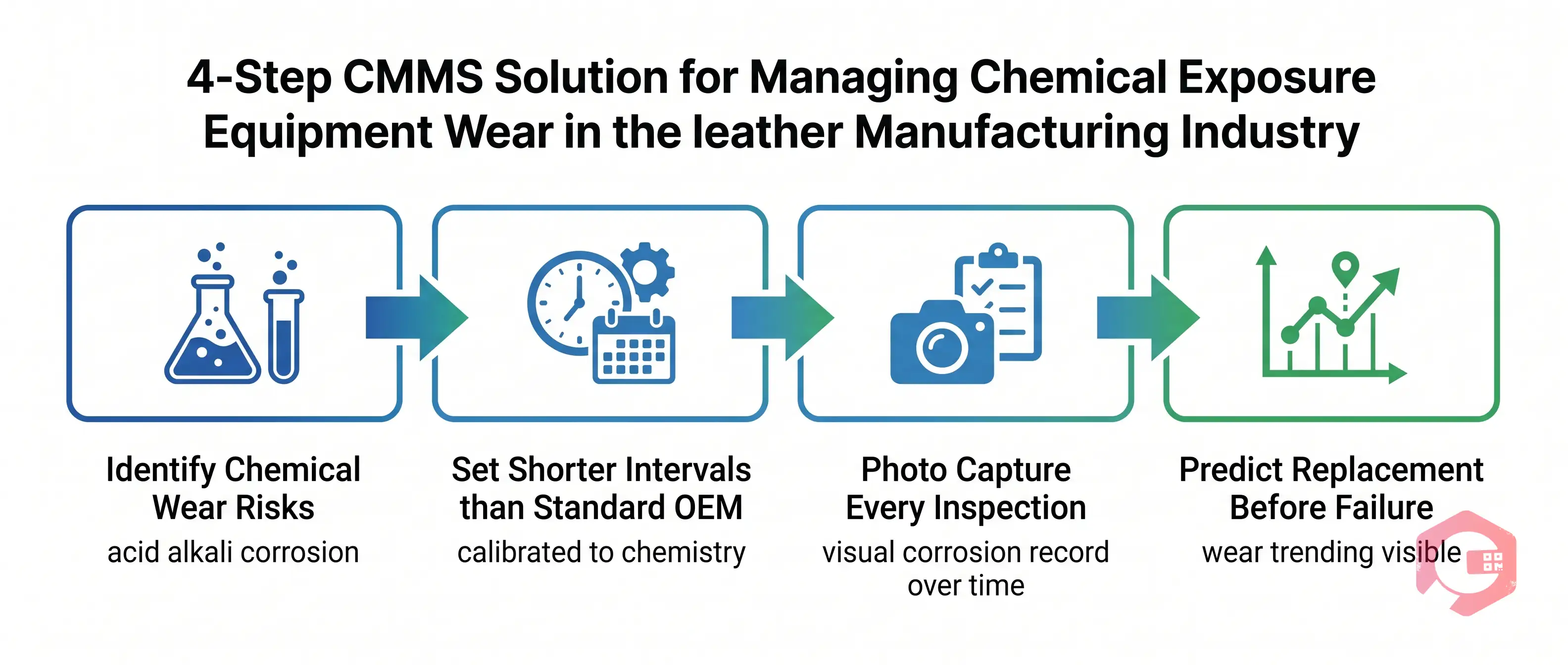
The tanning process — whether chrome-based or vegetable-based — continuously exposes equipment to acids, alkalis, tanning agents, and salts. These chemicals attack metal components, degrade rubber seals and gaskets, contaminate lubrication systems, and corrode electrical contacts. In a paper-based maintenance environment, this chemical wear goes untracked until something visibly fails.
The challenge is that chemical degradation is gradual and invisible until it isn't. A seal that's been slowly attacked by chromic acid looks fine until it fails completely. A drive belt exposed to repeated chemical splash has its tensile strength reduced before any visual sign appears. Without systematic inspection schedules calibrated to the harsh chemistry of leather processing, maintenance teams are always one step behind the damage.
A CMMS allows plant managers to configure inspection schedules that reflect the chemical reality of their environment — not just generic OEM recommendations. Drum interior lining inspections can be scheduled quarterly rather than annually. Seal condition checks on chemical loading valves can be set at shorter intervals for equipment exposed to stronger acids. These custom PM templates can be imported from existing Excel records or built directly in the system.
With Cryotos, each inspection checklist includes specific fields for what to look for — corrosion scoring, seal swelling, belt surface condition — so technicians know exactly what to assess, not just that they should “check the machine.” The system stores photos from each inspection, building a visual record of equipment degradation over time that helps predict when component replacement is approaching even before physical failure occurs.

Ask any leather factory maintenance manager about their biggest frustration and spare parts management is almost always near the top of the list. A tanning drum goes down, the technician identifies the problem — worn drum lining panels — but the parts aren't in the storeroom. The procurement process takes two to three days. Production is halted for the entire period, costing far more than a small safety stock of lining panels would have.
The opposite problem is equally costly: over-ordering parts that sit in storage for years, tying up working capital and taking up storeroom space. Both problems — stockouts and overstocking — stem from the same root cause: no systematic real-time visibility into parts consumption and stock levels.
Inventory management software tracks every spare part in real time — belts, seals, bearings, nozzles, drum lining panels, filter elements, hydraulic seals — with minimum stock thresholds configured for each item. When inventory for a critical part drops below the minimum level, the system automatically generates an alert so procurement can reorder before a stockout occurs, not after it's already causing a production halt.
Cryotos also links spare parts consumption directly to work orders. When a technician uses two drum bearing assemblies to complete a repair, those items are automatically deducted from inventory as the work order closes. This creates an accurate, real-time picture of stock levels without requiring manual stockroom counts or data entry. Over time, the consumption data reveals usage patterns — which parts are consumed fastest, which sit unused, and where minimum thresholds need adjusting.

Leather manufacturers operate under some of the most demanding environmental and safety regulations in manufacturing. Effluent Treatment Plant (ETP) equipment must meet discharge standards. Chrome VI handling requires documented procedures and equipment checks. Electrical systems in high-humidity chemical environments need regular inspections. Fire suppression systems, emergency stops, and ventilation units all have mandatory maintenance and certification requirements.
In a paper-based system, tracking all of these obligations is genuinely difficult. Inspection dates get missed. Certification renewals expire without anyone noticing. When a regulatory audit arrives, assembling the maintenance records from scattered paper files takes days — and missing entries create serious liability. The fines, shutdowns, and reputational damage that follow a failed audit can far exceed the cost of proper compliance tracking.
A CMMS creates a complete, time-stamped maintenance log for every compliance-critical asset automatically. ETP pump inspections, chemical dosing equipment calibrations, electrical panel checks, and fire safety inspections are all scheduled, tracked, and stored digitally with technician sign-offs. When a regulatory inspector asks for the ETP maintenance records for the past 24 months, you can generate the complete audit report in seconds — not after hours of archive searching.
Cryotos also integrates digital Permit to Work (PTW) and Lockout/Tagout (LOTO) workflows directly into maintenance tasks. When a technician works on high-voltage electrical equipment or a pressurized chemical system, the system enforces the safety authorization process before the work order can proceed. This eliminates the most common safety compliance failures — work performed without proper permits — and creates a documented audit trail that protects both the worker and the organization.
This is perhaps the most pervasive maintenance problem in leather manufacturing — and the hardest to fix without the right tools. Plant managers and maintenance supervisors often have no real-time picture of what's happening across their facility. Which machines are currently in repair? Which preventive maintenance tasks are overdue? Which technician is working on what? How much downtime did the finishing line accumulate this week?
Without answers to these questions, maintenance management is reactive by necessity. Problems get discovered when they're already at crisis point. Resources get allocated based on whoever shouts loudest rather than where they're most needed. And when senior management asks for a monthly maintenance report, the maintenance supervisor spends two days manually compiling data from paper records that may not be accurate.
Downtime tracking software and real-time dashboards give leather plant managers complete visibility at every level — from the entire facility down to individual assets. Live dashboards show open work orders, overdue PMs, machines currently in repair, and downtime hours by department and asset. Every maintenance event is visible as it happens, not after the fact.
Cryotos includes a dedicated downtime management module that calculates key metrics automatically — MTTR (Mean Time to Repair), MTBF (Mean Time Between Failures), and asset availability percentages — without anyone needing to enter numbers into a spreadsheet. Scheduled reports can be delivered automatically to management inboxes on whatever cadence they prefer: daily, weekly, or monthly. The result is that maintenance decisions are made with real data, resource allocation improves, and the shift from reactive firefighting to proactive planning becomes achievable rather than aspirational.
A CMMS (Computerized Maintenance Management System) is software that centralises all maintenance operations — work orders, preventive schedules, asset tracking, spare parts, and reporting — in a single platform. For leather manufacturers, it eliminates paper-based maintenance logs, reduces unplanned breakdowns by enabling proactive maintenance, and provides the digital audit trail needed for environmental and safety compliance.
The highest-priority assets are rotary tanning drums, splitting machines, embossing presses, ETP pumps, and compressors. These machines have the greatest production impact when they fail and the most demanding maintenance profiles due to chemical exposure and continuous operation. A CMMS allows you to set different inspection frequencies and PM intervals for each asset type based on actual criticality and operating conditions.
Yes — this is one of the most valuable use cases in the leather industry. A CMMS maintains timestamped maintenance records for ETP equipment, chemical storage systems, and ventilation — all areas that environmental regulators inspect. Calibration records, safety inspection logs, and PTW documentation are stored digitally and retrievable in seconds. This makes compliance audits straightforward rather than scrambling through paper files.
Most leather plants complete basic CMMS implementation in 4 to 8 weeks. This covers building the asset register, configuring PM schedules, uploading spare parts inventory, and training the maintenance team. Starting with the most critical assets — tanning drums, splitting machines, ETP equipment — and expanding from there is the most practical approach.
Absolutely. Modern CMMS platforms like Cryotos scale from small single-plant tanneries with 20 assets to large multi-site leather groups. Small manufacturers benefit immediately from organised PM schedules and digital work orders without needing a large IT team to deploy the system. The ROI tends to be faster for smaller operations because every hour of reduced downtime represents a higher percentage of their total capacity.
If your leather plant is still relying on paper maintenance registers and verbal work orders, the cost of staying put compounds every month. Cryotos CMMS is built for industrial manufacturers facing exactly these challenges — with the mobile-first interface, automation capabilities, and reporting depth that leather plants need to shift from reactive chaos to proactive control. Explore Cryotos CMMS and see how your maintenance operations can transform within weeks.




Cryotos AI predicts failures, automates work orders, and simplifies maintenance—before problems slow you down.



