Kaizen sustainability is the ability of an organization to preserve, measure, and build upon process improvements over time — without reverting to old behaviors or standards. Most Kaizen events produce real results in the first 30 days. The problem is what happens after day 31.
Studies from the Lean Enterprise Institute show that more than 60% of improvement gains are lost within six months of a Kaizen event if no formal sustainment system is in place. Equipment reverts to previous performance levels. Operators drift back to familiar habits. Checklists go unfilled. And managers move on to the next project before measuring whether the last one actually stuck.
This backsliding is not a people problem — it is a systems problem. Without digital tools to track action items, enforce standard procedures, and monitor KPIs in real time, Kaizen improvements exist only as Post-it notes on a whiteboard and good intentions in a meeting room.
This guide walks through ten proven strategies to sustain Kaizen gains and prevent backsliding, and shows how a CMMS like Cryotos can be the digital backbone that holds those improvements in place.

Before you can stop backsliding, you need to understand why it happens. Three root causes appear in almost every failed Kaizen sustainment effort:
Solving for all three requires a platform that digitizes ownership, standardizes procedures, and makes KPIs visible to everyone — from the shop floor to the boardroom.
The fastest way to lose a Kaizen gain is to leave it as a verbal instruction. The fastest way to sustain it is to make it part of every work order.
Work order management software lets maintenance teams convert Kaizen findings into standardized task templates. If a Kaizen event identified that lubrication must happen every 72 hours to prevent bearing failure, that interval gets written directly into a recurring work order — not a whiteboard, not a logbook, not someone's memory.
Every time a technician receives that work order, they follow the same procedure. Every time they complete it, there is a timestamp, a digital signature, and a record. Accountability is automatic.
A Kaizen improvement only becomes an organizational standard when it is embedded into a documented, enforceable procedure that every operator follows.
Digital checklists and SOPs prevent the most common form of backsliding: operator variation. When a technician retires or moves to a different shift, their knowledge leaves with them. When a procedure exists only in their head, the improvement disappears too.
With Cryotos, maintenance checklists can be built directly into work orders, customized by asset type or line, and enforced at the point of execution — meaning technicians cannot complete a task without confirming each step. This is how Kaizen improvements get embedded into daily operations rather than forgotten after the event closes.
SOP compliance also becomes trackable. Managers can see checklist completion rates across teams, shifts, and facilities — and spot gaps before they become regressions.
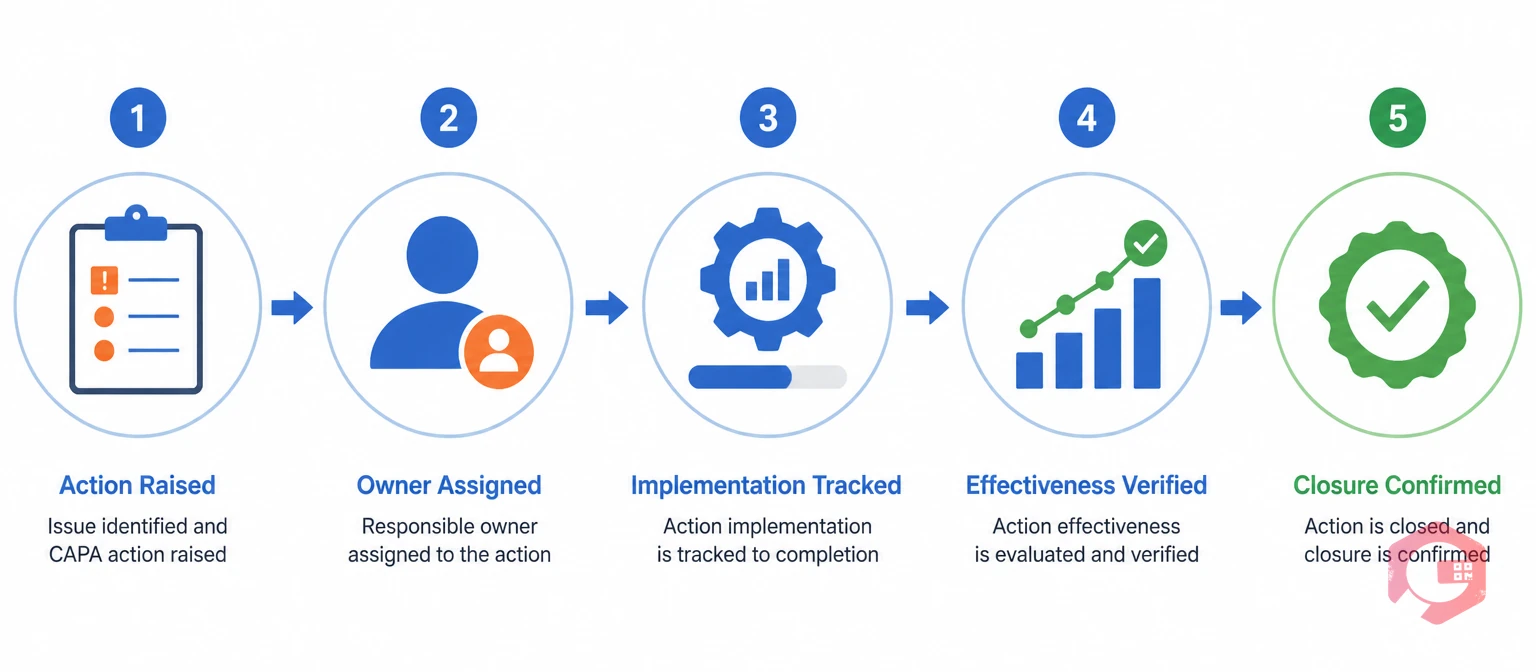
Every Kaizen event produces a list of corrective and preventive actions. Most organizations track these on spreadsheets. Spreadsheets don't send reminders, don't escalate overdue items, and don't tell you whether a fix actually worked.
A CAPA management system digitizes the entire lifecycle: action raised → owner assigned → implementation tracked → effectiveness verified → closure confirmed.
With Cryotos, CAPA items from any Kaizen event are logged as structured action records. Each item has an owner, a due date, a status, and a verification step. When a deadline is missed, the system escalates it automatically. When an action is marked complete, a follow-up review confirms the improvement held.
This closes the loop that most organizations leave open. It turns a Kaizen event report from a document into a living system.
Many Kaizen events target equipment performance — reducing changeover time, eliminating micro-stoppages, improving mean time between failures. These gains erode the moment maintenance frequency drops or tasks get skipped during busy production periods.
Preventive maintenance software protects equipment gains by scheduling maintenance automatically, based on time intervals, usage hours, or sensor readings — not on someone remembering to raise a work request.
If a Kaizen event improved a machine's OEE from 62% to 78% by tightening the PM schedule, that gain only holds if the new PM schedule runs without exception. Automation ensures it does. The system generates tasks, assigns them to the right technician, and tracks completion — with no manual follow-up required.
The difference between a process that holds and one that regresses is often just one thing: someone checking.
Audit management gives teams a structured way to verify that Kaizen improvements are still being followed. Scheduled audits — weekly, monthly, or quarterly depending on the criticality of the process — compare current practice against the improved standard. When gaps appear, they trigger corrective actions before the regression becomes entrenched.
Cryotos supports digital audit workflows with configurable checklists, mobile data capture, finding tracking, and direct linkage to corrective actions. An auditor conducting a floor walk can raise a non-conformance directly on their mobile device, assign it to an owner, and track it to resolution — all without leaving the app.
This is how organizations catch drift at 5% before it becomes a full reversal. The maintenance audit checklist framework helps teams ensure audits cover all critical process points consistently.

You cannot sustain what you cannot measure. The moment a Kaizen improvement becomes invisible in the data, it starts to erode.
The BI dashboard in Cryotos provides real-time visibility into the metrics that matter most after a Kaizen event: OEE, downtime frequency, work order completion rates, PM compliance percentages, and CAPA closure rates.
When a metric trends in the wrong direction, managers see it immediately — not in the next monthly report. This allows early intervention instead of reactive firefighting. Dashboard KPIs can be configured per facility, per production line, or per asset class, so the right people see the right data.
Key metrics to track after a Kaizen event include:
Kaizen sustainability depends on clear ownership at every level — from the technician completing a PM task to the team leader verifying compliance. When ownership is vague, accountability disappears.
Mobile workforce management closes the gap between the shop floor and the system of record. Technicians receive task assignments on their mobile devices, update status in real time, attach photos as proof of work, and capture digital signatures on completion — all from the floor, without returning to a desktop terminal.
This real-time loop means supervisors always know what is done, what is pending, and what is overdue. It also means that when an improvement is not being followed, someone knows about it that day — not next week.
Cryotos supports full offline functionality with auto-sync, so technicians in low-connectivity environments — warehouses, cold stores, remote plants — continue working without interruption.
Backsliding often looks like a new problem. In most cases, it is the same problem that was never fully solved.
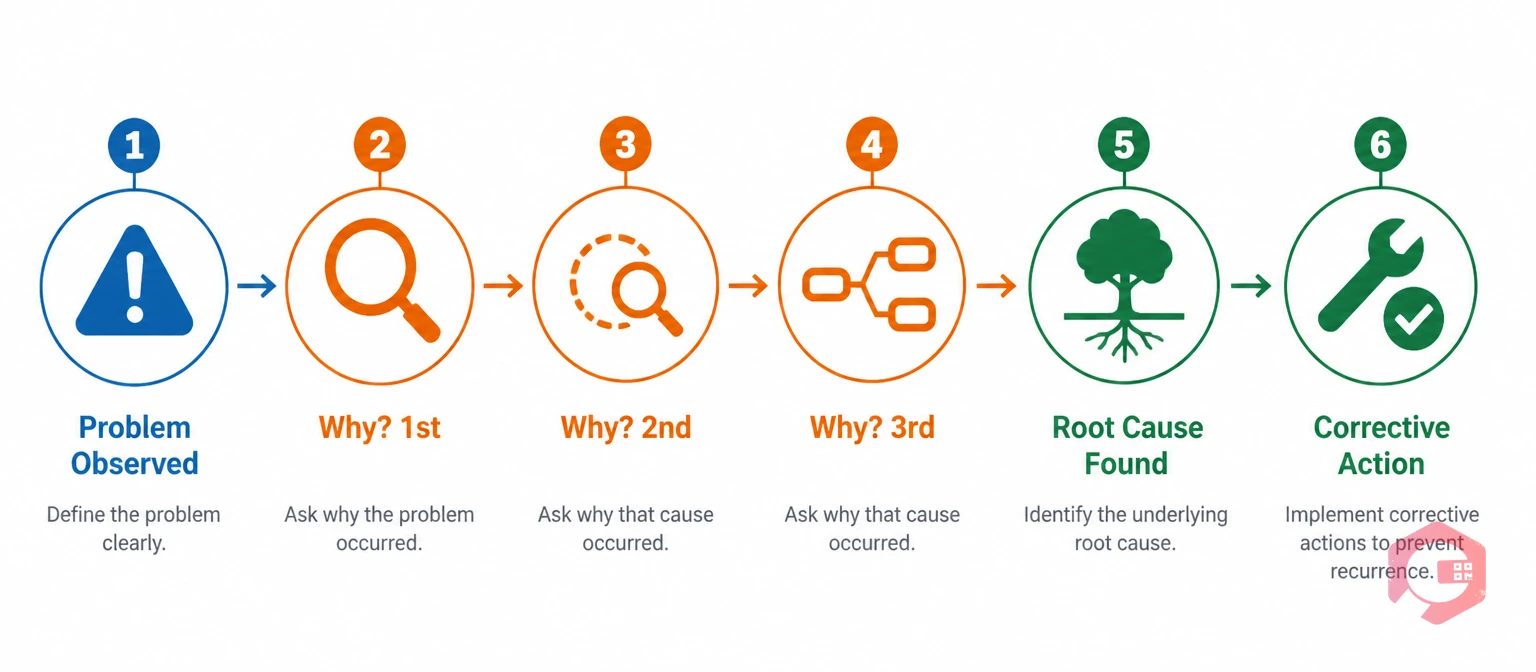
A structured Root Cause Analysis (RCA) approach — such as the Five Whys — ensures that Kaizen improvements address the actual cause of a problem, not just its symptoms. When a machine fails again three months after a Kaizen event, RCA determines whether the original fix was insufficient, the standard procedure was not followed, or a new contributing factor emerged.
Cryotos integrates Five Whys RCA directly into work orders. When a failure is logged, technicians can initiate an RCA investigation from the same interface — documenting the cause chain, attaching supporting evidence, and linking findings to corrective actions. This creates a traceable record of why problems occurred and what was done to prevent recurrence.
Incident and non-conformance tracking turns isolated events into patterns — and patterns into preventive action.
One equipment failure after a Kaizen event might be bad luck. Three failures on the same asset in the same month signal a systemic issue. Without a digital tracking system that aggregates incidents across time, teams miss these patterns entirely.
Cryotos captures non-conformances as structured records linked to assets, processes, and responsible teams. Pattern analysis in the reporting module identifies recurring issue types, high-frequency assets, and shifts or time periods with elevated defect rates. This data feeds directly into the next cycle of improvement — keeping the Kaizen wheel turning rather than stalling.
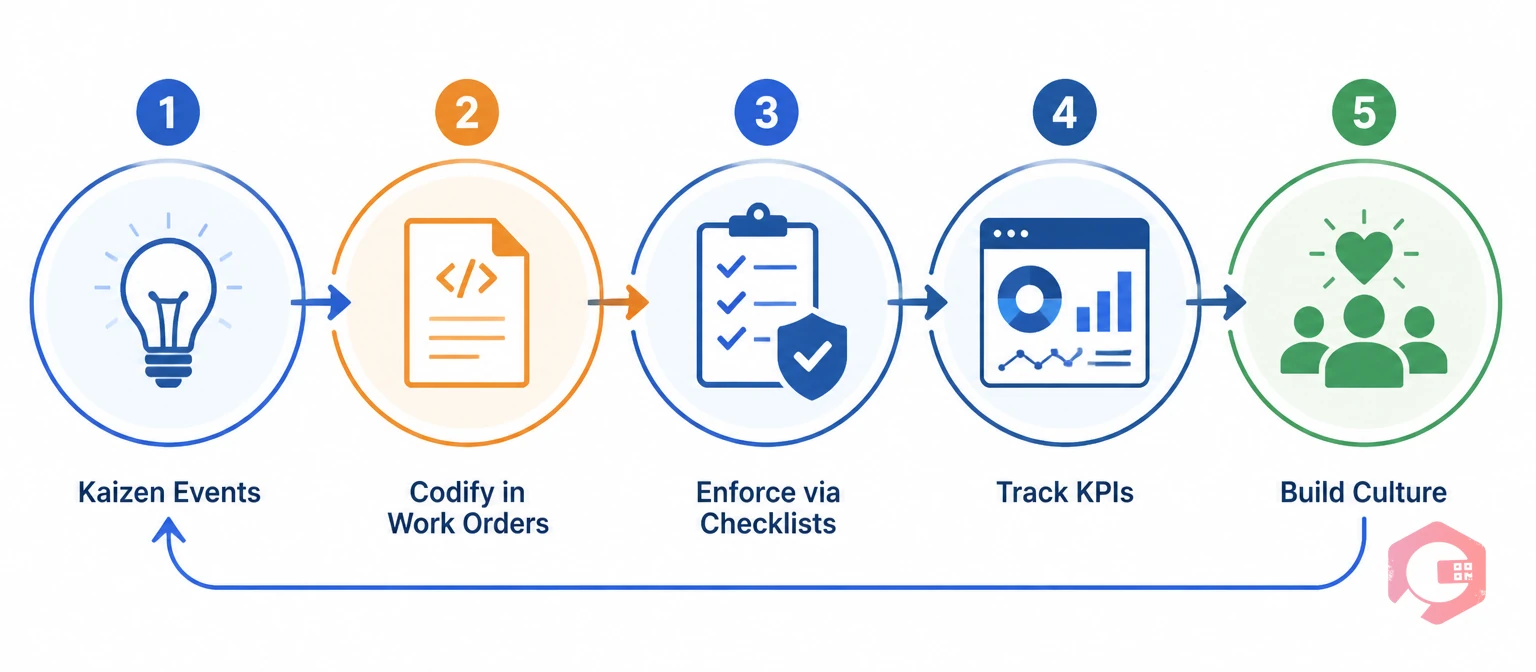
The most durable Kaizen improvements come from organizations where continuous improvement is a daily habit, not an annual event. Technology enables this culture — it doesn't replace it.
When technicians see their checklist completion rates on a public dashboard, they take ownership of the number. When team leaders receive automated alerts about overdue CAPA items, they act quickly. When managers can trace every improvement back to measurable OEE impact, they invest in the next Kaizen initiative with confidence.
A CMMS becomes the institutional memory that a Kaizen program needs to outlast any single event, team, or leadership change. Improvements get codified in work order templates. Standards get enforced through digital checklists. KPIs track every gain in real time. The result is an organization where backsliding becomes the exception, not the expectation.
For manufacturing, food and beverage, pharma, automotive, and process industries aiming for operational excellence, this is the foundation on which Lean programs scale.
Kaizen sustainability refers to the ability of an organization to maintain and build on process improvements achieved through Kaizen events, rather than reverting to previous performance levels. It matters because most Kaizen events produce real short-term gains, but without formal systems for tracking actions, standardizing procedures, and monitoring KPIs, those gains typically erode within three to six months.
Kaizen backsliding is caused by three primary factors: unassigned improvement actions with no accountability, improvements communicated verbally without formal documentation in SOPs or work orders, and absence of real-time monitoring that would signal when a process starts drifting from the improved standard. Addressing all three requires both process discipline and digital tools.
A CMMS sustains Kaizen improvements by converting action items into trackable work orders, embedding improved procedures into digital checklists, automating preventive maintenance schedules, providing real-time KPI dashboards, and linking incident reports to root cause analysis workflows. This makes improvements part of the operational system rather than one-off event outcomes.
Organizations should track OEE before and after the improvement event, unplanned downtime frequency, PM compliance rate, CAPA closure rate and average days to resolution, checklist completion rates by shift, and recurrence rates of previously resolved issues. These metrics, monitored through a real-time dashboard, indicate whether improvements are holding or degrading.
The frequency depends on the criticality of the process and the risk of regression. High-risk or high-variability processes benefit from weekly audits in the first 90 days after a Kaizen event, transitioning to monthly reviews once stability is confirmed. Lower-risk improvements can be audited quarterly, but all processes should have a minimum annual formal review linked to corrective action tracking.
Cryotos helps manufacturing, food and beverage, pharmaceutical, and process industry teams sustain Kaizen gains by digitizing action tracking, standardizing work procedures, automating maintenance workflows, monitoring KPIs in real time, and ensuring continuous compliance through audits and CAPA management. If your organization runs Kaizen events but struggles to hold the gains, schedule a free demo to see how Cryotos builds sustainment into every part of your maintenance management operation.




Cryotos AI predicts failures, automates work orders, and simplifies maintenance—before problems slow you down.