

Aligning your asset management practices to ISO 55001 means building a documented, auditable system that manages physical assets across their full lifecycle — from acquisition through disposal — in a way that delivers measurable value to your organisation. ISO 55001 is the only certifiable standard in the ISO 55000 series, and organisations that align with it consistently cut unplanned downtime, lower total cost of ownership, and clear regulatory audits without last-minute scrambling.
According to the ISO 55001 standard published by the International Organisation for Standardisation, a conforming asset management system must cover six core areas: organisational context, leadership commitment, risk-based planning, asset management plans, operational lifecycle controls, and a formal performance evaluation cycle. This step-by-step guide breaks down each requirement in plain language — and shows exactly how a CMMS maps to each clause so your compliance evidence is built into daily operations, not assembled before an audit.
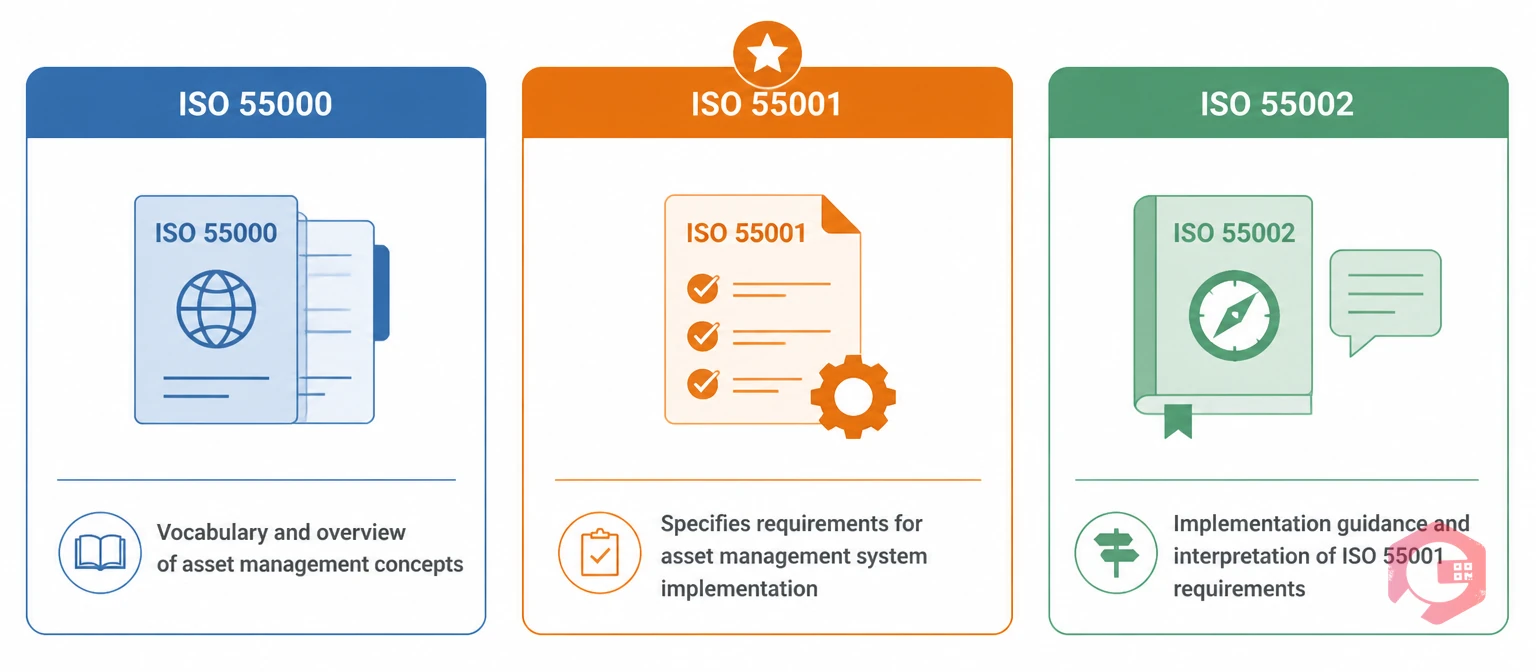
ISO 55001 is the certifiable asset management standard that specifies requirements for establishing, implementing, maintaining, and improving an asset management system. It does not tell you how to maintain a specific pump or conveyor — it specifies the system of governance that ensures your entire asset portfolio is managed with consistent strategy, documented controls, and measurable outcomes.
Any organisation that owns physical assets it depends on to generate value needs this framework. In practice, the industries that pursue formal ISO 55001 certification most aggressively are utilities (water, gas, electricity), oil and gas, heavy manufacturing, healthcare facilities, transport and infrastructure, and government asset owners. The common thread: these sectors carry significant financial, safety, or regulatory consequences when assets fail.
Even if certification is not your immediate goal, aligning your practices to ISO 55001 is worth doing. The framework forces you to close the gaps that create unplanned failures — missing asset registers, undefined maintenance strategies, no performance measurement cycle, and accountability structures that exist on paper but not in practice. According to a McKinsey analysis on maintenance efficiency, organisations with structured asset management programs cut maintenance costs by 10–25% and reduce downtime by 35–45% compared to reactive-only operations.
| Standard | Purpose | Certifiable? | When to Use It |
|---|---|---|---|
| ISO 55000 | Overview, principles, and vocabulary for asset management | No | Start here — understand the terminology and philosophy before building your system |
| ISO 55001 | Requirements your asset management system must satisfy | Yes | The standard your organisation is audited against for certification |
| ISO 55002 | Guidance on applying and implementing ISO 55001 | No | Use alongside ISO 55001 when building your system — practical implementation advice |
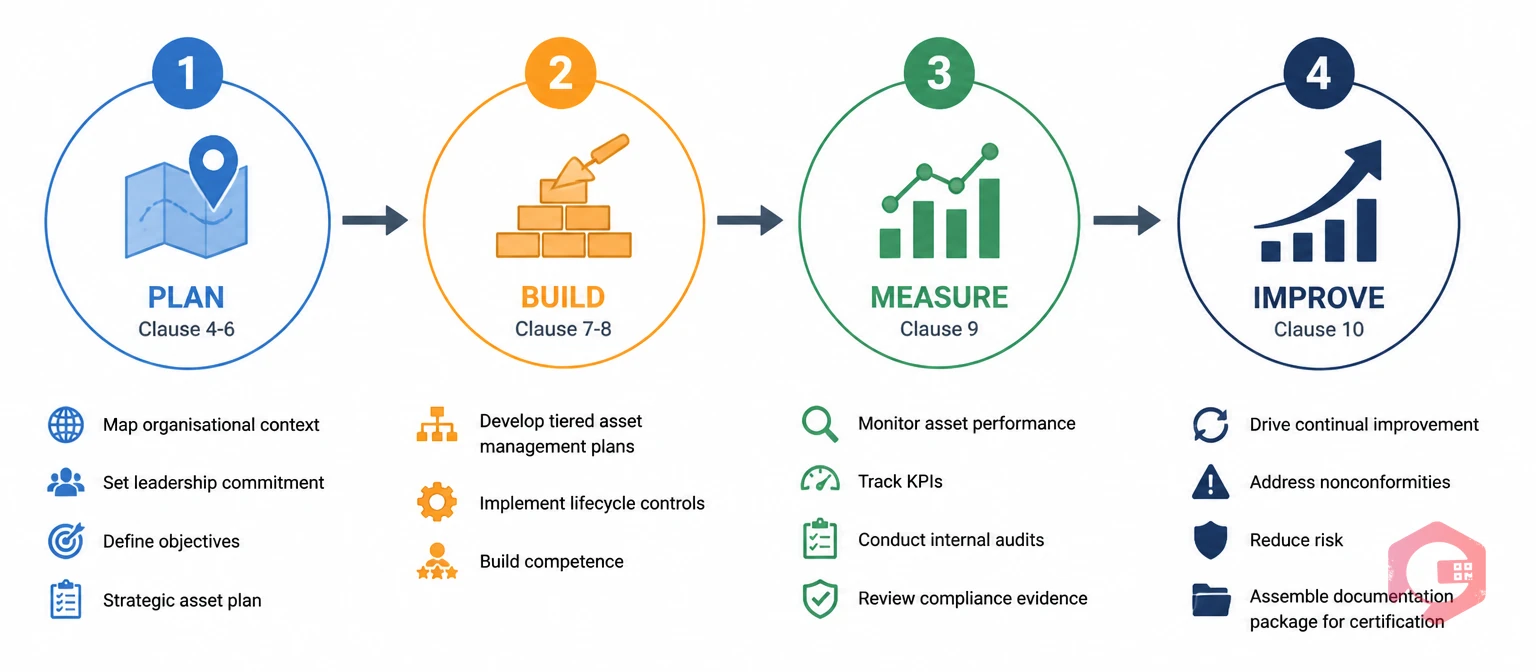
Clause 4 is the foundation of ISO 55001. Before you can build a compliant asset management system, you need to document the internal and external factors that affect your ability to achieve your objectives. This is not a bureaucratic exercise — it's how you make sure your maintenance strategy actually fits the organisation it's meant to serve.
You need to identify: the regulatory environment you operate in, the risk appetite of your leadership team, the current condition and criticality of your asset base, the expectations of key stakeholders (regulators, insurers, customers, boards), and any constraints — budget, skills, geography — that will shape how you manage assets. Document these as the context inputs that drive your asset management policy and objectives.
Start with a complete asset inventory. Every major asset class needs: a unique identifier, its criticality to operations (Tier 1 critical, Tier 2 important, Tier 3 routine), its estimated remaining useful life, its current maintenance model (reactive, preventive, or condition-based), and its location. This inventory is the raw material for your asset lifecycle management system.
Cryotos gives you the asset register Clause 4 requires. Every asset gets a unique ID, a criticality tier, a full maintenance history, and a location — all searchable from a single platform. When an auditor asks to see your asset inventory, you export it in minutes rather than days. The register also forms the data foundation for every other clause: you cannot plan maintenance, set objectives, or measure performance without knowing what you actually own.
Clause 5 is where most asset management programs quietly fail. ISO 55001 requires top management to do more than sign off on a policy document — it requires active, visible leadership. The standard is specific: leadership must establish an asset management policy, assign roles and responsibilities, ensure the system gets adequate resources, and integrate asset management objectives with the organisation's broader strategic goals.
Your policy needs to be a living document — visible to all relevant personnel, reviewed at defined intervals, and signed by an accountable executive. It should state your commitment to managing assets for optimal whole-life value, your approach to balancing cost, risk, and performance, and the framework for setting and reviewing asset management objectives. A policy that no one can find or quote is not compliant with Clause 5.
Document who owns each element of the asset management system. This means named roles (not just job titles) responsible for: maintaining the asset register, developing and reviewing Asset Management Plans, executing maintenance activities, monitoring KPIs, and conducting internal audits. The role-based access controls in Cryotos turn this accountability structure into something operational — technicians, supervisors, managers, and auditors each see exactly what they need and can only act within their defined scope. Accountability is built into the system, not just stated in a policy.
Clause 6 covers planning — specifically, how your organisation sets asset management objectives and develops the plans to achieve them. ISO 55001 requires that your objectives are measurable, consistent with your asset management policy, and aligned with your broader organisational objectives. The output of this step is your Strategic Asset Management Plan (SAMP) and, below it, individual Asset Management Plans for each asset class.
Objectives must be SMART: specific, measurable, achievable, relevant, and time-bound. Vague objectives like "improve reliability" do not satisfy Clause 6. Strong examples include: "Achieve a PM compliance rate of 90% or above for all Tier 1 assets by Q4 of this financial year", "Reduce the MTTR for critical production assets from 4.2 hours to 3.0 hours within 12 months", or "Maintain total maintenance cost below 3.5% of Replacement Asset Value across the manufacturing site."
Before writing your objectives, establish your baseline. The BI Dashboard in Cryotos gives you current MTBF, MTTR, availability percentage, OEE, and planned vs unplanned maintenance ratio — broken down by asset, department, and site. You cannot set credible improvement targets without knowing where you're starting from.
Clause 6 also requires risk-based planning. Document the risks associated with your asset base — failure of a critical asset, inadequate maintenance resources, loss of skilled personnel, or regulatory non-compliance — and the controls you have in place for each. This risk register becomes a key audit document and feeds directly into how you prioritise your Asset Management Plans.
ISO 55001 requires documented Asset Management Plans for each asset or asset class. These plans describe the lifecycle activities needed to achieve your objectives, the resources required, the risk controls in place, and how performance will be measured. Think of each plan as the operational instruction manual for a specific group of assets — from commissioning through to decommissioning.
Build your plans around asset criticality. The depth of planning should match the consequence of failure:
Cryotos's preventive maintenance software supports both static (calendar-based) and dynamic (usage-based) PM schedules, so you can apply different strategies to different tiers within the same system. Dynamic PMs — triggered by operating hours, mileage, or meter readings — are particularly important for Tier 1 assets where calendar-based intervals are too coarse.
Clause 8 is the largest and most operationally demanding clause in ISO 55001. It covers the actual execution of asset lifecycle activities: procurement and commissioning, operational maintenance, modification and upgrade, decommissioning and disposal. The standard requires that all of these activities are planned, controlled, and documented — with consideration given to risk and the consequences of failure at each stage.
Every maintenance activity — planned or reactive — needs a documented work order that captures who did the work, what was done, what parts were used, how long it took, and what the outcome was. This is not optional for ISO 55001 compliance. The work order record is your primary evidence that Clause 8 operational controls are functioning.
In Cryotos, every work order is automatically time-stamped, attributed to a named user, linked to the relevant asset record, and closed with documented findings and parts consumed. The compliance record is the natural output of daily operations — not something your team assembles before an audit arrives.
Clause 8 requires risk-based decision-making in asset lifecycle management. When the same asset fails repeatedly, that is a risk signal that demands investigation, not just repair. Cryotos's built-in root cause analysis tools — including guided 5 Whys workflows — make structured failure investigation a standard step in the work order closure process. Every RCA finding is stored against the asset record, creating a cumulative knowledge base that informs future maintenance decisions and satisfies the documented risk management evidence ISO 55001 auditors look for.
ISO 55001 Clause 8 extends to spare parts and materials needed for maintenance. Your asset management plans must address parts availability — critical assets cannot wait for parts to arrive on a three-week lead time. Cryotos's spare parts inventory module links parts directly to the assets that use them, sets automatic minimum-threshold alerts, and tracks consumption against work orders — so your parts strategy is tied to your asset plans, not managed as a separate and disconnected operation.
Clause 9 requires your organisation to monitor, measure, analyse, and evaluate the performance of its asset management system. You need to define what you measure, how you measure it, at what intervals, and who reviews it. The evidence this clause demands is a documented, recurring performance review cycle with outputs that either confirm the system is on track or trigger corrective action.
Set a formal three-tier review structure: monthly reviews at asset and team level, quarterly reviews at department level, annual reviews at the organisational level against your SAMP objectives. Each review must produce a documented output — even a one-page summary that records what was reviewed, what the data showed, and what action (if any) was triggered. These outputs become primary audit evidence for Clause 9.
Cryotos's Report Builder lets you schedule KPI reports to arrive automatically in stakeholders' inboxes — daily, weekly, or monthly — so the performance review cycle is an operational routine, not an exercise someone has to remember to run before the auditor arrives.
Clause 10 is what separates an ISO 55001-compliant system from one that simply ticks boxes. The standard requires active, evidenced continual improvement — addressing nonconformities when they occur, taking corrective actions that eliminate root causes rather than symptoms, and actively seeking improvement opportunities even when nothing has obviously gone wrong.
Conduct an internal audit of your asset management system at least annually. The audit should cover: whether your objectives are being met, whether your Asset Management Plans are being executed as written, whether your operational controls (work orders, inspections, RCA) are functioning, and whether nonconformities from the previous cycle have been closed. A well-run internal audit is both your early-warning system and your strongest demonstration to an external auditor that your system is genuinely improving.
Every nonconformity — whether identified through an audit, a failure incident, a KPI threshold breach, or a stakeholder complaint — needs a documented corrective action. Record: what was identified, the root cause, the corrective action taken, who is responsible, the target closure date, and the verified outcome. This log is primary certification audit evidence. It proves your system catches problems and closes them, rather than letting them recur.
Use the regulatory compliance checklist as a framework for structuring your internal audit. It gives your team a consistent review framework that maps to the ISO 55001 clause structure.
ISO 55001 requires documented information as evidence of conformance. The standard is explicit: you must maintain documented information to support the operation of your processes and retain documented information as evidence that your planned activities have been carried out. For a certification audit, your minimum documentation set needs to cover all of the following:
The document management features in Cryotos let you store all asset-related documentation — maintenance manuals, inspection certificates, SOPs, calibration records, and compliance records — directly against each asset record. When an auditor asks for the full documentation trail for a specific asset, everything is retrievable from a single screen in seconds. The maintenance audit checklist can run a pre-certification gap analysis against this list — surface the gaps, prioritise the fixes, and arrive at your external audit prepared rather than reactive.
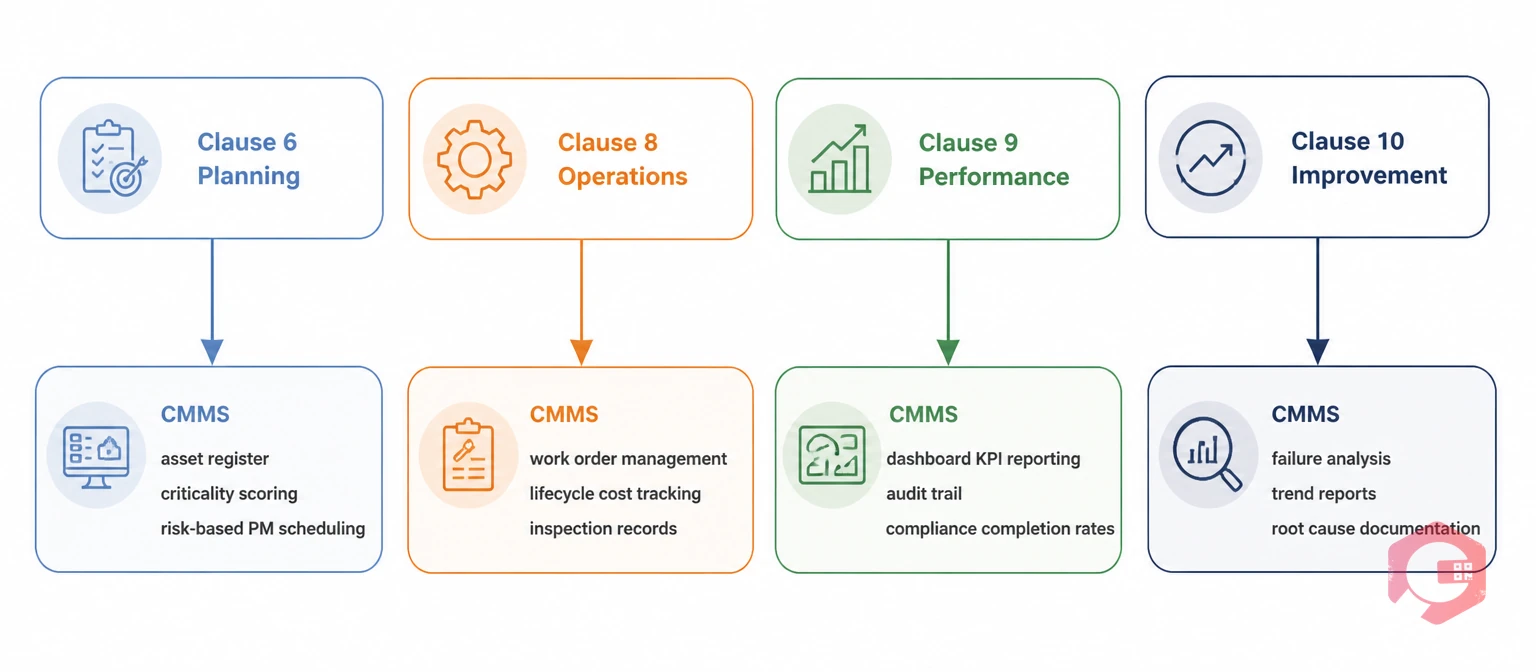
ISO 55001 alignment without a CMMS is theoretically possible — in practice, it is not sustainable for any asset-intensive organisation. The standard demands documented processes, measurable data, and auditable records at every clause. A CMMS generates this evidence as a natural output of daily operations rather than as a parallel compliance exercise.
Cryotos maps to the ISO 55001 clause structure directly: the asset register satisfies Clause 4, role-based access and policy documentation support Clause 5, BI dashboards and objective tracking cover Clause 6, PM scheduling and work order management execute Clause 8, automated KPI reporting delivers Clause 9, and the RCA and corrective action workflows drive Clause 10. Organisations using Cryotos report a 30% reduction in downtime and 25% faster repair times — the performance outcomes that ISO 55001 is designed to produce.
For organisations actively pursuing ISO 55001 certification, the most direct path is to configure your CMMS to mirror the clause structure — so the evidence your auditor needs is the same data your maintenance team uses every day. Explore Cryotos asset management software and see how the platform maps to your ISO 55001 requirements from day one.
ISO 55000 provides the foundational overview, principles, and vocabulary for asset management systems — it is a reference document, not a certifiable standard. ISO 55001 is the standard your organisation is audited against for certification. It specifies the requirements your asset management system must satisfy. ISO 55002 provides practical implementation guidance for applying ISO 55001. Only ISO 55001 is certifiable.
Timeline depends heavily on starting maturity. Organisations with a structured CMMS, documented maintenance plans, and an existing KPI tracking cycle typically achieve full alignment in 12–18 months. Organisations starting from reactive maintenance and spreadsheets should plan for 24–36 months — you need to build the system, generate a performance record across at least one full audit cycle, and complete the certification audit process. The single biggest time driver is data readiness: organisations with a clean asset register and at least 12 months of CMMS maintenance history consistently move through certification faster.
The standard does not mandate any specific software. But the volume of documented information, auditable work order records, performance data, and corrective action trails that ISO 55001 requires makes a CMMS the most practical approach at scale. Attempting to sustain full ISO 55001 compliance with paper records and spreadsheets across a significant asset base is not realistic — the administrative overhead collapses under the weight of its own complexity.
A SAMP is your top-level documented plan that translates your organisational objectives into asset management objectives and describes how those objectives will be achieved across your asset portfolio. ISO 55001 Clause 6 requires it explicitly. Think of it as the bridge between your business strategy and your maintenance operations — it answers the question "what does the organisation need from its assets, and how is the asset management system going to deliver that?"
Preventive maintenance is the primary operational control under Clause 8 of ISO 55001. Your Asset Management Plans must define the maintenance strategies for each asset class — and your CMMS must demonstrate those strategies are being executed on schedule. PM compliance rate is one of the first metrics an ISO 55001 auditor examines. It is the most direct evidence that your operational controls are functioning as designed rather than existing only on paper.
The four most common failure points are: an incomplete or out-of-date asset register (Clause 4), asset management objectives that are not measurable or not linked to organisational goals (Clause 6), corrective actions that are logged but never verified as closed (Clause 10), and competency records that cannot demonstrate the people executing asset management activities have the required qualifications (Clause 7). All four of these gaps are preventable with the right CMMS configuration and a structured internal audit process before the external certification audit.


Cryotos AI predicts failures, automates work orders, and simplifies maintenance—before problems slow you down.



