Preventive Maintenance for Leather Manufacturing Equipment: A Complete Guide

Article Written by:

Ganesh Veerappan

Created On:

April 10, 2026

Preventive Maintenance for Leather Manufacturing Equipment: A Complete Guide

Preventive maintenance for leather manufacturing equipment is a scheduled, proactive approach to servicing machines before they fail — keeping your production line running, your hide quality consistent, and your costs predictable. In an industry where a seized fleshing drum or a broken splitting blade can halt an entire batch of hides, unplanned downtime isn't just expensive — it wastes raw material that can never be recovered.

Leather plants run some of the most chemically aggressive, mechanically demanding equipment in any manufacturing sector. Yet most facilities still rely on reactive maintenance — fixing machines after they break. The result? According to industry estimates, unplanned equipment failures cost manufacturers up to $260,000 per hour in lost production. For leather tanneries running on thin margins, even a two-hour drum failure can wipe out a day's profit.

This guide walks you through everything you need to build a preventive maintenance (PM) programme that fits the unique demands of leather manufacturing — from beam house operations through finishing.

Why Preventive Maintenance Matters in Leather Manufacturing

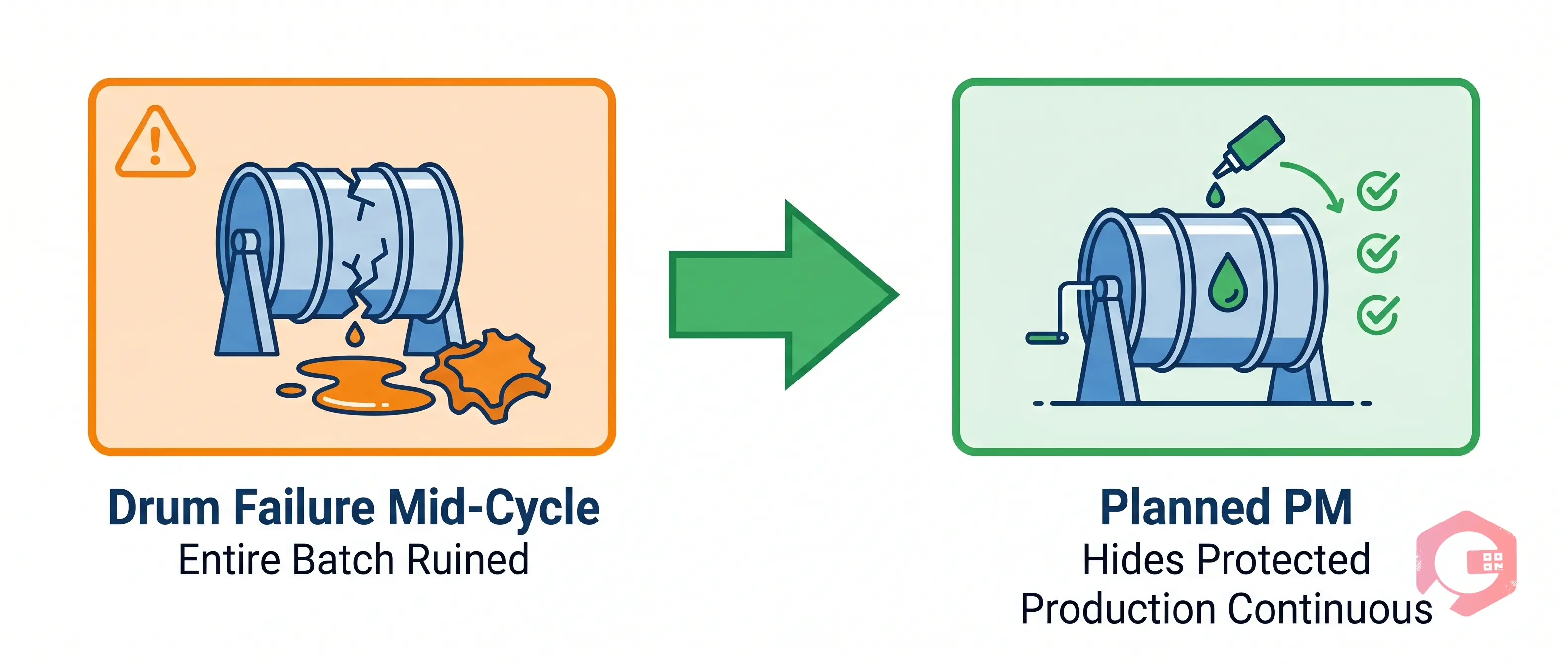
Leather production is a multi-stage, time-sensitive process. Hides move through soaking, liming, deliming, pickling, tanning, sammying, splitting, dyeing, and finishing — each stage dependent on the one before it. A drum failure mid-tanning cycle doesn't just delay that batch; it can ruin the entire load of hides if the process can't be completed within the required time window.

Beyond production loss, leather plants operate in harsh environments — high humidity, chemical exposure, and continuous heavy loads that wear out equipment faster than most industries. Without a structured PM programme, maintenance teams spend their time firefighting rather than preventing. The financial impact compounds quickly: emergency repair costs typically run 3–5× higher than planned maintenance, and replacement parts for specialist leather machinery often have lead times of weeks.

A proactive preventive maintenance strategy shifts your team from reactive to reliable — reducing downtime, extending equipment life, and protecting hide quality at every stage.

Key Equipment in a Leather Plant That Needs PM

Every leather plant has a mix of wet processing and dry finishing equipment, and each machine has its own maintenance rhythm. Here are the critical assets that demand regular PM attention:

  • Tanning Drums: The workhorses of any tannery — continuous rotation under heavy chemical loads stresses bearings, gearboxes, seals, and drum linings on a daily basis.
  • Fleshing Machines: High-speed rotating blades operate in a wet, chemically contaminated environment; blade condition, shaft bearings, and drive belts require weekly attention.
  • Splitting Machines: Precision blade alignment is critical — even a small deviation wastes expensive hide and risks blade damage or operator injury.
  • Sammying Presses and Setting-Out Machines: Hydraulic systems under continuous high pressure are prone to seal failures and fluid contamination, which must be caught early.
  • Finishing Lines (spray booths, staking, plating machines): Solvent and coating residues build up rapidly, clogging nozzles, conveyor rollers, and heating elements if cleaning schedules slip.
  • Effluent Treatment Plant (ETP): ETP pump failures can trigger regulatory non-compliance within hours — reliable PM is not optional for any plant operating under environmental permits.

Common Maintenance Challenges in the Leather Industry

Leather manufacturers face maintenance challenges that are largely unique to the industry. Understanding them is the first step to solving them.

Chemical Corrosion and Accelerated Wear

Chromium sulphate, lime, formic acid, and other tanning chemicals aggressively corrode metal components, degrade rubber seals, and shorten the life of bearings and shafts. Standard maintenance intervals designed for dry manufacturing environments are often too infrequent for leather plants. Your PM schedules need to account for chemical exposure — not just run hours.

Paper-Based Records and Missed PMs

Many leather plants still use paper job cards or spreadsheets to track maintenance. In a humid, chemical-laden environment, paper records degrade, get lost, or simply don't get filled in. Missed preventive tasks accumulate silently until a machine fails — and then no one can tell you when it was last serviced.

Spare Parts Availability

Specialist leather machinery — particularly imported European equipment — often has long spare parts lead times. Without visibility into current stock levels and minimum thresholds, teams routinely discover that a critical part is out of stock only when they need it urgently. Inventory management integrated with maintenance solves this directly.

Multi-Shift Operations and Handover Gaps

Leather plants typically run multiple shifts. Without a structured digital handover, maintenance observations made by the day shift never reach the night shift — and small issues that could be caught early escalate into failures during off-hours when skilled technicians may not be available.

Building a Preventive Maintenance Schedule for Leather Equipment

An effective PM schedule for a leather plant needs to be tiered — daily checks that operators can do, weekly tasks for maintenance technicians, and monthly/quarterly deep inspections. Here's a framework to start from:

Daily (Operator-Level Checks)

  • Drum temperature and noise check: Listen for unusual grinding, squealing, or vibration from drum motors and gearboxes — early signs of bearing wear.
  • Fleshing machine blade inspection: Check for visible nicks, chips, or dull edges; a damaged blade wastes hides and risks operator injury.
  • Hydraulic line inspection: Walk the sammying and setting machines for visible oil seepage at fittings, hoses, and cylinder rods.
  • ETP pump check: Confirm all ETP pumps are operating, chemical dosing is active, and no alarms are showing on the control panel.
  • Fault logging: Any abnormal observation — vibration, noise, smell, or performance change — must be logged immediately in the maintenance system.

Weekly (Technician Tasks)

  • Lubricate drum bearings and axles: Apply manufacturer-specified grease to all drum bearing points and check for signs of overheating or unusual wear.
  • Belt tension and condition check: Inspect drive belts on fleshing machines, splitting machines, and conveyors — adjust tension and replace any belts showing cracking or glazing.
  • Chemical dosing pump service: Clean dosing pump filters, check flow rates, and inspect tube connections for leaks or blockages.
  • Hydraulic fluid check: Test hydraulic fluid levels across all press machines and inspect for discolouration or contamination indicating seal breakdown.
  • Electrical panel inspection: Check control panels for corrosion on terminals, loose connections, and any warning indicators — a common failure point in high-humidity environments.

Monthly / Quarterly (Full Inspections)

  • Drum lining inspection: Conduct a full internal inspection of drum rubber linings for tears, punctures, or delamination — damaged linings allow chemical contact with the drum shell, accelerating corrosion.
  • Splitting machine blade alignment: Check blade alignment and parallelism with precision gauges; even minor misalignment causes uneven splitting and increased hide waste.
  • Gearbox oil change: Replace gearbox oil on drums and major drive systems — chemical contamination of oil is common in leather plants and drastically shortens gear life if unaddressed.
  • Full ETP service: Service all ETP pumps, aeration blowers, and dosing systems; recalibrate pH and DO sensors.
  • Structural corrosion audit: Inspect all machine frames, floor mounts, and overhead structures for rust progression — mark and schedule treatment before structural integrity is affected.

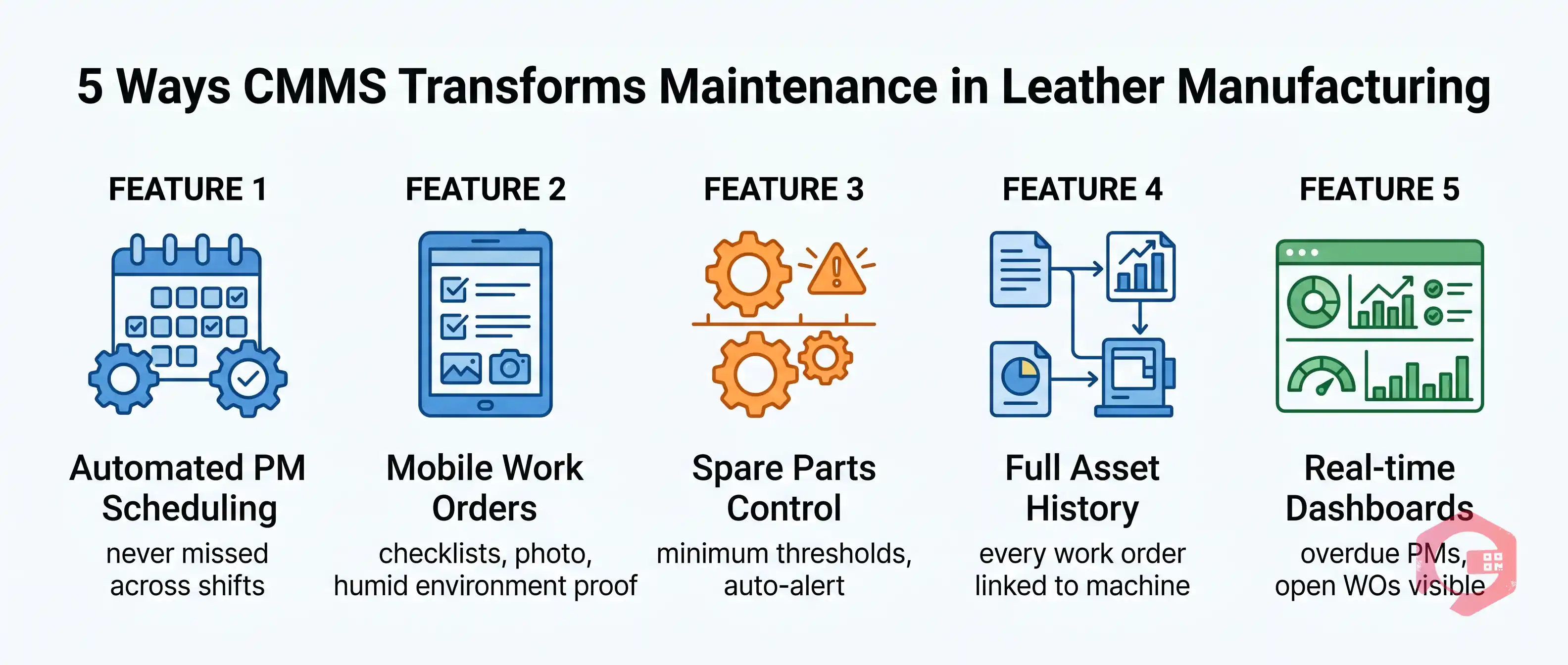
How CMMS Transforms Maintenance in Leather Manufacturing

A Computerised Maintenance Management System (CMMS) gives leather manufacturers a single platform to plan, execute, and track all maintenance activity — replacing paper job cards, spreadsheets, and tribal knowledge with structured, searchable data.

Here's what changes when a leather plant deploys a CMMS like Cryotos:

  • Automated PM scheduling: PMs are automatically triggered by calendar intervals or meter readings — no task falls through the cracks, even across multiple shifts.
  • Mobile work orders: Technicians receive task assignments on their phones with step-by-step checklists, photo capture, and sign-off — eliminating paper records that degrade in humid plant environments.
  • Spare parts inventory control: Set minimum stock thresholds for critical parts; the system alerts you when stock drops below the threshold — before the part is needed urgently.
  • Full asset maintenance history: Every work order, inspection, and part replacement is recorded against the specific asset, giving you the audit trail needed for compliance and warranty claims.
  • Real-time dashboards: Managers see overdue PMs, open work orders, and equipment health indicators at a glance — without chasing technicians for status updates.

Leather manufacturers using a structured CMMS approach consistently report 30% reductions in unplanned downtime and faster repair cycles — freeing up technician time to focus on improvement rather than firefighting.

Preventive Maintenance Checklist for Leather Plants

Use this checklist as a starting point for your own PM templates. In a CMMS like Cryotos, these can be imported via Excel and assigned to specific assets with automatic scheduling.

Fleshing Machine — Weekly Checklist

  • Blade condition: Inspect for nicks, chips, and dullness — sharpen or replace blades as required to maintain clean flesh removal.
  • Blade shaft bearings: Lubricate bearing points and check for any lateral play indicating bearing wear.
  • Blade gap and alignment: Verify correct gap between blade and pressure roller; adjust to manufacturer specification.
  • Drive belt inspection: Check tension, condition, and alignment — replace any belts showing cracking, glazing, or uneven wear.
  • Chemical residue cleaning: Remove build-up from all accessible surfaces, rollers, and blade guards to prevent corrosion and cross-contamination.

Tanning Drum — Monthly Checklist

  • Rubber lining inspection: Check entire internal lining for tears, punctures, and delamination — any breach allows acid contact with the steel drum shell.
  • Axle bearing lubrication: Apply grease to all axle bearing points; check for play, overheating, or unusual noise during rotation.
  • Gearbox oil check: Verify oil level and condition; discoloured or milky oil indicates water contamination — change immediately.
  • Door seals and gaskets: Inspect drum door seals for compression set, tears, or chemical degradation — replace worn gaskets to prevent leaks.
  • Motor temperature test: Check motor operating temperature under load and compare against baseline; elevated temperature indicates cooling or winding issues.

ETP — Monthly Checklist

  • Dosing pump service: Clean all chemical dosing pump filters, check flow accuracy against set points, and inspect tube connections.
  • Aeration system inspection: Clean diffuser membranes and inspect blower belts and impellers — blocked diffusers reduce dissolved oxygen and impair biological treatment.
  • Sensor calibration: Calibrate pH, dissolved oxygen, and turbidity sensors; replace sensor membranes if readings drift outside acceptable range.
  • Pump impeller inspection: Check pump impellers for wear and corrosion from chemical exposure — worn impellers reduce flow rates and increase power consumption.
  • Pipe joints and flanges: Walk all chemical feed lines and check every joint, flange, and valve for seepage — chemical leaks are both a safety and compliance risk.

KPIs to Track Maintenance Performance in Leather Manufacturing

Tracking the right KPIs tells you whether your PM programme is actually working — or just generating paperwork. Focus on these metrics for a leather plant context:

  • Mean Time Between Failures (MTBF): Measures average operating time between equipment breakdowns — a rising MTBF confirms your PM programme is extending equipment reliability.
  • Mean Time to Repair (MTTR): Tracks how quickly your team resolves breakdowns — high MTTR often points to spare parts availability or diagnostic skill gaps.
  • PM Compliance Rate: Percentage of scheduled PMs completed on time — target above 90%; anything below 80% signals a scheduling or resource problem.
  • Planned vs Reactive Maintenance Ratio: Track the split between planned (scheduled) and reactive (breakdown) work orders — industry best practice targets 80%+ planned work.
  • Cost of Maintenance per Unit Produced: Normalises maintenance spend against production output, allowing fair comparison across periods and between sites.

Frequently Asked Questions

What is preventive maintenance in leather manufacturing?

Preventive maintenance in leather manufacturing is a scheduled approach to servicing equipment — drums, fleshing machines, splitting machines, and finishing lines — at set intervals before failures occur. It differs from reactive maintenance, which only addresses problems after a breakdown has already stopped production and potentially ruined a batch of hides.

How often should tanning drums be serviced?

Tanning drums should be visually inspected daily by operators for unusual noise, vibration, or leaks. A full technical inspection — covering lining condition, axle seals, motor temperature, and gearbox — should be carried out monthly or after every 500 operating hours, whichever comes first. Chemical exposure accelerates wear, so don't rely solely on calendar-based schedules.

Can a CMMS work for small leather tanneries?

Yes. A cloud-based CMMS like Cryotos is designed to scale from small single-site operations to large multi-plant facilities. For a small tannery, even basic work order management and PM scheduling provides immediate value — replacing paper records, ensuring nothing gets forgotten, and giving management visibility into what maintenance was done and when.

What are the biggest causes of downtime in leather plants?

The most common causes of unplanned downtime in leather manufacturing are drum motor failures, hydraulic system leaks on sammying and setting machines, fleshing blade failures from inadequate sharpening schedules, and ETP pump failures. Most of these are predictable and preventable with a structured PM programme and regular inspections.

How do I get my maintenance team to follow PM schedules consistently?

Consistency comes from removing friction. When PM tasks are delivered to technicians via a mobile app with clear checklists, photo capture, and simple sign-off — rather than paper forms that get lost in a wet environment — compliance rates climb significantly. A CMMS also gives supervisors real-time visibility into task completion, so overdue PMs are flagged before they become breakdowns.

Leather manufacturing is too demanding — and your raw material too valuable — to leave equipment reliability to chance. A structured preventive maintenance programme, backed by a purpose-built CMMS, gives your team the tools to keep machines running, protect hide quality, and turn maintenance from a cost centre into a competitive advantage. Cryotos CMMS is built for exactly this — mobile-first, easy to configure for leather plant workflows, and designed to deliver measurable downtime reduction from day one. Schedule a free demo to see how it fits your operation.

Want to Try Cryotos CMMS Today? Lets Connect!
Thank you! Your submission has been received!
Oops! Something went wrong while submitting the form.
Related Post

Preventive Maintenance for Leather Manufacturing Equipment: A Complete Guide

Calendar
Duration:
12 min read
calendar today
Published on
April 10, 2026
Featured Image

Preventive maintenance for leather manufacturing equipment is a scheduled, proactive approach to servicing machines before they fail — keeping your production line running, your hide quality consistent, and your costs predictable. In an industry where a seized fleshing drum or a broken splitting blade can halt an entire batch of hides, unplanned downtime isn't just expensive — it wastes raw material that can never be recovered.

Leather plants run some of the most chemically aggressive, mechanically demanding equipment in any manufacturing sector. Yet most facilities still rely on reactive maintenance — fixing machines after they break. The result? According to industry estimates, unplanned equipment failures cost manufacturers up to $260,000 per hour in lost production. For leather tanneries running on thin margins, even a two-hour drum failure can wipe out a day's profit.

This guide walks you through everything you need to build a preventive maintenance (PM) programme that fits the unique demands of leather manufacturing — from beam house operations through finishing.

Why Preventive Maintenance Matters in Leather Manufacturing

Leather production is a multi-stage, time-sensitive process. Hides move through soaking, liming, deliming, pickling, tanning, sammying, splitting, dyeing, and finishing — each stage dependent on the one before it. A drum failure mid-tanning cycle doesn't just delay that batch; it can ruin the entire load of hides if the process can't be completed within the required time window.

Beyond production loss, leather plants operate in harsh environments — high humidity, chemical exposure, and continuous heavy loads that wear out equipment faster than most industries. Without a structured PM programme, maintenance teams spend their time firefighting rather than preventing. The financial impact compounds quickly: emergency repair costs typically run 3–5× higher than planned maintenance, and replacement parts for specialist leather machinery often have lead times of weeks.

A proactive preventive maintenance strategy shifts your team from reactive to reliable — reducing downtime, extending equipment life, and protecting hide quality at every stage.

Key Equipment in a Leather Plant That Needs PM

Every leather plant has a mix of wet processing and dry finishing equipment, and each machine has its own maintenance rhythm. Here are the critical assets that demand regular PM attention:

  • Tanning Drums: The workhorses of any tannery — continuous rotation under heavy chemical loads stresses bearings, gearboxes, seals, and drum linings on a daily basis.
  • Fleshing Machines: High-speed rotating blades operate in a wet, chemically contaminated environment; blade condition, shaft bearings, and drive belts require weekly attention.
  • Splitting Machines: Precision blade alignment is critical — even a small deviation wastes expensive hide and risks blade damage or operator injury.
  • Sammying Presses and Setting-Out Machines: Hydraulic systems under continuous high pressure are prone to seal failures and fluid contamination, which must be caught early.
  • Finishing Lines (spray booths, staking, plating machines): Solvent and coating residues build up rapidly, clogging nozzles, conveyor rollers, and heating elements if cleaning schedules slip.
  • Effluent Treatment Plant (ETP): ETP pump failures can trigger regulatory non-compliance within hours — reliable PM is not optional for any plant operating under environmental permits.

Common Maintenance Challenges in the Leather Industry

Leather manufacturers face maintenance challenges that are largely unique to the industry. Understanding them is the first step to solving them.

Chemical Corrosion and Accelerated Wear

Chromium sulphate, lime, formic acid, and other tanning chemicals aggressively corrode metal components, degrade rubber seals, and shorten the life of bearings and shafts. Standard maintenance intervals designed for dry manufacturing environments are often too infrequent for leather plants. Your PM schedules need to account for chemical exposure — not just run hours.

Paper-Based Records and Missed PMs

Many leather plants still use paper job cards or spreadsheets to track maintenance. In a humid, chemical-laden environment, paper records degrade, get lost, or simply don't get filled in. Missed preventive tasks accumulate silently until a machine fails — and then no one can tell you when it was last serviced.

Spare Parts Availability

Specialist leather machinery — particularly imported European equipment — often has long spare parts lead times. Without visibility into current stock levels and minimum thresholds, teams routinely discover that a critical part is out of stock only when they need it urgently. Inventory management integrated with maintenance solves this directly.

Multi-Shift Operations and Handover Gaps

Leather plants typically run multiple shifts. Without a structured digital handover, maintenance observations made by the day shift never reach the night shift — and small issues that could be caught early escalate into failures during off-hours when skilled technicians may not be available.

Building a Preventive Maintenance Schedule for Leather Equipment

An effective PM schedule for a leather plant needs to be tiered — daily checks that operators can do, weekly tasks for maintenance technicians, and monthly/quarterly deep inspections. Here's a framework to start from:

Daily (Operator-Level Checks)

  • Drum temperature and noise check: Listen for unusual grinding, squealing, or vibration from drum motors and gearboxes — early signs of bearing wear.
  • Fleshing machine blade inspection: Check for visible nicks, chips, or dull edges; a damaged blade wastes hides and risks operator injury.
  • Hydraulic line inspection: Walk the sammying and setting machines for visible oil seepage at fittings, hoses, and cylinder rods.
  • ETP pump check: Confirm all ETP pumps are operating, chemical dosing is active, and no alarms are showing on the control panel.
  • Fault logging: Any abnormal observation — vibration, noise, smell, or performance change — must be logged immediately in the maintenance system.

Weekly (Technician Tasks)

  • Lubricate drum bearings and axles: Apply manufacturer-specified grease to all drum bearing points and check for signs of overheating or unusual wear.
  • Belt tension and condition check: Inspect drive belts on fleshing machines, splitting machines, and conveyors — adjust tension and replace any belts showing cracking or glazing.
  • Chemical dosing pump service: Clean dosing pump filters, check flow rates, and inspect tube connections for leaks or blockages.
  • Hydraulic fluid check: Test hydraulic fluid levels across all press machines and inspect for discolouration or contamination indicating seal breakdown.
  • Electrical panel inspection: Check control panels for corrosion on terminals, loose connections, and any warning indicators — a common failure point in high-humidity environments.

Monthly / Quarterly (Full Inspections)

  • Drum lining inspection: Conduct a full internal inspection of drum rubber linings for tears, punctures, or delamination — damaged linings allow chemical contact with the drum shell, accelerating corrosion.
  • Splitting machine blade alignment: Check blade alignment and parallelism with precision gauges; even minor misalignment causes uneven splitting and increased hide waste.
  • Gearbox oil change: Replace gearbox oil on drums and major drive systems — chemical contamination of oil is common in leather plants and drastically shortens gear life if unaddressed.
  • Full ETP service: Service all ETP pumps, aeration blowers, and dosing systems; recalibrate pH and DO sensors.
  • Structural corrosion audit: Inspect all machine frames, floor mounts, and overhead structures for rust progression — mark and schedule treatment before structural integrity is affected.

How CMMS Transforms Maintenance in Leather Manufacturing

A Computerised Maintenance Management System (CMMS) gives leather manufacturers a single platform to plan, execute, and track all maintenance activity — replacing paper job cards, spreadsheets, and tribal knowledge with structured, searchable data.

Here's what changes when a leather plant deploys a CMMS like Cryotos:

  • Automated PM scheduling: PMs are automatically triggered by calendar intervals or meter readings — no task falls through the cracks, even across multiple shifts.
  • Mobile work orders: Technicians receive task assignments on their phones with step-by-step checklists, photo capture, and sign-off — eliminating paper records that degrade in humid plant environments.
  • Spare parts inventory control: Set minimum stock thresholds for critical parts; the system alerts you when stock drops below the threshold — before the part is needed urgently.
  • Full asset maintenance history: Every work order, inspection, and part replacement is recorded against the specific asset, giving you the audit trail needed for compliance and warranty claims.
  • Real-time dashboards: Managers see overdue PMs, open work orders, and equipment health indicators at a glance — without chasing technicians for status updates.

Leather manufacturers using a structured CMMS approach consistently report 30% reductions in unplanned downtime and faster repair cycles — freeing up technician time to focus on improvement rather than firefighting.

Preventive Maintenance Checklist for Leather Plants

Use this checklist as a starting point for your own PM templates. In a CMMS like Cryotos, these can be imported via Excel and assigned to specific assets with automatic scheduling.

Fleshing Machine — Weekly Checklist

  • Blade condition: Inspect for nicks, chips, and dullness — sharpen or replace blades as required to maintain clean flesh removal.
  • Blade shaft bearings: Lubricate bearing points and check for any lateral play indicating bearing wear.
  • Blade gap and alignment: Verify correct gap between blade and pressure roller; adjust to manufacturer specification.
  • Drive belt inspection: Check tension, condition, and alignment — replace any belts showing cracking, glazing, or uneven wear.
  • Chemical residue cleaning: Remove build-up from all accessible surfaces, rollers, and blade guards to prevent corrosion and cross-contamination.

Tanning Drum — Monthly Checklist

  • Rubber lining inspection: Check entire internal lining for tears, punctures, and delamination — any breach allows acid contact with the steel drum shell.
  • Axle bearing lubrication: Apply grease to all axle bearing points; check for play, overheating, or unusual noise during rotation.
  • Gearbox oil check: Verify oil level and condition; discoloured or milky oil indicates water contamination — change immediately.
  • Door seals and gaskets: Inspect drum door seals for compression set, tears, or chemical degradation — replace worn gaskets to prevent leaks.
  • Motor temperature test: Check motor operating temperature under load and compare against baseline; elevated temperature indicates cooling or winding issues.

ETP — Monthly Checklist

  • Dosing pump service: Clean all chemical dosing pump filters, check flow accuracy against set points, and inspect tube connections.
  • Aeration system inspection: Clean diffuser membranes and inspect blower belts and impellers — blocked diffusers reduce dissolved oxygen and impair biological treatment.
  • Sensor calibration: Calibrate pH, dissolved oxygen, and turbidity sensors; replace sensor membranes if readings drift outside acceptable range.
  • Pump impeller inspection: Check pump impellers for wear and corrosion from chemical exposure — worn impellers reduce flow rates and increase power consumption.
  • Pipe joints and flanges: Walk all chemical feed lines and check every joint, flange, and valve for seepage — chemical leaks are both a safety and compliance risk.

KPIs to Track Maintenance Performance in Leather Manufacturing

Tracking the right KPIs tells you whether your PM programme is actually working — or just generating paperwork. Focus on these metrics for a leather plant context:

  • Mean Time Between Failures (MTBF): Measures average operating time between equipment breakdowns — a rising MTBF confirms your PM programme is extending equipment reliability.
  • Mean Time to Repair (MTTR): Tracks how quickly your team resolves breakdowns — high MTTR often points to spare parts availability or diagnostic skill gaps.
  • PM Compliance Rate: Percentage of scheduled PMs completed on time — target above 90%; anything below 80% signals a scheduling or resource problem.
  • Planned vs Reactive Maintenance Ratio: Track the split between planned (scheduled) and reactive (breakdown) work orders — industry best practice targets 80%+ planned work.
  • Cost of Maintenance per Unit Produced: Normalises maintenance spend against production output, allowing fair comparison across periods and between sites.

Frequently Asked Questions

What is preventive maintenance in leather manufacturing?

Preventive maintenance in leather manufacturing is a scheduled approach to servicing equipment — drums, fleshing machines, splitting machines, and finishing lines — at set intervals before failures occur. It differs from reactive maintenance, which only addresses problems after a breakdown has already stopped production and potentially ruined a batch of hides.

How often should tanning drums be serviced?

Tanning drums should be visually inspected daily by operators for unusual noise, vibration, or leaks. A full technical inspection — covering lining condition, axle seals, motor temperature, and gearbox — should be carried out monthly or after every 500 operating hours, whichever comes first. Chemical exposure accelerates wear, so don't rely solely on calendar-based schedules.

Can a CMMS work for small leather tanneries?

Yes. A cloud-based CMMS like Cryotos is designed to scale from small single-site operations to large multi-plant facilities. For a small tannery, even basic work order management and PM scheduling provides immediate value — replacing paper records, ensuring nothing gets forgotten, and giving management visibility into what maintenance was done and when.

What are the biggest causes of downtime in leather plants?

The most common causes of unplanned downtime in leather manufacturing are drum motor failures, hydraulic system leaks on sammying and setting machines, fleshing blade failures from inadequate sharpening schedules, and ETP pump failures. Most of these are predictable and preventable with a structured PM programme and regular inspections.

How do I get my maintenance team to follow PM schedules consistently?

Consistency comes from removing friction. When PM tasks are delivered to technicians via a mobile app with clear checklists, photo capture, and simple sign-off — rather than paper forms that get lost in a wet environment — compliance rates climb significantly. A CMMS also gives supervisors real-time visibility into task completion, so overdue PMs are flagged before they become breakdowns.

Leather manufacturing is too demanding — and your raw material too valuable — to leave equipment reliability to chance. A structured preventive maintenance programme, backed by a purpose-built CMMS, gives your team the tools to keep machines running, protect hide quality, and turn maintenance from a cost centre into a competitive advantage. Cryotos CMMS is built for exactly this — mobile-first, easy to configure for leather plant workflows, and designed to deliver measurable downtime reduction from day one. Schedule a free demo to see how it fits your operation.
Want to Try Cryotos CMMS Today?

Get Free Demo

Let AI Take Control of Your Maintenance

Cryotos AI predicts failures, automates work orders, and simplifies maintenance—before problems slow you down.

Try AI-Powered CMMS
🡢