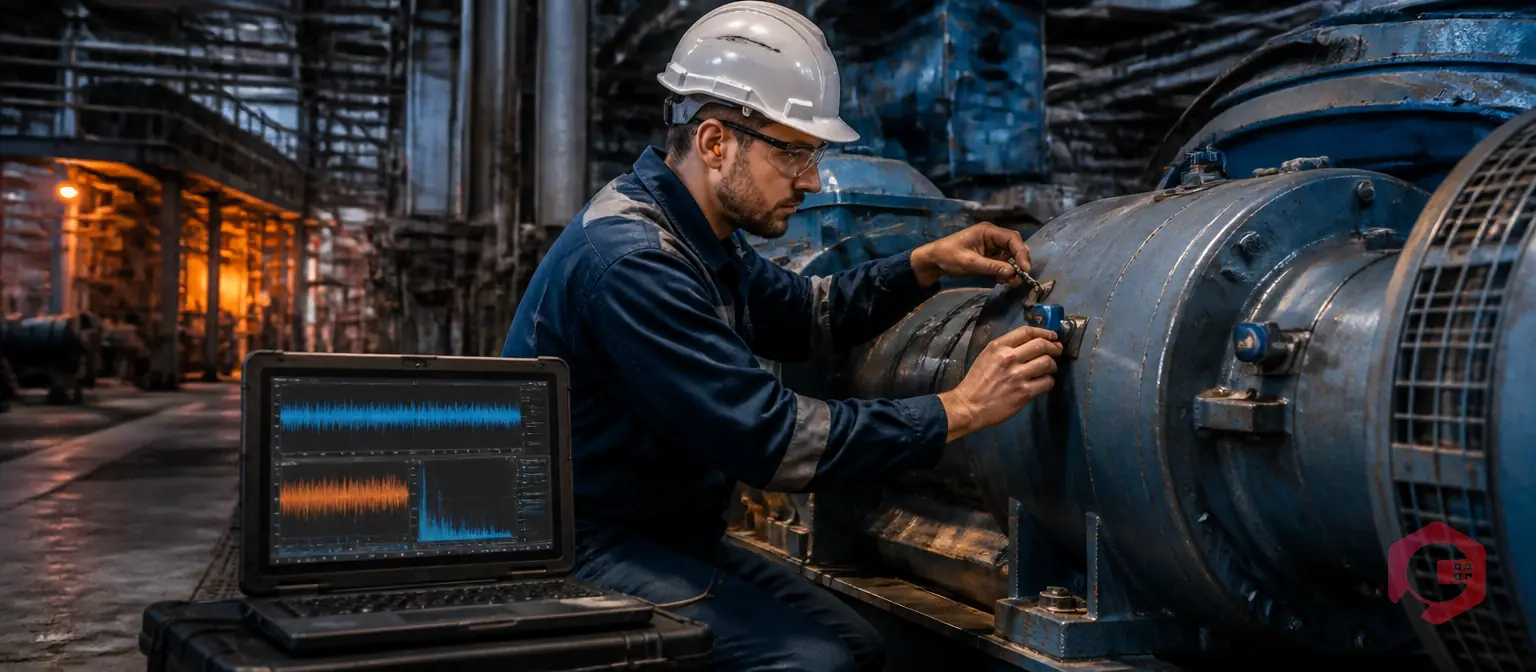
Predictive Maintenance in the Textile Industry: A Complete Guide

Article Written by:

Created On:

April 7, 2026

Predictive Maintenance in the Textile Industry: A Complete Guide

Predictive maintenance in the textile industry is the practice of using real-time sensor data, IoT devices, and CMMS software to monitor the health of textile machinery - and trigger maintenance only when equipment actually shows signs of impending failure. Unlike fixed-schedule preventive maintenance or purely reactive repairs, predictive maintenance catches problems before they cause costly unplanned downtime.

For textile manufacturers, where a single loom stoppage can halt an entire production line, this matters enormously. A 2023 industry report by Deloitte found that unplanned downtime costs manufacturers an average of $260,000 per hour - and textile mills, running continuous multi-shift operations, are among the most exposed. This guide breaks down exactly how predictive maintenance works in the textile context, which machines benefit most, and how to implement it step by step using a modern CMMS platform.

What Is Predictive Maintenance in the Textile Industry?

Predictive maintenance (PdM) in the textile industry means continuously monitoring the condition of your machinery - spindles, looms, carding machines, humidification systems - using sensors that track vibration, temperature, current draw, and acoustic emissions. When those readings drift outside normal operating ranges, your CMMS generates a work order before the machine fails.

The key distinction from preventive maintenance is that PdM is condition-based, not calendar-based. Instead of replacing bearings every 90 days whether they need it or not, you replace them when the vibration data tells you they're starting to degrade. This eliminates both premature replacements (wasted parts and labor) and missed failures (expensive breakdowns).

In a textile mill context, this typically involves three layers working together:


Why Textile Mills Cannot Afford Reactive Maintenance Anymore

The Hidden Cost of Unplanned Downtime in Textile Plants

Textile manufacturing is a high-throughput, margin-sensitive business. Your machines run around the clock, often across three shifts. When one critical asset - a ring frame, a loom set, a carding machine - goes down unexpectedly, the ripple effect is immediate: production targets are missed, orders get delayed, and urgent repair work at odd hours costs significantly more in labor and expedited parts.

The numbers reinforce this. Studies across discrete and process manufacturing consistently show that reactive maintenance costs 3-9 times more per machine hour than planned maintenance. In textile mills where equipment density is high and interdependencies are tight, a single unplanned failure can take down adjacent processes that depend on it - making the real cost multiply quickly.

How Reactive Maintenance Drains Textile Mill Profitability

Beyond direct repair costs, reactive maintenance creates a set of harder-to-quantify losses. Quality suffers - a loom running with worn components produces defective fabric before it fails outright, meaning you lose not just machine time but also raw material and finished goods. Technician burnout increases when teams are constantly firefighting instead of working structured maintenance plans. And spare parts inventory bloats as maintenance managers stock "just in case" buffers to cover unexpected breakdowns.

Textile plants that shift from reactive to predictive maintenance typically report 20-30% reductions in overall maintenance costs, 50% fewer unplanned breakdowns, and meaningful improvements in OEE - overall equipment effectiveness - which directly maps to production throughput and margin.

Key Textile Machines That Benefit Most from Predictive Maintenance

Predictive Maintenance in the Textile Industry — lifecycle

Not every machine in a textile plant has the same criticality or failure profile. Here are the equipment categories where predictive maintenance delivers the strongest return.

Ring Frames and Spinning Machines

Ring frames are among the highest-spindle-count machines in any spinning mill - a single frame can carry 500 to 1,000 spindles. Spindle bearing wear is the dominant failure mode, and it's progressive: vibration amplitudes increase gradually over weeks before actual failure. Vibration sensors mounted at the bearing housings can detect this early degradation and flag specific spindle positions for targeted replacement, avoiding the cost of either full-section shutdowns or catastrophic spindle failures.

Looms and Weaving Machines

Rapier, air-jet, and water-jet looms are high-speed, high-precision machines where even minor mechanical drift causes weave defects or complete stoppages. Key failure modes include reed wear, cam and crank mechanism degradation, and weft insertion system issues. Current sensors (tracking motor load curves) and vibration monitoring at drive components are the most effective PdM inputs for weaving equipment.

Carding and Combing Machines

Carding machines process raw fiber at high speeds across multiple rotating cylinders. Wire clothing wear, flat wear, and cylinder bearing degradation are the primary failure modes. Because carding is early in the production sequence, a carding breakdown creates a cascade of stoppages downstream. Thermal imaging and vibration analysis are both effective - wire clothing generates heat as it degrades, making temperature sensors particularly useful here.

Humidification and HVAC Systems

Humidity control is not optional in textile manufacturing - cotton and synthetic fibers are highly sensitive to relative humidity variations, and running out of spec causes yarn breaks, static buildup, and quality failures. Humidification plant failures (fan motors, atomizer nozzles, ductwork) often go unnoticed until production quality starts slipping. Monitoring motor current draw, airflow sensors, and humidity levels against setpoints gives early warning of HVAC degradation before it affects the production floor.

Predictive vs. Preventive vs. Reactive Maintenance - What Works Best in Textiles?

Predictive Maintenance in the Textile Industry — problems grid

The right maintenance strategy depends on the asset, its criticality, and the failure pattern it exhibits. Here's a comparison across the three approaches in a textile manufacturing context:


Most textile mills that operate mature maintenance programs use a blend: PdM on critical production assets, scheduled preventive maintenance on medium-criticality equipment, and run-to-fail on low-value, easily replaced assets. A CMMS platform lets you manage all three strategies in one system, with clear asset criticality classifications driving which approach applies where.
How IoT Sensors Power Predictive Maintenance in Textile Manufacturing

Predictive Maintenance in the Textile Industry — scenario

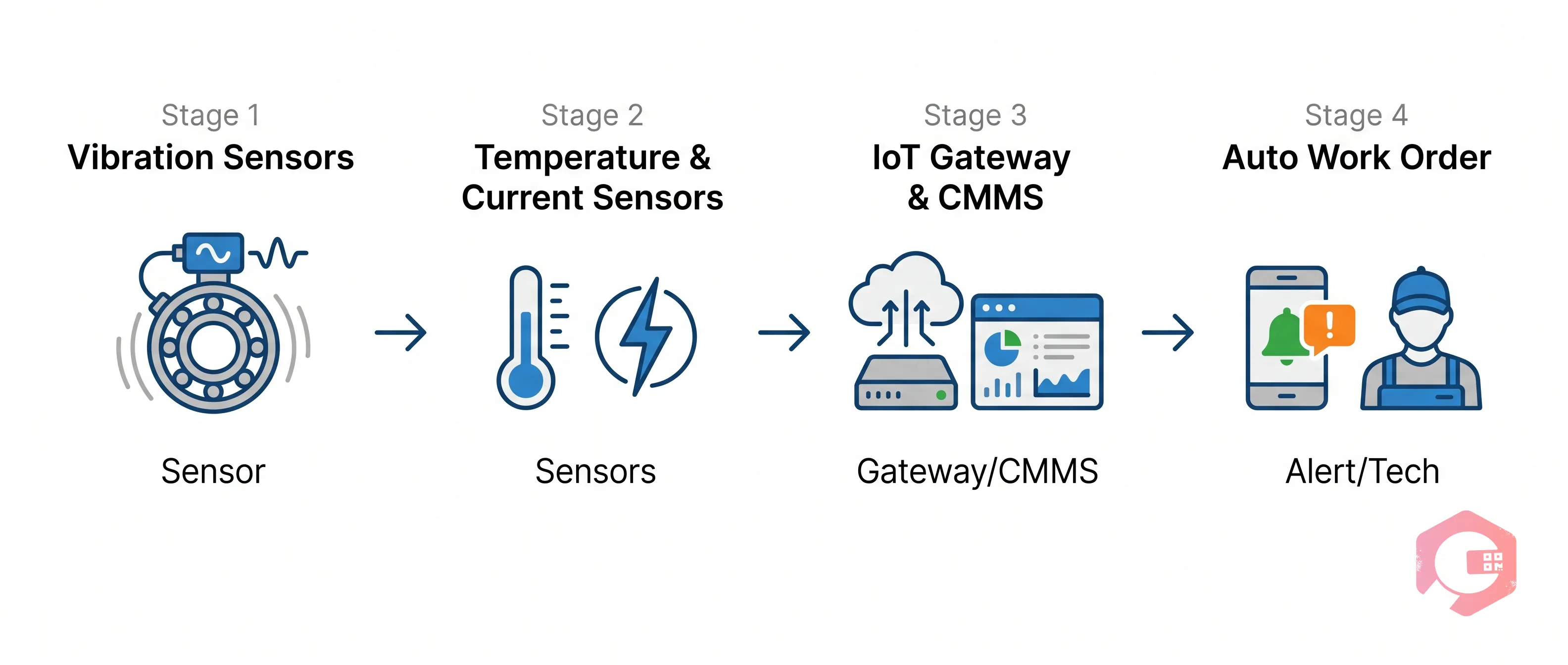
The backbone of any predictive maintenance program is real-time sensor data. In textile manufacturing, four types of sensors cover the vast majority of failure modes across spinning, weaving, and finishing equipment:


These sensors connect via edge devices or IoT gateways to your CMMS, which processes the data streams and applies alert thresholds. When a reading crosses a defined limit - or when trend analysis shows a parameter drifting steadily upward - the CMMS automatically creates a work order, assigns a technician, and pulls the relevant maintenance history and parts list. That closed loop, from sensor signal to completed repair, is what makes predictive maintenance operational rather than just theoretical.
How to Implement Predictive Maintenance in Your Textile Plant with CMMS

Predictive Maintenance in the Textile Industry — workflow

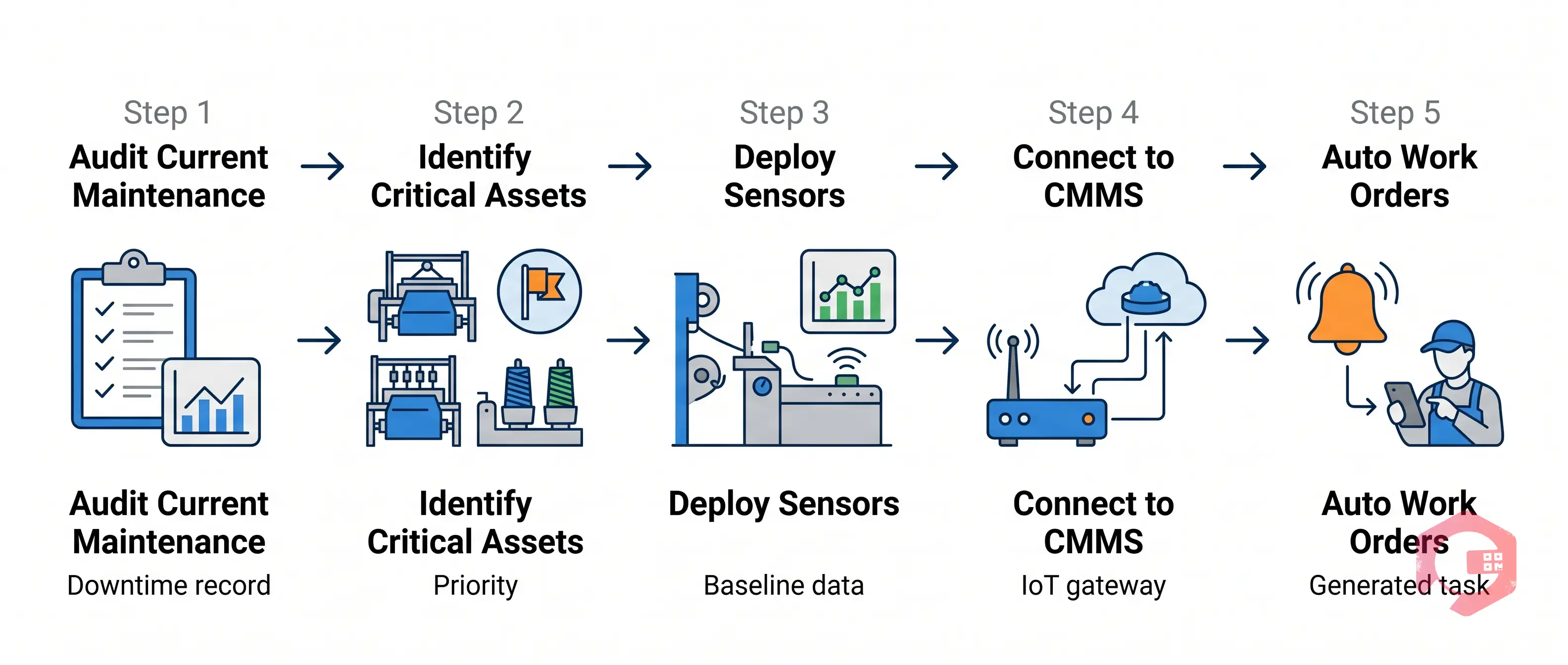
Rolling out predictive maintenance doesn't have to be a big-bang transformation. A phased approach - starting with your highest-criticality assets and expanding from there - delivers early ROI and builds the team's capability steadily.

Step 1 - Audit Your Current Maintenance Approach

Before adding sensors and software, understand what you're starting from. Pull your downtime records for the past 12 months. Which assets caused the most unplanned stoppages? Which failures were recurring? Which breakdowns had the highest cost in lost production and repair labor? This data tells you where predictive maintenance will deliver the fastest payback - and that's where you should start.

Step 2 - Identify Critical Assets and Failure Modes

For each high-priority asset, document the specific failure modes that cause unplanned downtime. Bearing failure on ring frames. Reed damage on rapier looms. Flat wear on carding machines. Each failure mode has a physical signature - vibration, temperature, current - that a sensor can detect. Matching assets to their detectable failure modes is what determines your sensor specification.

Step 3 - Deploy the Right Sensors

Based on your failure mode mapping, select and install sensors on your priority assets. Start with a pilot - one ring frame section or one loom set - before plant-wide deployment. Establish baseline readings during normal operation. These baselines are your reference point: future deviations from baseline are what trigger alerts, so the quality of your baseline data determines the reliability of your predictions.

Step 4 - Connect Sensor Data to Your CMMS

Sensor data needs to flow into your CMMS platform in real time. Modern CMMS systems integrate with IoT gateways, SCADA systems, and edge devices via APIs. Configure alert thresholds for each parameter - and set them intelligently: too tight and you'll generate alert fatigue; too loose and you'll miss real failures. A tiered alert structure (warning ? critical ? auto-work order) works well for most textile applications.

Step 5 - Build Automated Work Order Triggers

The payoff of PdM is not the data - it's the action. Configure your CMMS to automatically create a work order when an alert is triggered, pre-populated with the asset details, failure mode description, required parts, and recommended procedure. Assign it to the right technician based on availability and skill set. This automation closes the gap between detection and response, which is where most PdM programs fail in practice.

How Cryotos CMMS Enables Predictive Maintenance for Textile Manufacturers

Cryotos CMMS is built to support the full predictive maintenance workflow for industrial manufacturers, including textile mills. Here's how the platform's features map to the PdM use case:


Plants using Cryotos have reported up to 30% reduction in unplanned downtime and 25% faster repair times - gains that translate directly to production throughput and maintenance cost reduction in textile manufacturing environments.

Frequently Asked Questions

What types of sensors are most useful for predictive maintenance in textile mills?

Vibration sensors are the most widely used - they detect bearing wear, imbalance, and misalignment across rotating machinery like ring frames and looms. Temperature sensors complement vibration data by catching friction and lubrication failures. Current sensors on drive motors and acoustic emission sensors on high-speed equipment round out a comprehensive PdM sensor strategy for most textile applications.

How long does it take to implement predictive maintenance in a textile plant?

A pilot program on 5-10 critical assets can be operational in 4-8 weeks, depending on sensor installation complexity and CMMS integration readiness. Plant-wide deployment typically takes 3-6 months. The key to a fast rollout is starting with your highest-downtime assets, using existing CMMS infrastructure, and building on the pilot learnings before scaling.

Is predictive maintenance expensive for textile manufacturers?

The upfront cost includes sensors, IoT gateways, and CMMS software - but these are typically recovered within 12-18 months through reduced breakdown costs, lower spare parts spend, and improved production output. Most textile mills that implement PdM on their critical assets find that the program pays for itself before full plant-wide rollout is complete.

Can a small or mid-sized textile mill benefit from predictive maintenance?

Yes - and cloud-based CMMS platforms like Cryotos make PdM accessible without large capital expenditure on on-premise infrastructure. A mid-sized spinning mill can start with sensor monitoring on its highest-criticality ring frames, connect the data to a cloud CMMS, and have a functioning predictive maintenance program at a fraction of what enterprise-scale PdM systems cost even five years ago.

How does predictive maintenance improve fabric quality in textile manufacturing?

Machinery running with degraded components - worn wire clothing, loose spindles, misaligned loom parts - produces quality defects before it fails outright. Catching and correcting these issues early means your machines run within specification for longer, producing consistent fabric quality. Many textile manufacturers find that predictive maintenance reduces fabric defect rates alongside downtime, delivering a double quality-and-efficiency benefit.

If you're ready to move your textile plant from reactive firefighting to condition-based predictive maintenance, Cryotos CMMS gives you the IoT integration, automated work order management, and OEE reporting you need - all in one platform built for industrial manufacturers. Explore Cryotos for your textile facility or book a free demo to see how it maps to your specific maintenance challenges.


Want to Try Cryotos CMMS Today? Lets Connect!
Thank you! Your submission has been received!
Oops! Something went wrong while submitting the form.
Related Post

Predictive Maintenance in the Textile Industry: A Complete Guide

Calendar
Duration:
10 min read
person
calendar today
Published on
April 7, 2026
Featured Image

Predictive maintenance in the textile industry is the practice of using real-time sensor data, IoT devices, and CMMS software to monitor the health of textile machinery - and trigger maintenance only when equipment actually shows signs of impending failure. Unlike fixed-schedule preventive maintenance or purely reactive repairs, predictive maintenance catches problems before they cause costly unplanned downtime.

For textile manufacturers, where a single loom stoppage can halt an entire production line, this matters enormously. A 2023 industry report by Deloitte found that unplanned downtime costs manufacturers an average of $260,000 per hour - and textile mills, running continuous multi-shift operations, are among the most exposed. This guide breaks down exactly how predictive maintenance works in the textile context, which machines benefit most, and how to implement it step by step using a modern CMMS platform.

What Is Predictive Maintenance in the Textile Industry?

Predictive maintenance (PdM) in the textile industry means continuously monitoring the condition of your machinery - spindles, looms, carding machines, humidification systems - using sensors that track vibration, temperature, current draw, and acoustic emissions. When those readings drift outside normal operating ranges, your CMMS generates a work order before the machine fails.

The key distinction from preventive maintenance is that PdM is condition-based, not calendar-based. Instead of replacing bearings every 90 days whether they need it or not, you replace them when the vibration data tells you they're starting to degrade. This eliminates both premature replacements (wasted parts and labor) and missed failures (expensive breakdowns).

In a textile mill context, this typically involves three layers working together:


Why Textile Mills Cannot Afford Reactive Maintenance Anymore

The Hidden Cost of Unplanned Downtime in Textile Plants

Textile manufacturing is a high-throughput, margin-sensitive business. Your machines run around the clock, often across three shifts. When one critical asset - a ring frame, a loom set, a carding machine - goes down unexpectedly, the ripple effect is immediate: production targets are missed, orders get delayed, and urgent repair work at odd hours costs significantly more in labor and expedited parts.

The numbers reinforce this. Studies across discrete and process manufacturing consistently show that reactive maintenance costs 3-9 times more per machine hour than planned maintenance. In textile mills where equipment density is high and interdependencies are tight, a single unplanned failure can take down adjacent processes that depend on it - making the real cost multiply quickly.

How Reactive Maintenance Drains Textile Mill Profitability

Beyond direct repair costs, reactive maintenance creates a set of harder-to-quantify losses. Quality suffers - a loom running with worn components produces defective fabric before it fails outright, meaning you lose not just machine time but also raw material and finished goods. Technician burnout increases when teams are constantly firefighting instead of working structured maintenance plans. And spare parts inventory bloats as maintenance managers stock "just in case" buffers to cover unexpected breakdowns.

Textile plants that shift from reactive to predictive maintenance typically report 20-30% reductions in overall maintenance costs, 50% fewer unplanned breakdowns, and meaningful improvements in OEE - overall equipment effectiveness - which directly maps to production throughput and margin.

Key Textile Machines That Benefit Most from Predictive Maintenance

Predictive Maintenance in the Textile Industry — lifecycle

Not every machine in a textile plant has the same criticality or failure profile. Here are the equipment categories where predictive maintenance delivers the strongest return.

Ring Frames and Spinning Machines

Ring frames are among the highest-spindle-count machines in any spinning mill - a single frame can carry 500 to 1,000 spindles. Spindle bearing wear is the dominant failure mode, and it's progressive: vibration amplitudes increase gradually over weeks before actual failure. Vibration sensors mounted at the bearing housings can detect this early degradation and flag specific spindle positions for targeted replacement, avoiding the cost of either full-section shutdowns or catastrophic spindle failures.

Looms and Weaving Machines

Rapier, air-jet, and water-jet looms are high-speed, high-precision machines where even minor mechanical drift causes weave defects or complete stoppages. Key failure modes include reed wear, cam and crank mechanism degradation, and weft insertion system issues. Current sensors (tracking motor load curves) and vibration monitoring at drive components are the most effective PdM inputs for weaving equipment.

Carding and Combing Machines

Carding machines process raw fiber at high speeds across multiple rotating cylinders. Wire clothing wear, flat wear, and cylinder bearing degradation are the primary failure modes. Because carding is early in the production sequence, a carding breakdown creates a cascade of stoppages downstream. Thermal imaging and vibration analysis are both effective - wire clothing generates heat as it degrades, making temperature sensors particularly useful here.

Humidification and HVAC Systems

Humidity control is not optional in textile manufacturing - cotton and synthetic fibers are highly sensitive to relative humidity variations, and running out of spec causes yarn breaks, static buildup, and quality failures. Humidification plant failures (fan motors, atomizer nozzles, ductwork) often go unnoticed until production quality starts slipping. Monitoring motor current draw, airflow sensors, and humidity levels against setpoints gives early warning of HVAC degradation before it affects the production floor.

Predictive vs. Preventive vs. Reactive Maintenance - What Works Best in Textiles?

Predictive Maintenance in the Textile Industry — problems grid

The right maintenance strategy depends on the asset, its criticality, and the failure pattern it exhibits. Here's a comparison across the three approaches in a textile manufacturing context:


Most textile mills that operate mature maintenance programs use a blend: PdM on critical production assets, scheduled preventive maintenance on medium-criticality equipment, and run-to-fail on low-value, easily replaced assets. A CMMS platform lets you manage all three strategies in one system, with clear asset criticality classifications driving which approach applies where.

How IoT Sensors Power Predictive Maintenance in Textile Manufacturing

Predictive Maintenance in the Textile Industry — scenario

The backbone of any predictive maintenance program is real-time sensor data. In textile manufacturing, four types of sensors cover the vast majority of failure modes across spinning, weaving, and finishing equipment:


These sensors connect via edge devices or IoT gateways to your CMMS, which processes the data streams and applies alert thresholds. When a reading crosses a defined limit - or when trend analysis shows a parameter drifting steadily upward - the CMMS automatically creates a work order, assigns a technician, and pulls the relevant maintenance history and parts list. That closed loop, from sensor signal to completed repair, is what makes predictive maintenance operational rather than just theoretical.

How to Implement Predictive Maintenance in Your Textile Plant with CMMS

Predictive Maintenance in the Textile Industry — workflow

Rolling out predictive maintenance doesn't have to be a big-bang transformation. A phased approach - starting with your highest-criticality assets and expanding from there - delivers early ROI and builds the team's capability steadily.

Step 1 - Audit Your Current Maintenance Approach

Before adding sensors and software, understand what you're starting from. Pull your downtime records for the past 12 months. Which assets caused the most unplanned stoppages? Which failures were recurring? Which breakdowns had the highest cost in lost production and repair labor? This data tells you where predictive maintenance will deliver the fastest payback - and that's where you should start.

Step 2 - Identify Critical Assets and Failure Modes

For each high-priority asset, document the specific failure modes that cause unplanned downtime. Bearing failure on ring frames. Reed damage on rapier looms. Flat wear on carding machines. Each failure mode has a physical signature - vibration, temperature, current - that a sensor can detect. Matching assets to their detectable failure modes is what determines your sensor specification.

Step 3 - Deploy the Right Sensors

Based on your failure mode mapping, select and install sensors on your priority assets. Start with a pilot - one ring frame section or one loom set - before plant-wide deployment. Establish baseline readings during normal operation. These baselines are your reference point: future deviations from baseline are what trigger alerts, so the quality of your baseline data determines the reliability of your predictions.

Step 4 - Connect Sensor Data to Your CMMS

Sensor data needs to flow into your CMMS platform in real time. Modern CMMS systems integrate with IoT gateways, SCADA systems, and edge devices via APIs. Configure alert thresholds for each parameter - and set them intelligently: too tight and you'll generate alert fatigue; too loose and you'll miss real failures. A tiered alert structure (warning ? critical ? auto-work order) works well for most textile applications.

Step 5 - Build Automated Work Order Triggers

The payoff of PdM is not the data - it's the action. Configure your CMMS to automatically create a work order when an alert is triggered, pre-populated with the asset details, failure mode description, required parts, and recommended procedure. Assign it to the right technician based on availability and skill set. This automation closes the gap between detection and response, which is where most PdM programs fail in practice.

How Cryotos CMMS Enables Predictive Maintenance for Textile Manufacturers

Cryotos CMMS is built to support the full predictive maintenance workflow for industrial manufacturers, including textile mills. Here's how the platform's features map to the PdM use case:


Plants using Cryotos have reported up to 30% reduction in unplanned downtime and 25% faster repair times - gains that translate directly to production throughput and maintenance cost reduction in textile manufacturing environments.

Frequently Asked Questions

What types of sensors are most useful for predictive maintenance in textile mills?

Vibration sensors are the most widely used - they detect bearing wear, imbalance, and misalignment across rotating machinery like ring frames and looms. Temperature sensors complement vibration data by catching friction and lubrication failures. Current sensors on drive motors and acoustic emission sensors on high-speed equipment round out a comprehensive PdM sensor strategy for most textile applications.

How long does it take to implement predictive maintenance in a textile plant?

A pilot program on 5-10 critical assets can be operational in 4-8 weeks, depending on sensor installation complexity and CMMS integration readiness. Plant-wide deployment typically takes 3-6 months. The key to a fast rollout is starting with your highest-downtime assets, using existing CMMS infrastructure, and building on the pilot learnings before scaling.

Is predictive maintenance expensive for textile manufacturers?

The upfront cost includes sensors, IoT gateways, and CMMS software - but these are typically recovered within 12-18 months through reduced breakdown costs, lower spare parts spend, and improved production output. Most textile mills that implement PdM on their critical assets find that the program pays for itself before full plant-wide rollout is complete.

Can a small or mid-sized textile mill benefit from predictive maintenance?

Yes - and cloud-based CMMS platforms like Cryotos make PdM accessible without large capital expenditure on on-premise infrastructure. A mid-sized spinning mill can start with sensor monitoring on its highest-criticality ring frames, connect the data to a cloud CMMS, and have a functioning predictive maintenance program at a fraction of what enterprise-scale PdM systems cost even five years ago.

How does predictive maintenance improve fabric quality in textile manufacturing?

Machinery running with degraded components - worn wire clothing, loose spindles, misaligned loom parts - produces quality defects before it fails outright. Catching and correcting these issues early means your machines run within specification for longer, producing consistent fabric quality. Many textile manufacturers find that predictive maintenance reduces fabric defect rates alongside downtime, delivering a double quality-and-efficiency benefit.

If you're ready to move your textile plant from reactive firefighting to condition-based predictive maintenance, Cryotos CMMS gives you the IoT integration, automated work order management, and OEE reporting you need - all in one platform built for industrial manufacturers. Explore Cryotos for your textile facility or book a free demo to see how it maps to your specific maintenance challenges.

Want to Try Cryotos CMMS Today?

Get Free Demo

Let AI Take Control of Your Maintenance

Cryotos AI predicts failures, automates work orders, and simplifies maintenance—before problems slow you down.

Try AI-Powered CMMS
🡢