Condition-based maintenance triggers work orders from real-time sensor data. Predictive maintenance forecasts failures before they happen. This guide breaks down the key differences, costs, and how to choose the right strategy for your operation.

Condition-based maintenance (CBM) is a strategy where maintenance work is triggered by the actual measured condition of an asset - such as a spike in vibration, a rise in temperature, or degraded oil quality - rather than a fixed schedule. Predictive maintenance (PdM) goes a step further: it uses historical data, AI, and machine learning to forecast when a failure is likely to occur before any threshold is breached. The practical difference is timing - CBM acts when a condition exceeds a limit; PdM acts before it does.
Both approaches reduce unplanned downtime compared to reactive maintenance. Studies from Deloitte's Industry 4.0 research found that predictive maintenance can reduce machine downtime by 30-50% and extend machine life by 20-40%. Condition-based monitoring typically delivers 10-25% downtime reduction at a lower implementation cost - making it the practical starting point for most maintenance teams.
This guide breaks down exactly how CBM and PdM differ, where each performs best, and how to decide which strategy fits your operation.
Condition-based maintenance is a proactive maintenance strategy where work orders are triggered by real-time data from the asset itself. Instead of performing maintenance every 30 days whether the asset needs it or not, you only act when a sensor reading - vibration level, temperature, pressure, or fluid contamination - crosses a pre-set threshold.
CBM was formally defined in ISO 17359 (Condition Monitoring and Diagnostics of Machines) and has been a standard in military and aviation maintenance since the 1960s. Today it's widely used in manufacturing, utilities, oil and gas, and heavy industry.
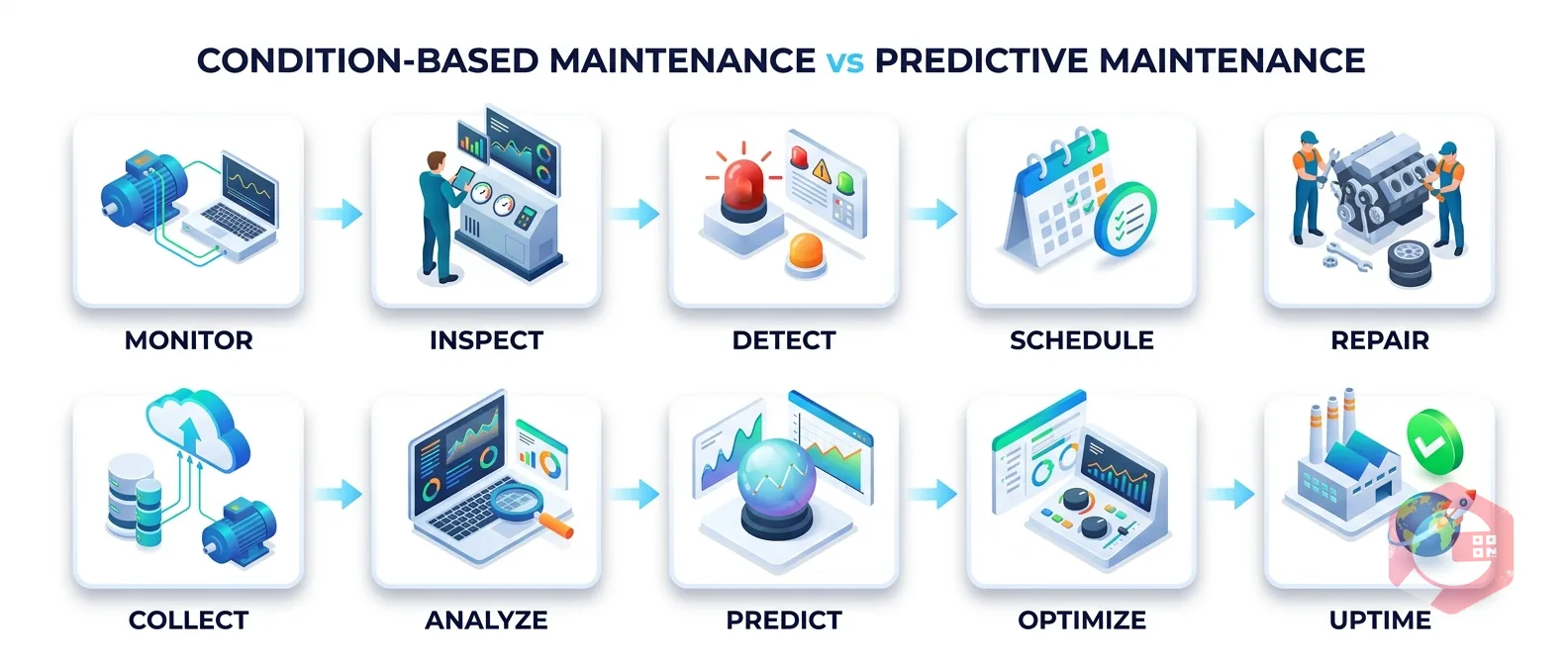
The CBM process follows a straightforward loop:
This is what separates CBM from time-based preventive maintenance: you're not spending labor and parts on equipment that's running fine. A Plant Engineering survey found that CBM programs reduce unnecessary preventive maintenance tasks by up to 30%, freeing technician hours for higher-priority work.
Different assets call for different monitoring methods. Here are the five most common techniques used in industrial CBM programs:
Predictive maintenance uses historical asset data, statistical models, and increasingly AI and machine learning to forecast when a failure is likely to occur - and schedule maintenance just before that point. Where CBM reacts when a threshold is crossed, PdM projects forward: "Based on this asset's degradation trend, it will fail in approximately 14 days."
PdM requires more data infrastructure than CBM: continuous monitoring feeds, historical failure records, and often a dedicated analytics platform or CMMS software with IoT integration. The payoff is longer lead time before intervention - giving maintenance teams more planning flexibility and avoiding emergency call-outs entirely.
A mature PdM program works like this:
Modern predictive maintenance programs typically combine several technology layers:
According to McKinsey & Company, factories that successfully implement AI-driven predictive maintenance see 10-25% improvements in overall equipment effectiveness (OEE) and 20-30% reductions in maintenance costs.
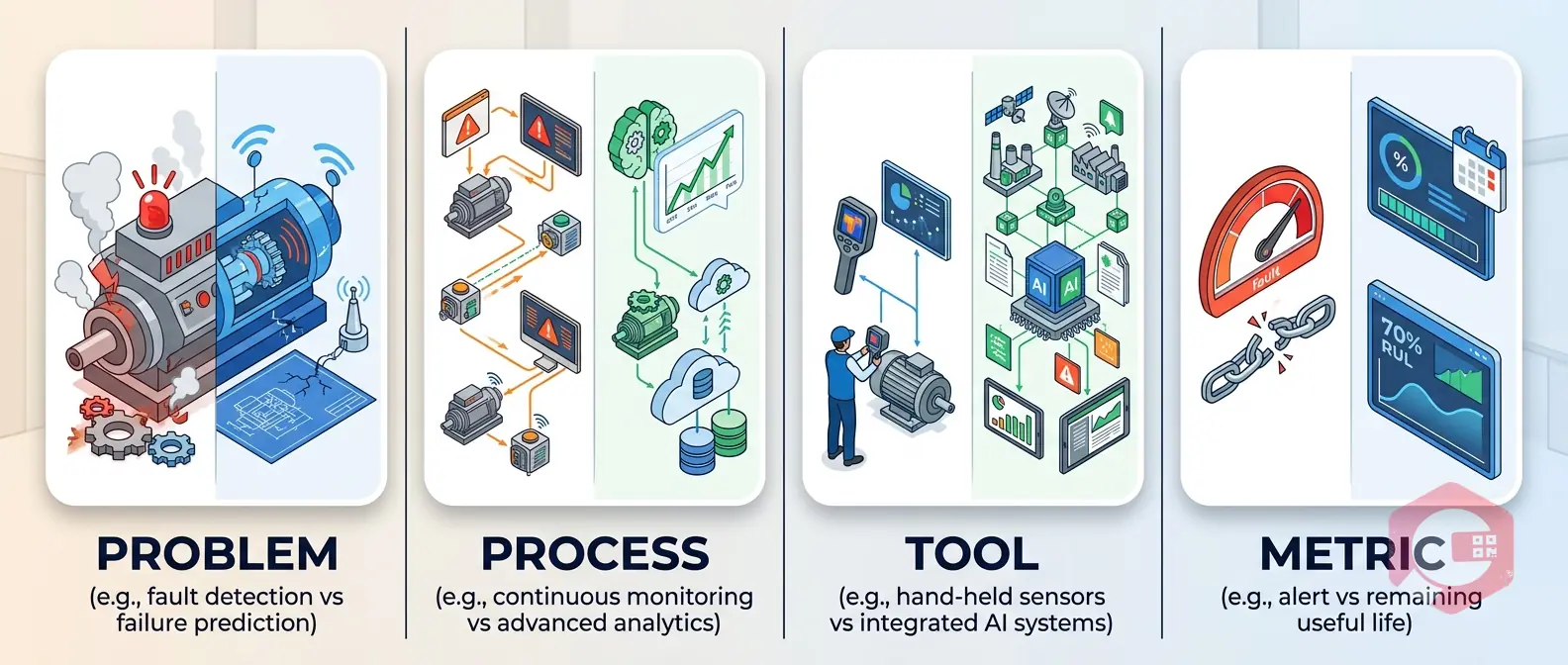
Here's how the two strategies stack up across eight practical dimensions:
| Dimension | Condition-Based Maintenance (CBM) | Predictive Maintenance (PdM) |
|---|---|---|
| Maintenance trigger | Threshold breach (e.g., vibration exceeds 8 mm/s) | Forecasted failure date based on degradation trend |
| Data requirements | Real-time sensor readings; alert thresholds | Historical failure data + continuous monitoring + ML models |
| Lead time | Hours to days after threshold is crossed | Days to weeks before projected failure |
| Implementation cost | Lower - sensors + alert rules + CMMS | Higher - data platform, ML infrastructure, training data |
| Technology complexity | Moderate - IoT sensors, threshold configuration | High - AI/ML models, digital twins, data science expertise |
| Best-fit assets | Assets with clear, measurable failure signals (pumps, motors, compressors) | Critical, high-value assets with rich historical data |
| Best-fit industries | Manufacturing, utilities, oil & gas, food processing | Aviation, large power generation, automotive, advanced manufacturing |
| CMMS integration | Sensor alert ? auto work order creation | Prediction output ? scheduled work order with RUL countdown |

CBM requires sensors, a monitoring platform, and alert thresholds - a straightforward investment most operations teams can scope and budget in weeks. A typical CBM rollout for a 50-asset facility costs $15,000-$80,000 depending on sensor types and CMMS integration.
PdM adds significant cost on top: data science resources, a machine learning platform, and months of baseline data collection before the first useful prediction fires. Enterprise PdM implementations at large facilities routinely run $200,000-$1 million+ in the first two years. The ROI is real - but so is the investment.
CBM can start working from day one. You define thresholds (often from OEM specifications or industry standards like ISO 10816 for vibration), install sensors, and connect alerts to your CMMS. No historical data needed to begin.
PdM needs history. A machine learning model must be trained on real failure events to recognize early warning patterns. For assets that fail infrequently - say, once every 18 months - it can take years to accumulate enough labeled failure data to train a reliable model. This is why many teams start with CBM and graduate to PdM for their highest-criticality assets once they have sufficient data.
This is the most operationally significant difference. A CBM alert fires when a threshold is crossed - meaning the asset is already showing signs of stress. Your maintenance window may be hours or a few days. That's usually enough for straightforward repairs, but not ideal for complex jobs requiring specialized parts or contractor support.
PdM gives you the longer runway. A well-tuned predictive model can flag a bearing failure 2-4 weeks before it happens, giving you time to order parts, schedule downtime during a low-production window, and assemble the right team. For facilities running continuous production, that planning window has direct revenue impact.
CBM works best when the failure mode produces a clear, measurable signal: a pump cavitating shows vibration; an overloaded motor runs hot; a worn gear produces metal particles in oil. Most rotating equipment falls into this category.
PdM excels with complex, multi-mode failure assets where no single sensor threshold captures all failure paths - like jet engines, large gas turbines, or CNC machining centers. It's also the right choice when the cost of a single failure is catastrophic (think: a turbine failure at a power plant) and justifies the investment in advanced analytics.
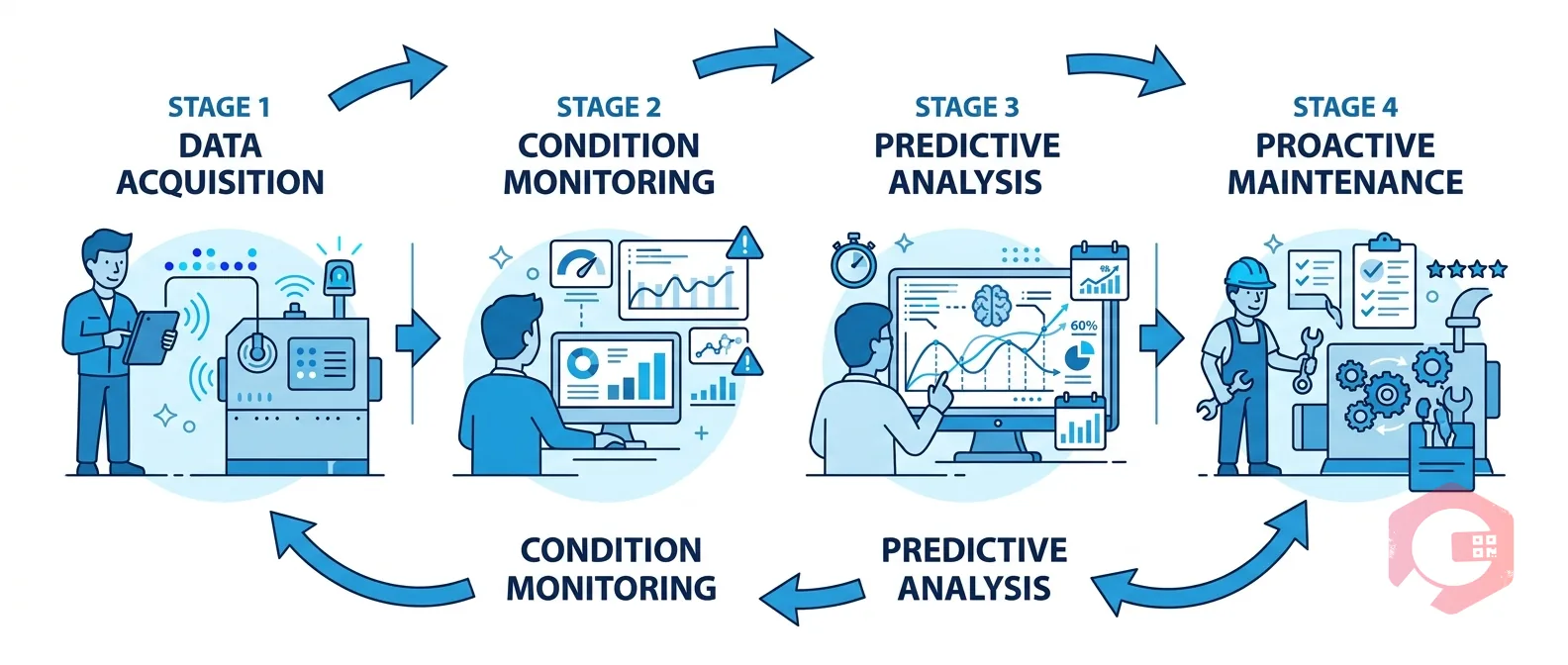
Yes - and most mature maintenance organizations do. The two strategies are complementary, not competing. Think of CBM as your safety net and PdM as your early warning system for critical assets.
A practical hybrid approach looks like this:
This tiered model lets you apply the right level of technology and cost to each asset based on its criticality, failure consequences, and data availability.
If you're choosing between CBM and PdM as a starting point, answer these three questions:
For most operations, CBM is the right starting point. It delivers measurable results quickly, builds the data foundation that PdM needs, and works with the asset management and IoT integration capabilities in modern CMMS platforms.
Ready to get started with CBM? Here's a practical implementation roadmap:
No - they're related but distinct strategies. Condition-based maintenance triggers action when a measured parameter crosses a defined threshold. Predictive maintenance uses historical data and AI to forecast when a failure will occur before any threshold is crossed. Many industry practitioners consider CBM a subset of the broader predictive maintenance category, but operationally they work quite differently and have different data and technology requirements.
Common CBM examples include: replacing a pump bearing when vibration exceeds 7.5 mm/s RMS; changing hydraulic fluid when oil analysis shows contamination above 18/16/13 per ISO 4406; servicing a motor when thermal imaging reveals a winding temperature 15�C above baseline; and inspecting a compressor valve when ultrasonic monitoring detects high-frequency leakage. In each case, the maintenance action is triggered by a measured condition - not a calendar date.
The most common CBM sensors include accelerometers (vibration), thermocouples and infrared cameras (temperature), pressure transducers, current transformers (electrical signature), oil quality sensors, and ultrasonic transducers. The right sensor depends on the asset type and the most likely failure mode. Most modern CBM programs connect these sensors to a central CMMS or IoT platform for real-time monitoring and automated alerts.
CBM stands for Condition-Based Maintenance - a maintenance strategy in which work is performed based on actual equipment condition rather than a fixed time interval or usage schedule. It is also sometimes abbreviated as CbM and is closely related to condition monitoring (CM), which is the process of measuring the parameters that CBM uses to make maintenance decisions.
Neither is universally better - the right choice depends on your assets, data maturity, and budget. CBM is faster to implement, lower cost, and works well for most industrial assets with measurable failure signals. Predictive maintenance delivers longer lead times and lower intervention rates, but requires significant data infrastructure and historical failure records. Most maintenance organizations benefit from using both: PdM for critical high-value assets and CBM as a baseline strategy across the broader asset population.
Managing condition-based and predictive maintenance programs manually is where most teams lose efficiency. Cryotos CMMS connects directly to your IoT sensors and SCADA systems to automatically generate work orders when CBM thresholds are crossed - and integrates with predictive analytics platforms to schedule PdM-triggered maintenance with full asset history and parts availability context. If you're building or scaling a CBM or PdM program, explore how Cryotos supports condition-based maintenance from sensor alert to closed work order.
Condition-based maintenance (CBM) is a strategy where maintenance work is triggered by the actual measured condition of an asset - such as a spike in vibration, a rise in temperature, or degraded oil quality - rather than a fixed schedule. Predictive maintenance (PdM) goes a step further: it uses historical data, AI, and machine learning to forecast when a failure is likely to occur before any threshold is breached. The practical difference is timing - CBM acts when a condition exceeds a limit; PdM acts before it does.
Both approaches reduce unplanned downtime compared to reactive maintenance. Studies from Deloitte's Industry 4.0 research found that predictive maintenance can reduce machine downtime by 30-50% and extend machine life by 20-40%. Condition-based monitoring typically delivers 10-25% downtime reduction at a lower implementation cost - making it the practical starting point for most maintenance teams.
This guide breaks down exactly how CBM and PdM differ, where each performs best, and how to decide which strategy fits your operation.
Condition-based maintenance is a proactive maintenance strategy where work orders are triggered by real-time data from the asset itself. Instead of performing maintenance every 30 days whether the asset needs it or not, you only act when a sensor reading - vibration level, temperature, pressure, or fluid contamination - crosses a pre-set threshold.
CBM was formally defined in ISO 17359 (Condition Monitoring and Diagnostics of Machines) and has been a standard in military and aviation maintenance since the 1960s. Today it's widely used in manufacturing, utilities, oil and gas, and heavy industry.
The CBM process follows a straightforward loop:
This is what separates CBM from time-based preventive maintenance: you're not spending labor and parts on equipment that's running fine. A Plant Engineering survey found that CBM programs reduce unnecessary preventive maintenance tasks by up to 30%, freeing technician hours for higher-priority work.
Different assets call for different monitoring methods. Here are the five most common techniques used in industrial CBM programs:
Predictive maintenance uses historical asset data, statistical models, and increasingly AI and machine learning to forecast when a failure is likely to occur - and schedule maintenance just before that point. Where CBM reacts when a threshold is crossed, PdM projects forward: "Based on this asset's degradation trend, it will fail in approximately 14 days."
PdM requires more data infrastructure than CBM: continuous monitoring feeds, historical failure records, and often a dedicated analytics platform or CMMS software with IoT integration. The payoff is longer lead time before intervention - giving maintenance teams more planning flexibility and avoiding emergency call-outs entirely.
A mature PdM program works like this:
Modern predictive maintenance programs typically combine several technology layers:
According to McKinsey & Company, factories that successfully implement AI-driven predictive maintenance see 10-25% improvements in overall equipment effectiveness (OEE) and 20-30% reductions in maintenance costs.
Here's how the two strategies stack up across eight practical dimensions:
| Dimension | Condition-Based Maintenance (CBM) | Predictive Maintenance (PdM) |
|---|---|---|
| Maintenance trigger | Threshold breach (e.g., vibration exceeds 8 mm/s) | Forecasted failure date based on degradation trend |
| Data requirements | Real-time sensor readings; alert thresholds | Historical failure data + continuous monitoring + ML models |
| Lead time | Hours to days after threshold is crossed | Days to weeks before projected failure |
| Implementation cost | Lower - sensors + alert rules + CMMS | Higher - data platform, ML infrastructure, training data |
| Technology complexity | Moderate - IoT sensors, threshold configuration | High - AI/ML models, digital twins, data science expertise |
| Best-fit assets | Assets with clear, measurable failure signals (pumps, motors, compressors) | Critical, high-value assets with rich historical data |
| Best-fit industries | Manufacturing, utilities, oil & gas, food processing | Aviation, large power generation, automotive, advanced manufacturing |
| CMMS integration | Sensor alert ? auto work order creation | Prediction output ? scheduled work order with RUL countdown |
CBM requires sensors, a monitoring platform, and alert thresholds - a straightforward investment most operations teams can scope and budget in weeks. A typical CBM rollout for a 50-asset facility costs $15,000-$80,000 depending on sensor types and CMMS integration.
PdM adds significant cost on top: data science resources, a machine learning platform, and months of baseline data collection before the first useful prediction fires. Enterprise PdM implementations at large facilities routinely run $200,000-$1 million+ in the first two years. The ROI is real - but so is the investment.
CBM can start working from day one. You define thresholds (often from OEM specifications or industry standards like ISO 10816 for vibration), install sensors, and connect alerts to your CMMS. No historical data needed to begin.
PdM needs history. A machine learning model must be trained on real failure events to recognize early warning patterns. For assets that fail infrequently - say, once every 18 months - it can take years to accumulate enough labeled failure data to train a reliable model. This is why many teams start with CBM and graduate to PdM for their highest-criticality assets once they have sufficient data.
This is the most operationally significant difference. A CBM alert fires when a threshold is crossed - meaning the asset is already showing signs of stress. Your maintenance window may be hours or a few days. That's usually enough for straightforward repairs, but not ideal for complex jobs requiring specialized parts or contractor support.
PdM gives you the longer runway. A well-tuned predictive model can flag a bearing failure 2-4 weeks before it happens, giving you time to order parts, schedule downtime during a low-production window, and assemble the right team. For facilities running continuous production, that planning window has direct revenue impact.
CBM works best when the failure mode produces a clear, measurable signal: a pump cavitating shows vibration; an overloaded motor runs hot; a worn gear produces metal particles in oil. Most rotating equipment falls into this category.
PdM excels with complex, multi-mode failure assets where no single sensor threshold captures all failure paths - like jet engines, large gas turbines, or CNC machining centers. It's also the right choice when the cost of a single failure is catastrophic (think: a turbine failure at a power plant) and justifies the investment in advanced analytics.
Yes - and most mature maintenance organizations do. The two strategies are complementary, not competing. Think of CBM as your safety net and PdM as your early warning system for critical assets.
A practical hybrid approach looks like this:
This tiered model lets you apply the right level of technology and cost to each asset based on its criticality, failure consequences, and data availability.
If you're choosing between CBM and PdM as a starting point, answer these three questions:
For most operations, CBM is the right starting point. It delivers measurable results quickly, builds the data foundation that PdM needs, and works with the asset management and IoT integration capabilities in modern CMMS platforms.
Ready to get started with CBM? Here's a practical implementation roadmap:
No - they're related but distinct strategies. Condition-based maintenance triggers action when a measured parameter crosses a defined threshold. Predictive maintenance uses historical data and AI to forecast when a failure will occur before any threshold is crossed. Many industry practitioners consider CBM a subset of the broader predictive maintenance category, but operationally they work quite differently and have different data and technology requirements.
Common CBM examples include: replacing a pump bearing when vibration exceeds 7.5 mm/s RMS; changing hydraulic fluid when oil analysis shows contamination above 18/16/13 per ISO 4406; servicing a motor when thermal imaging reveals a winding temperature 15�C above baseline; and inspecting a compressor valve when ultrasonic monitoring detects high-frequency leakage. In each case, the maintenance action is triggered by a measured condition - not a calendar date.
The most common CBM sensors include accelerometers (vibration), thermocouples and infrared cameras (temperature), pressure transducers, current transformers (electrical signature), oil quality sensors, and ultrasonic transducers. The right sensor depends on the asset type and the most likely failure mode. Most modern CBM programs connect these sensors to a central CMMS or IoT platform for real-time monitoring and automated alerts.
CBM stands for Condition-Based Maintenance - a maintenance strategy in which work is performed based on actual equipment condition rather than a fixed time interval or usage schedule. It is also sometimes abbreviated as CbM and is closely related to condition monitoring (CM), which is the process of measuring the parameters that CBM uses to make maintenance decisions.
Neither is universally better - the right choice depends on your assets, data maturity, and budget. CBM is faster to implement, lower cost, and works well for most industrial assets with measurable failure signals. Predictive maintenance delivers longer lead times and lower intervention rates, but requires significant data infrastructure and historical failure records. Most maintenance organizations benefit from using both: PdM for critical high-value assets and CBM as a baseline strategy across the broader asset population.
Managing condition-based and predictive maintenance programs manually is where most teams lose efficiency. Cryotos CMMS connects directly to your IoT sensors and SCADA systems to automatically generate work orders when CBM thresholds are crossed - and integrates with predictive analytics platforms to schedule PdM-triggered maintenance with full asset history and parts availability context. If you're building or scaling a CBM or PdM program, explore how Cryotos supports condition-based maintenance from sensor alert to closed work order.


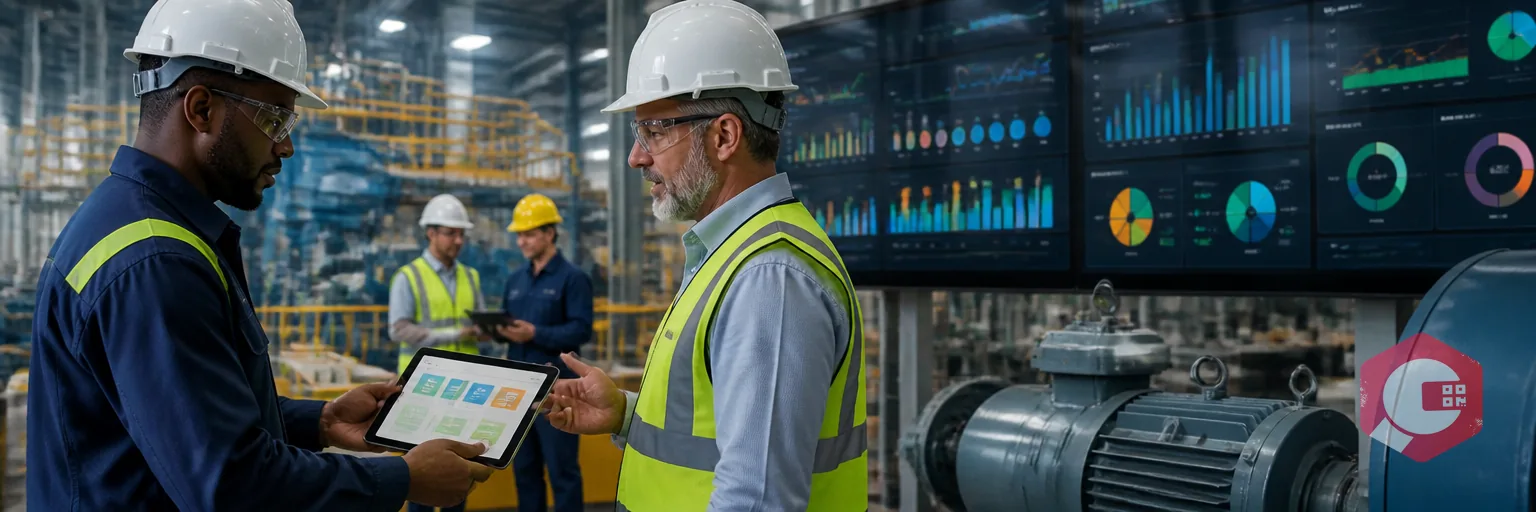

Cryotos AI predicts failures, automates work orders, and simplifies maintenance—before problems slow you down.