
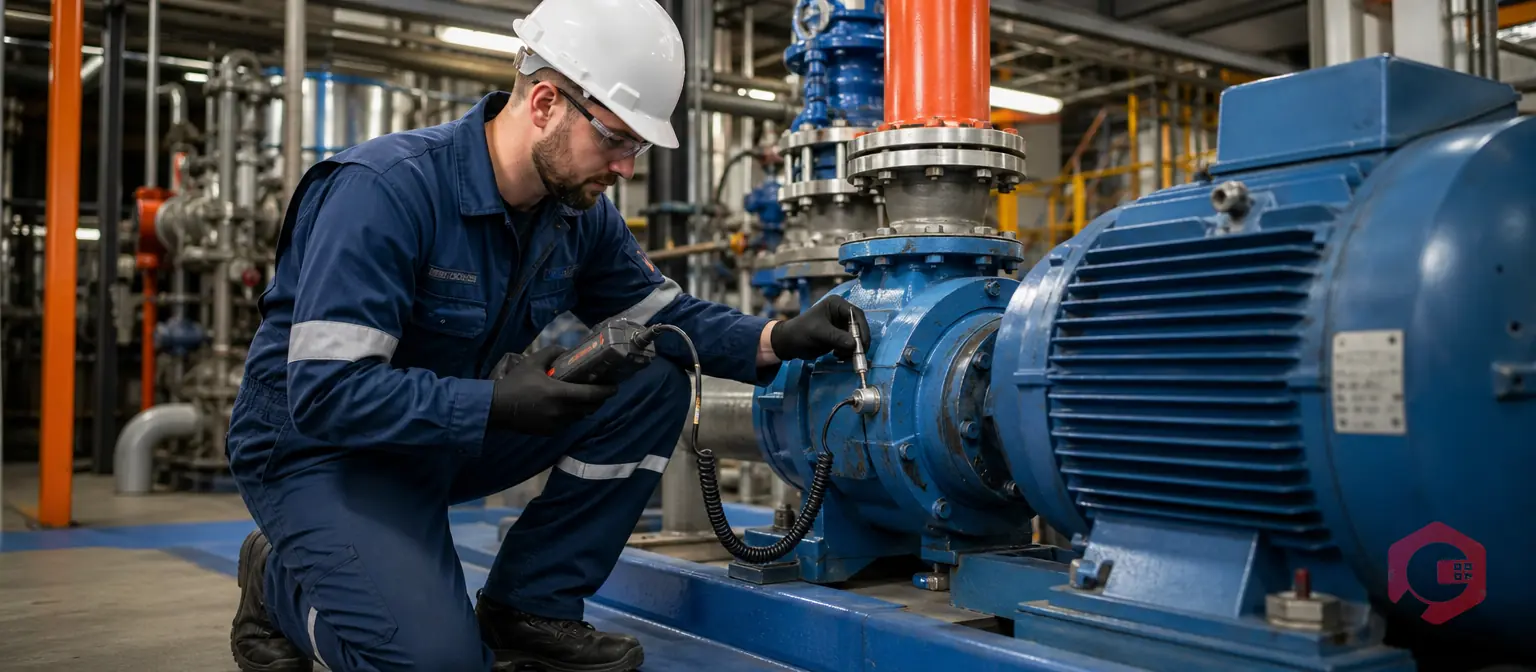
Vibration analysis is the process of measuring and interpreting mechanical vibrations in rotating equipment to detect faults before they cause failure. In predictive maintenance, it's one of the most reliable condition monitoring techniques available, giving maintenance teams early warning on bearing wear, shaft misalignment, imbalance, and looseness weeks or months before a breakdown occurs.
A Reliable Plant study found that predictive maintenance programs using vibration analysis deliver a 10:1 return on investment. These programs also cut machine failures by up to 55%. For plants running rotating machinery around the clock, that's the gap between a planned repair and a costly, unplanned shutdown.
This guide covers four things. First, the role vibration analysis plays in predictive maintenance. Second, the types of vibration and where they occur. Third, real industrial applications. Fourth, a step-by-step process for building your own program.
Key Takeaways
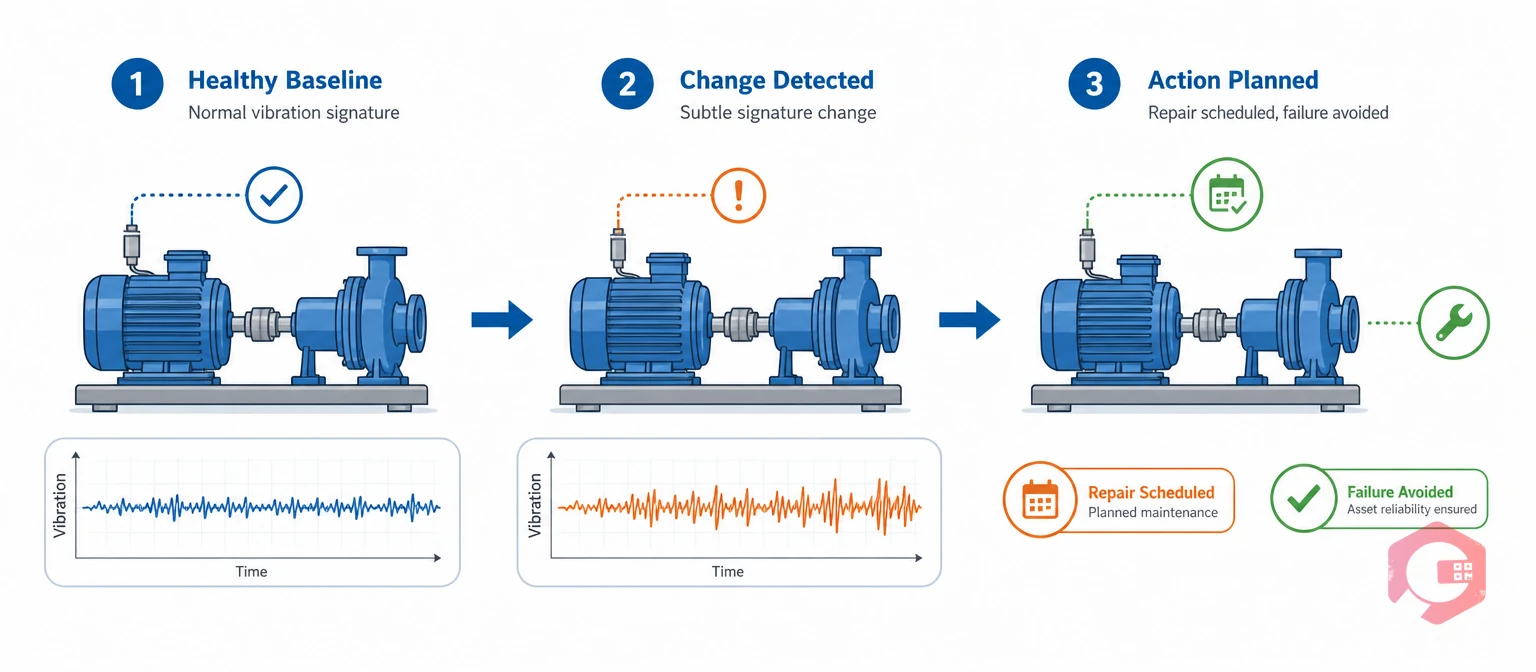
Predictive maintenance (PdM) checks the real condition of equipment. It schedules work only when the data says it's needed. Vibration analysis sits at the heart of this approach. Every rotating machine — motors, pumps, fans, compressors, gearboxes — has its own vibration signature. When parts start to wear out, that signature changes in predictable ways.
By tracking those changes, maintenance teams can:
Vibration analysis is a core part of condition-based monitoring (CBM). Condition-based monitoring means you schedule maintenance based on live equipment data, not a fixed calendar. Other CBM tools like thermography, oil analysis, and ultrasound each add value. But vibration analysis is the most sensitive method for rotating machinery. It catches the widest range of faults and often gives the earliest warning.
You can manage vibration data and the resulting work orders in a Computerized Maintenance Management System (CMMS) like Cryotos. It connects sensor readings to work orders and asset history automatically.
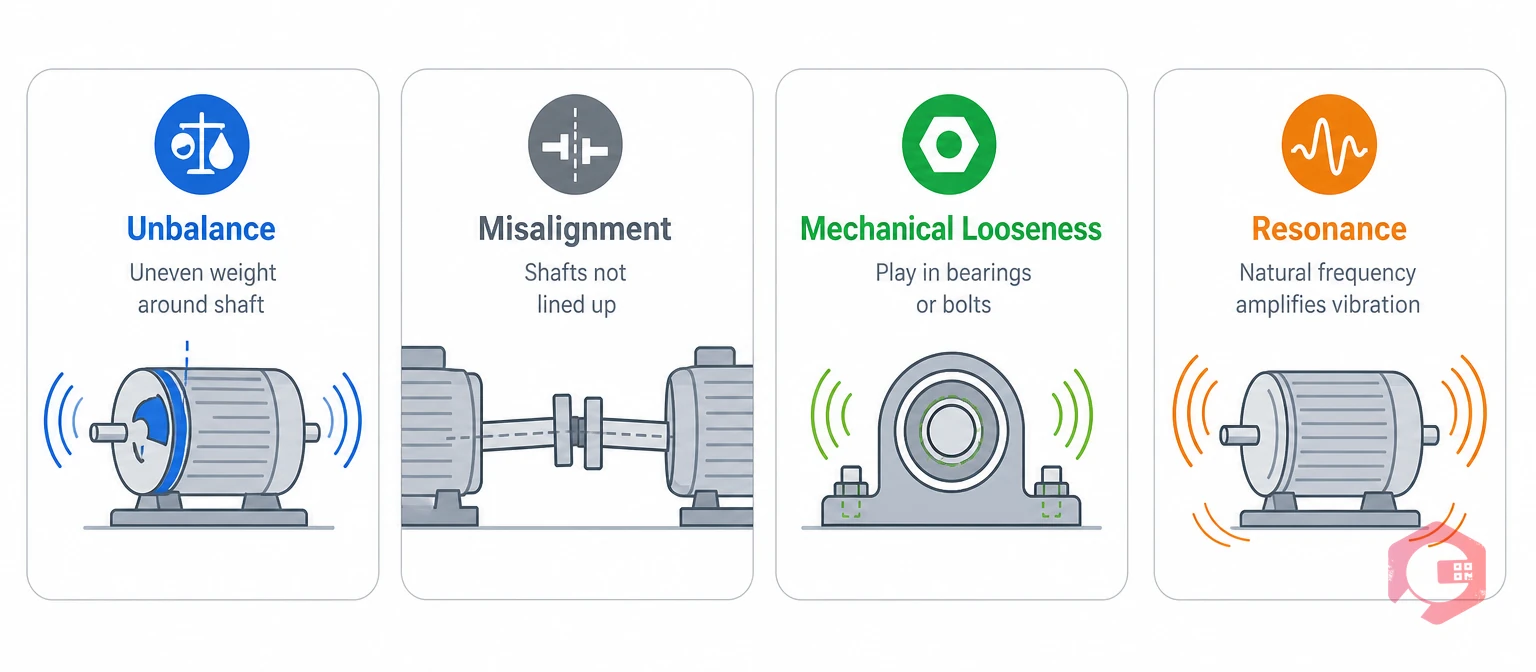
Before you read vibration data, you need to know what you're measuring. Vibration is the oscillation of a mechanical part around a reference point. In industrial equipment, vibration falls into a few main types. Each type points to a different problem.
Every vibration reading has three core parts:
The Vibration Health Triangle: amplitude, frequency, and phase, read together. They show how bad a fault is and what causes it. Read alone, each one leaves gaps. Read together, they give you a clear answer.
Every rotating machine has known vibration measurement points. The most common locations are:
Vibration analysis works on any rotating or reciprocating machine. The method scales from one production line to a whole refinery. The same diagnostic ideas apply across industries.
Plants use vibration analysis on electric motors, conveyor drives, cooling tower fans, hydraulic pumps, and CNC spindles. A stamping plant might track 200+ motors on one route. This flags bearing faults or misalignment before they trip breakers or damage tooling.
A real example: a mid-sized auto parts plant added route-based vibration checks on all main drive motors. Unplanned motor failures dropped 42% in the first year. The program paid for itself in three months through fewer emergency repairs and less scrap.
These industries run compressors, turbines, and pumps at high speed under extreme conditions. One unplanned compressor failure can shut down a whole process unit. Continuous online monitoring with fixed accelerometers is standard here. The ISO 13373 series sets the accepted standard for this kind of monitoring.
Steam turbines, gas turbines, and large generators need constant monitoring. Plants use proximity probes for shaft movement and accelerometers for bearing vibration. This catches imbalance, blade fouling, and bearing wear before they cause a forced outage. Online monitoring with trip protection is standard on any machine critical to grid power.
Pump stations run all day and night with few staff on site. Vibration checks on submersible pumps, centrifugal pumps, and blowers let small teams cover dozens of assets remotely. Cavitation is a common pump problem caused by suction issues. It produces a broadband signal that's easy to spot in a spectrum.
Chillers, cooling towers, air handling units, and large fans are good candidates for vibration checks in commercial buildings. Dirty fan blades and worn motor bearings cause most HVAC downtime. Both show up in vibration data well before failure. Facilities teams using preventive maintenance software can automate reminders and log findings against each asset.
Crushers, ball mills, and conveyor drives run in harsh, dusty conditions under heavy load. Vibration checks help predict fatigue, liner wear, and bearing failure, all of which are costly and risky to fix reactively. Mining Weekly reports that predictive maintenance in mining cuts costs by 25-30% versus a purely reactive approach.
Teams weighing a new program often want to see the numbers on their own assets first. The MTTR calculator is a quick way to estimate what faster fault detection is worth before you invest in sensors.
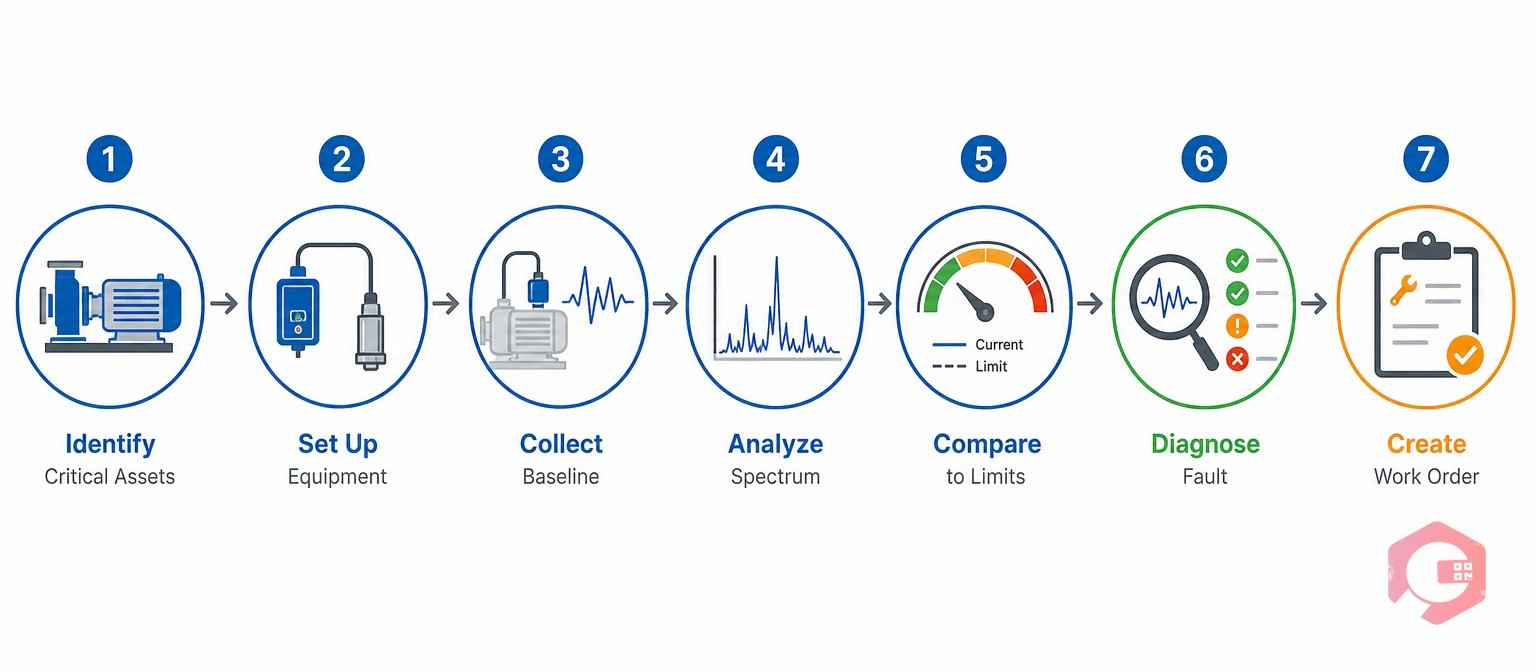
A vibration analysis program sounds technical, but the steps repeat in a fixed order. Here's how to do it, from picking equipment to acting on a diagnosis.
Start by ranking your rotating assets by criticality. Focus on machines where failure would hurt production, safety, or cost the most to replace. For each machine, set:
Mark each point on a machine diagram. Give it a unique ID in your asset management system. Keep measurement spots consistent. Even a small shift in position can throw off your trend data.
The right tool depends on your approach:
Calibrate sensors before use. Check that each machine runs at normal speed, load, and temperature during the reading. Readings taken at startup are not valid baselines.
The first reading you take on a healthy machine sets your baseline. This becomes your reference point going forward. A good baseline should include:
Store all baseline data in your asset history. Most maintenance teams use a CMMS to log readings, attach spectra as files, and link findings to each asset's record.
This is where the real diagnosis happens. Each part of a machine vibrates at its own frequency. That frequency is a multiple of running speed (1x means one times RPM, 2x means two times RPM, and so on):
Most vibration software — SKF @ptitude, Emerson CSI, or Azima DLI, for example — includes a fault frequency calculator. It matches peaks in your spectrum to known fault patterns for your exact bearing and gear setup.
Trending matters as much as the raw number. A machine at 4 mm/s that was at 1 mm/s six months ago is a bigger concern than one that has held steady at 6 mm/s for two years. Set two-tier alarm thresholds:
ISO 10816-3 gives internationally accepted vibration limits by machine class, power rating, and mounting type. Use it as your starting reference point.
Once a machine crosses an alarm limit, a qualified analyst checks the spectrum, waveform, and trend. This confirms the fault type and how bad it is. Common faults and fixes:
Every fault you find should turn into a work order. Include the fault type, severity, fix, and deadline. This is where your CMMS earns its keep. With Cryotos work order management, you can attach the vibration spectrum to the work order, assign it to the right technician, track parts, and close it out with root cause notes. After the repair, take a new reading. This confirms the fix worked and resets the baseline if needed.
Vibration analysis is powerful, but it works best inside a wider condition monitoring program that also uses thermography and other tools. Here's how it stacks up against the other main CBM methods:
Most maintenance teams get the best results by combining two or three of these methods, instead of relying on vibration alone.
Knowing which faults vibration analysis reliably catches helps you decide where to use it and what to look for in your data.
Most of these faults develop slowly, which is exactly why regular measurement — not a one-time check — is what makes a vibration program effective.
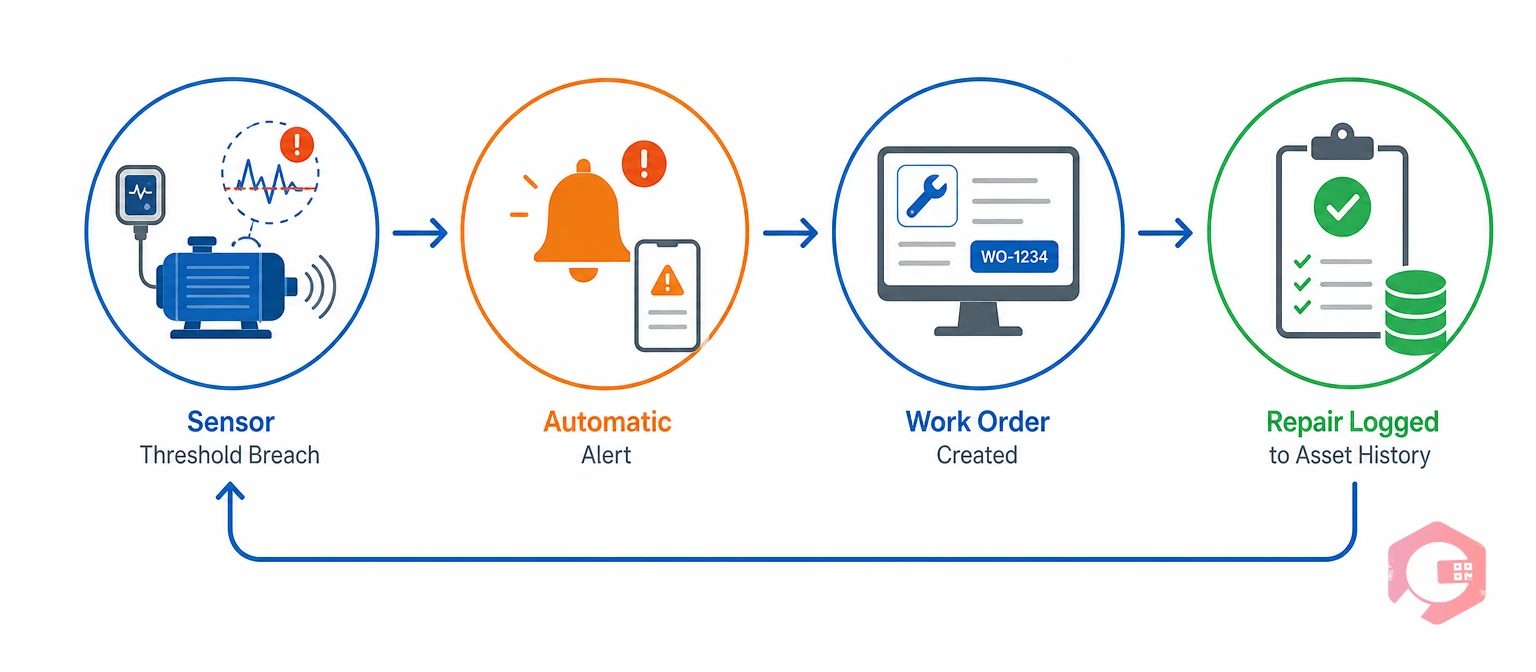
Vibration data is only as good as the action it drives. A reading that flags a bearing fault is useless if it takes three weeks to open a work order and two more to get the part. Linking your condition monitoring program to your CMMS closes that gap.
A good integration looks like this:
Cryotos CMMS supports IoT integration with live sensor data from SCADA, PLC, and edge devices. A threshold alert from a vibration sensor can open a work order on its own, send a WhatsApp or email to a technician, and log the finding in the asset's history. Cryotos users report a 30% reduction in downtime and 25% faster repair times after linking condition data to their maintenance workflow. Learn more about Cryotos downtime tracking.
If you're building or formalizing a vibration analysis program, Cryotos gives you the EAM software backbone. It tracks measurement routes, stores readings, manages repair work orders, and reports on equipment health across your whole facility.
It's the process of measuring vibration from rotating equipment and reading the changes to catch faults early. You compare the current reading — level, spectrum, and waveform — against a known baseline. This lets you plan a fix, instead of reacting to a breakdown.
It depends on how critical the machine is and how fast faults tend to grow. Most non-critical assets only need a monthly check on a walking route. Critical assets — ones whose failure would stop production or create a safety risk — need weekly checks or a fixed sensor running all the time. After any repair, take a new reading right away to set a fresh baseline.
You need a data collector or analyzer, accelerometer sensors, analysis software, and a place to store trend data. Basic portable analyzers from Fluke, SKF, or Emerson cost $3,000 to $15,000. For critical assets, fixed wireless sensors from SKF Enlight, Emerson AMS, or Azima WATCHMAN start around $200-500 per point.
It catches bearing wear, shaft imbalance, shaft misalignment, looseness, gear wear, pump cavitation, motor rotor bar defects, and resonance. It works best above 600 RPM. Below 200 RPM, ultrasound and oil analysis often catch faults earlier.
Overall level is one number — in mm/s or g. It tells you if a machine vibrates more than usual. That's good for a fast check. Frequency spectrum analysis (FFT) splits that vibration into its parts. It shows which component is causing the rise. Overall level is fast but vague. Spectrum analysis names the fault and the part behind it.
Yes, and it should be. Linking vibration analysis to a CMMS means an alarm opens a work order on its own. The reading gets stored in the asset's history. The fix gets tracked and documented. This turns raw sensor data into real maintenance decisions and fewer failures.
Vibration analysis gives you the earliest possible warning on the faults that cause the most unplanned downtime. Schedule a free demo to see how Cryotos turns your vibration readings into scheduled work orders instead of emergency repairs.




Cryotos AI predicts failures, automates work orders, and simplifies maintenance—before problems slow you down.



