
Condition based maintenance (CBM) and predictive maintenance (PdM) are both data-driven strategies that replace costly scheduled overhauls with smarter, condition-triggered action - but they work differently and suit different operational needs. CBM monitors real-time asset parameters (vibration, temperature, pressure) and triggers a work order the moment a threshold is crossed. Predictive maintenance goes a step further, using AI and machine learning to forecast exactly when a failure is likely to occur, so you can act before any threshold is breached.
Maintenance teams that rely purely on time-based schedules waste an estimated 30% of their maintenance budget on unnecessary work, according to a McKinsey analysis of Industry 4.0 adoption. Both CBM and PdM exist to eliminate that waste - but picking the wrong one for your assets can leave you over-investing in sensor infrastructure or reacting too late to stop failures. This guide breaks down exactly how each strategy works, where they differ, and how to choose the right approach using a practical 4-factor decision framework.
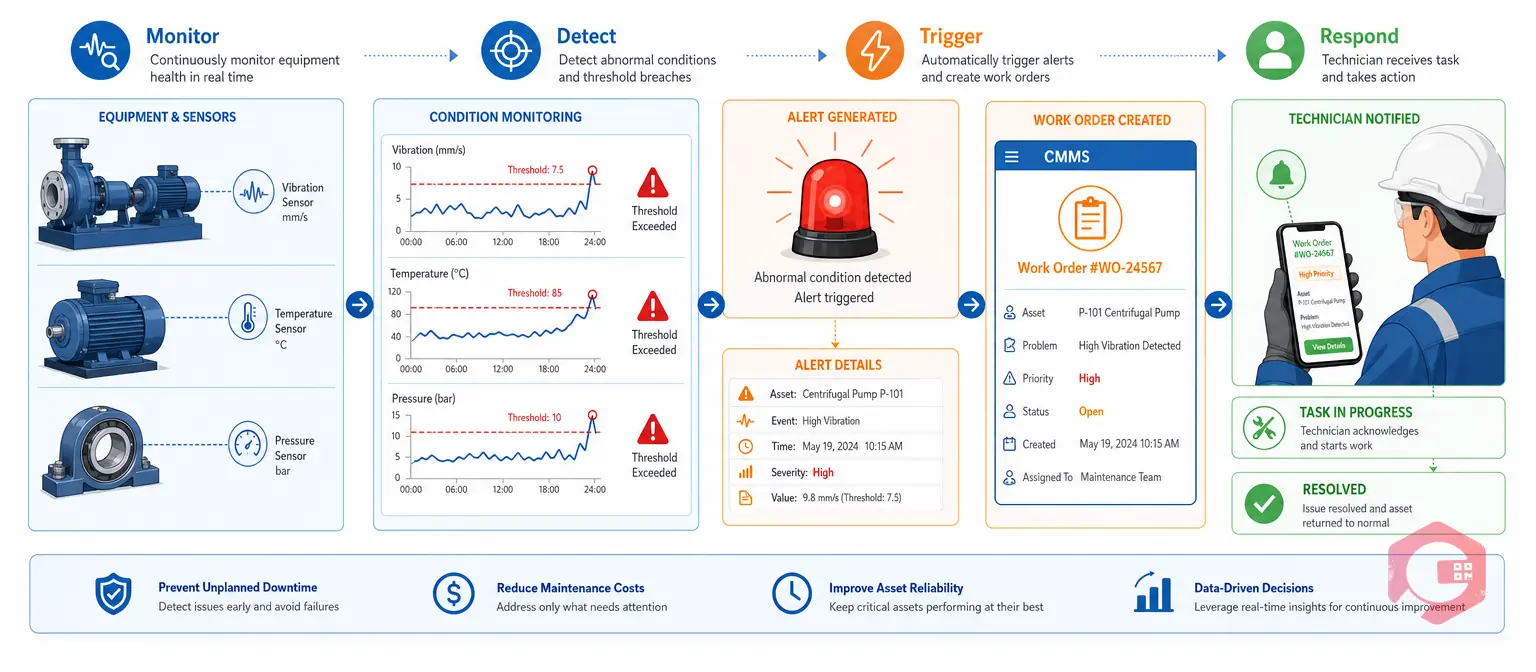
Condition based maintenance is a proactive maintenance strategy in which maintenance tasks are triggered by the actual condition of an asset, not by a fixed calendar schedule. Instead of replacing a bearing every 90 days whether it needs it or not, CBM monitors real-time parameters - vibration levels, oil viscosity, temperature, pressure - and initiates a work order only when those parameters exceed defined thresholds.
The result is a maintenance program that responds to reality rather than assumptions. Assets in good condition keep running. Assets showing early warning signs get serviced before they fail. This approach is part of a broader preventive maintenance strategy, sitting between time-based maintenance (do it on a schedule) and predictive maintenance (forecast when it will fail).
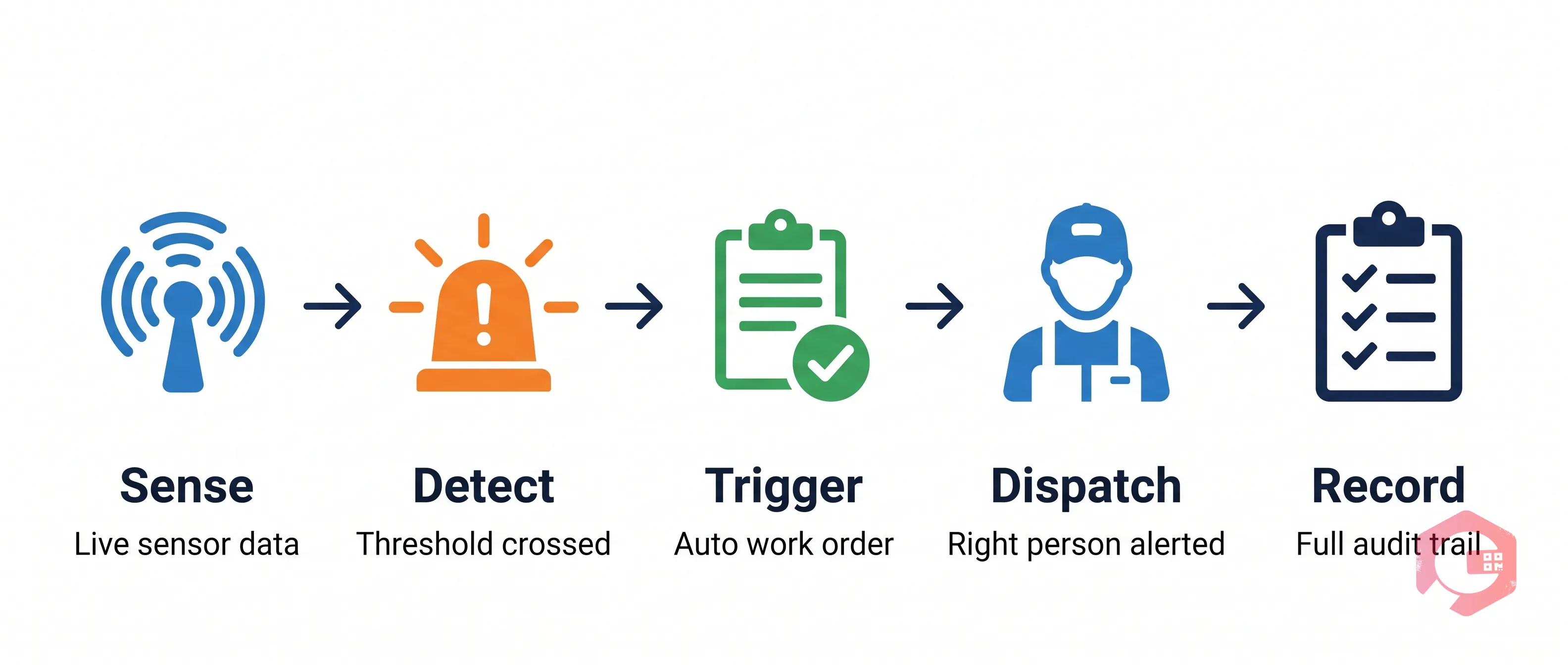
A condition based maintenance workflow follows four steps from sensor signal to resolved work order:
This trigger-to-work-order workflow is what makes CBM operationally powerful. It removes manual judgment from the alert-to-action chain, cuts response time, and creates a complete audit trail for each asset event.
CBM relies on one or more of these monitoring technologies, chosen based on asset type and failure mode:
Predictive maintenance is an advanced condition-based strategy that uses artificial intelligence, machine learning, and historical failure data to predict when an asset is likely to fail - before any threshold is crossed. Rather than reacting to an alert, PdM forecasts a remaining useful life (RUL) and schedules intervention at the optimal time: late enough to avoid unnecessary maintenance, early enough to prevent failure.
Where CBM asks "Is this asset failing right now?" - PdM asks "When will this asset fail?" That time horizon is the core distinction between the two strategies. Deloitte research on Industry 4.0 found that predictive maintenance can reduce equipment breakdowns by up to 70% and cut maintenance costs by 25% - but only when the underlying data infrastructure and analytical models are mature enough to generate reliable forecasts.
A PdM system layers AI and analytics on top of the same sensor data a CBM system collects, but processes it differently:
Beyond sensors, PdM systems typically integrate several advanced tools that CBM programs do not require:
Both strategies use real-time data from assets, but they differ significantly in how they process that data, what actions they trigger, and what infrastructure they require. Here is how they compare across the dimensions that matter most for maintenance planning:

Most maintenance teams do not need to choose one strategy and apply it universally. The right approach is to match the strategy to the asset based on four factors. Work through this framework for each major asset class in your facility:
Ask: What does an unplanned failure of this asset cost - in lost production, safety risk, and repair expense? For assets where a single failure costs over $50,000 in downtime or creates a safety hazard, PdM's ability to provide advance warning weeks before failure is worth the higher investment. For assets where failures are recoverable in hours and cause limited production impact, CBM's real-time threshold monitoring is sufficient and far less expensive to operate.
A practical cut-off: assets with an OEE impact above 5% per failure event typically justify PdM. Below that, CBM delivers the right balance of protection and cost.
PdM models need data to learn from. If an asset has less than 12 months of sensor history and fewer than 5-10 documented failure events, a machine learning model cannot be trained reliably - and the forecasts it produces will be inaccurate. In this situation, CBM is the correct choice. Deploy sensors, collect condition data, and run CBM threshold monitoring for 12-18 months. Once you have a meaningful failure dataset, you can graduate that asset to PdM.
CBM is often the foundation that makes PdM possible - not an alternative to it.
PdM has a longer return horizon. Between platform licensing, sensor upgrades, model tuning, and the data maturation period, most organizations do not see positive ROI from PdM for 18-36 months after deployment. CBM delivers returns faster - typically within 6-12 months - because it requires less infrastructure and the trigger logic is straightforward to configure.
If your maintenance budget is constrained or you are building the business case for a larger asset management program, start with CBM across your asset base. Use the documented downtime savings to fund PdM expansion on your highest-criticality assets.
Equipment type is often the deciding factor. Rotating equipment - pumps, motors, fans, gearboxes, compressors - tends to exhibit gradual, detectable degradation through vibration and temperature changes. This makes both CBM and PdM viable, with PdM delivering greater lead time on complex failures. Static equipment - pressure vessels, pipelines, structural components - degrades through corrosion, fatigue cracking, and stress that is harder to detect with simple threshold monitoring. For static equipment, acoustic emission monitoring and periodic inspection-based CBM are more practical than continuous PdM.
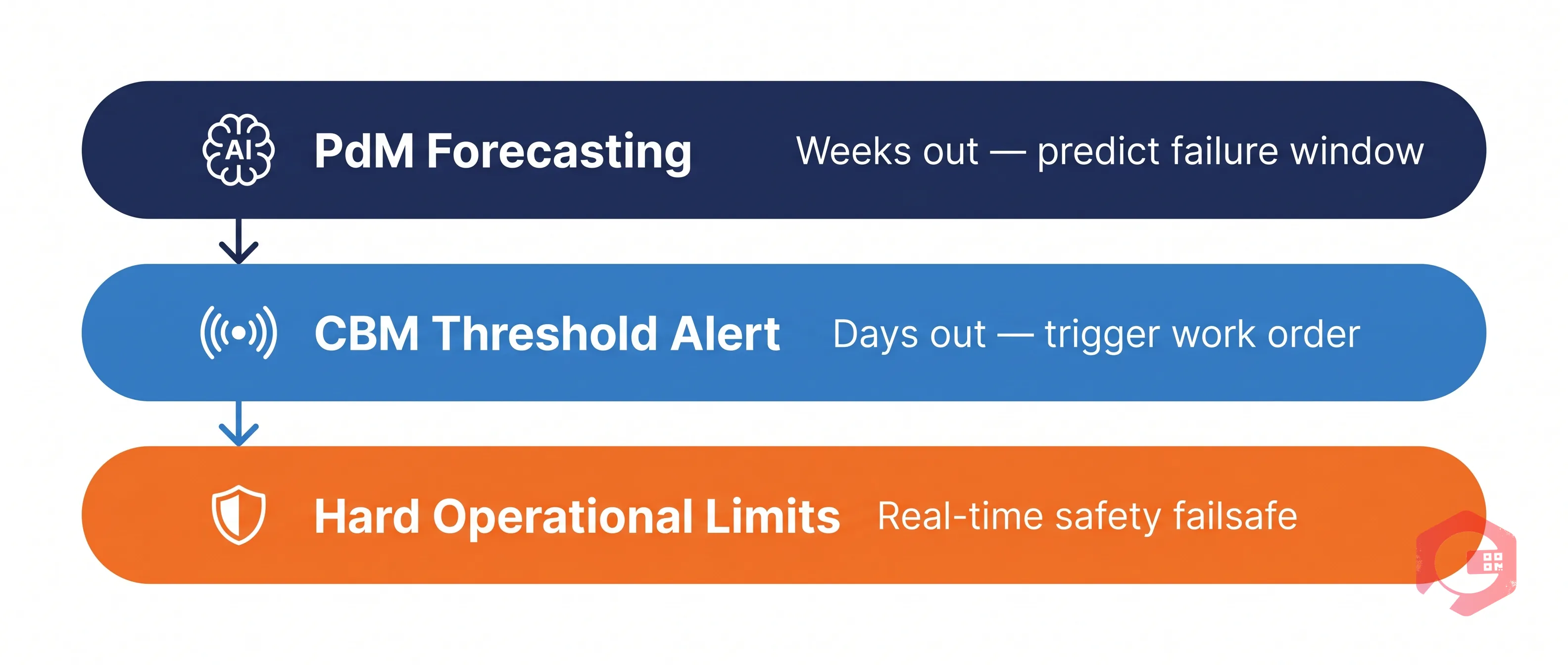
Yes - and in mature maintenance programs, using both in parallel is standard practice. A hybrid CBM + PdM strategy assigns each monitoring layer a different role in the same asset protection chain.
Here is how the layers work together in a real manufacturing environment:
This layered approach means your highest-criticality assets always have three lines of defense: a predictive forecast, a condition-based safety net, and a hard operational limit. According to Plant Engineering research, facilities running layered CBM and PdM programs report 40-50% lower unplanned downtime than those running either strategy alone.
A food and beverage manufacturer runs 47 centrifugal pumps across three production lines. Each pump carries a wireless vibration sensor configured to alert when overall vibration exceeds 6.5 mm/s (ISO 10816 Zone C boundary for machinery in this class). When a pump's weekly average crosses 5.5 mm/s - the early warning threshold - a lower-priority inspection work order is automatically created in the CMMS. When it crosses 6.5 mm/s, a high-priority work order triggers with same-shift response required.
Before implementing this CBM workflow, the facility averaged 2.4 pump failures per quarter that caused line stoppages. In the 12 months after deployment, that number dropped to 0.3 - a reduction in pump-related line downtime of over 85%. Total downtime tracking data showed the investment paid back in 8 months.
A commercial real estate operator managing 12 large office buildings deployed a PdM program on 180 HVAC units across its portfolio. Each unit was equipped with temperature, pressure, and electrical current sensors feeding data to a cloud-based ML platform. After 14 months of baseline data collection, the AI model began generating 21-day failure forecasts with an average accuracy of 87%.
In the first year of active PdM operation, the operator eliminated all 23 emergency HVAC failures that had occurred the previous year (average cost: $8,400 per event including tenant compensation). Planned replacement work, scheduled during off-hours using PdM forecasts, cost 34% less per intervention than the prior year's reactive repairs - a saving of over $190,000 in total maintenance spend.

The monitoring system - whether CBM sensors or PdM analytics - is only half the equation. The other half is what happens when an alert fires. Without a CMMS platform to translate condition data into structured maintenance work, alerts get lost in email inboxes, maintenance planners manually copy data between systems, and response times suffer.
A modern CMMS designed for condition based workflows handles the full trigger-to-resolution chain automatically:
Teams using Cryotos to manage condition based maintenance workflows have reported a 30% reduction in unplanned downtime and 25% faster mean time to repair - because the work order reaches the right person with the right information before the asset fails, not after.
No - they are related but distinct strategies. Condition based maintenance (CBM) reacts to current asset condition: it triggers a work order when a measured parameter exceeds a defined threshold. Predictive maintenance uses AI and historical data to forecast when a failure will occur in the future, allowing intervention before any threshold is reached. CBM is a subset of condition-monitoring strategies; PdM is an advanced evolution that adds forecasting capability on top of the same sensor infrastructure.
A CBM work order is triggered when a monitored asset parameter - such as vibration amplitude, temperature, oil viscosity, or pressure - crosses a pre-set threshold or alert level. The trigger is automatic: the monitoring system or CMMS generates the work order in real time when the condition is detected, without requiring manual input. In advanced CBM setups, compound conditions can be used - for example, triggering only when both vibration AND temperature exceed their respective thresholds simultaneously.
The main limitation of CBM is that it reacts to conditions that already exist rather than forecasting them in advance. This means your response window is short - often hours or days - once an alert fires. CBM also requires careful threshold calibration: set thresholds too high and you miss early faults; set them too low and you generate false alarms that erode technician trust. For highly critical assets, this reactive nature makes CBM insufficient on its own, which is why many facilities layer PdM forecasting on top of CBM alert monitoring.
CBM delivers the highest ROI in industries with continuous-process equipment where any unplanned stoppage is costly: manufacturing (rotating equipment, hydraulics, compressed air), utilities (pumps, motors, transformers), oil and gas (pipeline integrity, compressor health), and facilities management (HVAC, chillers, elevators). ISO 13374 - the international standard for condition monitoring data processing - is widely referenced in these sectors as the framework for CBM system design and data communication.
A basic CBM program - sensor deployment, threshold configuration, and CMMS integration - can be operational in 4-12 weeks depending on the number of assets and the complexity of the monitoring setup. Full program maturity, including threshold calibration refined from real operational data, typically takes 3-6 months. Predictive maintenance has a longer timeline: reliable AI models require 12-18 months of baseline data before forecasts are accurate enough to trust for maintenance scheduling decisions.
Condition based maintenance and predictive maintenance are not competing strategies - they are complementary layers of asset protection that your maintenance program can deploy together or in sequence. CBM is the right starting point for most teams: it is faster to implement, lower in cost, and delivers measurable downtime reduction within months. Predictive maintenance is the logical next step for your highest-criticality assets, once you have the sensor data history and analytical infrastructure to make AI forecasting reliable.
The single factor that determines how well either strategy works is the quality of your work order response once an alert fires. That is where a purpose-built CMMS transforms a monitoring system into a real maintenance improvement program. Cryotos CMMS integrates directly with IoT sensors and condition monitoring platforms, automating the trigger-to-work-order workflow so your team responds to every CBM alert with the right information, the right parts, and the right priority - every time. Book a free Cryotos demo and see how condition based maintenance workflows work in practice.


Condition based maintenance (CBM) and predictive maintenance (PdM) are both data-driven strategies that replace costly scheduled overhauls with smarter, condition-triggered action - but they work differently and suit different operational needs. CBM monitors real-time asset parameters (vibration, temperature, pressure) and triggers a work order the moment a threshold is crossed. Predictive maintenance goes a step further, using AI and machine learning to forecast exactly when a failure is likely to occur, so you can act before any threshold is breached.
Maintenance teams that rely purely on time-based schedules waste an estimated 30% of their maintenance budget on unnecessary work, according to a McKinsey analysis of Industry 4.0 adoption. Both CBM and PdM exist to eliminate that waste - but picking the wrong one for your assets can leave you over-investing in sensor infrastructure or reacting too late to stop failures. This guide breaks down exactly how each strategy works, where they differ, and how to choose the right approach using a practical 4-factor decision framework.
Condition based maintenance is a proactive maintenance strategy in which maintenance tasks are triggered by the actual condition of an asset, not by a fixed calendar schedule. Instead of replacing a bearing every 90 days whether it needs it or not, CBM monitors real-time parameters - vibration levels, oil viscosity, temperature, pressure - and initiates a work order only when those parameters exceed defined thresholds.
The result is a maintenance program that responds to reality rather than assumptions. Assets in good condition keep running. Assets showing early warning signs get serviced before they fail. This approach is part of a broader preventive maintenance strategy, sitting between time-based maintenance (do it on a schedule) and predictive maintenance (forecast when it will fail).
A condition based maintenance workflow follows four steps from sensor signal to resolved work order:
This trigger-to-work-order workflow is what makes CBM operationally powerful. It removes manual judgment from the alert-to-action chain, cuts response time, and creates a complete audit trail for each asset event.
CBM relies on one or more of these monitoring technologies, chosen based on asset type and failure mode:
Predictive maintenance is an advanced condition-based strategy that uses artificial intelligence, machine learning, and historical failure data to predict when an asset is likely to fail - before any threshold is crossed. Rather than reacting to an alert, PdM forecasts a remaining useful life (RUL) and schedules intervention at the optimal time: late enough to avoid unnecessary maintenance, early enough to prevent failure.
Where CBM asks "Is this asset failing right now?" - PdM asks "When will this asset fail?" That time horizon is the core distinction between the two strategies. Deloitte research on Industry 4.0 found that predictive maintenance can reduce equipment breakdowns by up to 70% and cut maintenance costs by 25% - but only when the underlying data infrastructure and analytical models are mature enough to generate reliable forecasts.
A PdM system layers AI and analytics on top of the same sensor data a CBM system collects, but processes it differently:
Beyond sensors, PdM systems typically integrate several advanced tools that CBM programs do not require:
Both strategies use real-time data from assets, but they differ significantly in how they process that data, what actions they trigger, and what infrastructure they require. Here is how they compare across the dimensions that matter most for maintenance planning:

Most maintenance teams do not need to choose one strategy and apply it universally. The right approach is to match the strategy to the asset based on four factors. Work through this framework for each major asset class in your facility:
Ask: What does an unplanned failure of this asset cost - in lost production, safety risk, and repair expense? For assets where a single failure costs over $50,000 in downtime or creates a safety hazard, PdM's ability to provide advance warning weeks before failure is worth the higher investment. For assets where failures are recoverable in hours and cause limited production impact, CBM's real-time threshold monitoring is sufficient and far less expensive to operate.
A practical cut-off: assets with an OEE impact above 5% per failure event typically justify PdM. Below that, CBM delivers the right balance of protection and cost.
PdM models need data to learn from. If an asset has less than 12 months of sensor history and fewer than 5-10 documented failure events, a machine learning model cannot be trained reliably - and the forecasts it produces will be inaccurate. In this situation, CBM is the correct choice. Deploy sensors, collect condition data, and run CBM threshold monitoring for 12-18 months. Once you have a meaningful failure dataset, you can graduate that asset to PdM.
CBM is often the foundation that makes PdM possible - not an alternative to it.
PdM has a longer return horizon. Between platform licensing, sensor upgrades, model tuning, and the data maturation period, most organizations do not see positive ROI from PdM for 18-36 months after deployment. CBM delivers returns faster - typically within 6-12 months - because it requires less infrastructure and the trigger logic is straightforward to configure.
If your maintenance budget is constrained or you are building the business case for a larger asset management program, start with CBM across your asset base. Use the documented downtime savings to fund PdM expansion on your highest-criticality assets.
Equipment type is often the deciding factor. Rotating equipment - pumps, motors, fans, gearboxes, compressors - tends to exhibit gradual, detectable degradation through vibration and temperature changes. This makes both CBM and PdM viable, with PdM delivering greater lead time on complex failures. Static equipment - pressure vessels, pipelines, structural components - degrades through corrosion, fatigue cracking, and stress that is harder to detect with simple threshold monitoring. For static equipment, acoustic emission monitoring and periodic inspection-based CBM are more practical than continuous PdM.

Yes - and in mature maintenance programs, using both in parallel is standard practice. A hybrid CBM + PdM strategy assigns each monitoring layer a different role in the same asset protection chain.
Here is how the layers work together in a real manufacturing environment:
This layered approach means your highest-criticality assets always have three lines of defense: a predictive forecast, a condition-based safety net, and a hard operational limit. According to Plant Engineering research, facilities running layered CBM and PdM programs report 40-50% lower unplanned downtime than those running either strategy alone.

A food and beverage manufacturer runs 47 centrifugal pumps across three production lines. Each pump carries a wireless vibration sensor configured to alert when overall vibration exceeds 6.5 mm/s (ISO 10816 Zone C boundary for machinery in this class). When a pump's weekly average crosses 5.5 mm/s - the early warning threshold - a lower-priority inspection work order is automatically created in the CMMS. When it crosses 6.5 mm/s, a high-priority work order triggers with same-shift response required.
Before implementing this CBM workflow, the facility averaged 2.4 pump failures per quarter that caused line stoppages. In the 12 months after deployment, that number dropped to 0.3 - a reduction in pump-related line downtime of over 85%. Total downtime tracking data showed the investment paid back in 8 months.
A commercial real estate operator managing 12 large office buildings deployed a PdM program on 180 HVAC units across its portfolio. Each unit was equipped with temperature, pressure, and electrical current sensors feeding data to a cloud-based ML platform. After 14 months of baseline data collection, the AI model began generating 21-day failure forecasts with an average accuracy of 87%.
In the first year of active PdM operation, the operator eliminated all 23 emergency HVAC failures that had occurred the previous year (average cost: $8,400 per event including tenant compensation). Planned replacement work, scheduled during off-hours using PdM forecasts, cost 34% less per intervention than the prior year's reactive repairs - a saving of over $190,000 in total maintenance spend.

The monitoring system - whether CBM sensors or PdM analytics - is only half the equation. The other half is what happens when an alert fires. Without a CMMS platform to translate condition data into structured maintenance work, alerts get lost in email inboxes, maintenance planners manually copy data between systems, and response times suffer.
A modern CMMS designed for condition based workflows handles the full trigger-to-resolution chain automatically:
Teams using Cryotos to manage condition based maintenance workflows have reported a 30% reduction in unplanned downtime and 25% faster mean time to repair - because the work order reaches the right person with the right information before the asset fails, not after.
No - they are related but distinct strategies. Condition based maintenance (CBM) reacts to current asset condition: it triggers a work order when a measured parameter exceeds a defined threshold. Predictive maintenance uses AI and historical data to forecast when a failure will occur in the future, allowing intervention before any threshold is reached. CBM is a subset of condition-monitoring strategies; PdM is an advanced evolution that adds forecasting capability on top of the same sensor infrastructure.
A CBM work order is triggered when a monitored asset parameter - such as vibration amplitude, temperature, oil viscosity, or pressure - crosses a pre-set threshold or alert level. The trigger is automatic: the monitoring system or CMMS generates the work order in real time when the condition is detected, without requiring manual input. In advanced CBM setups, compound conditions can be used - for example, triggering only when both vibration AND temperature exceed their respective thresholds simultaneously.
The main limitation of CBM is that it reacts to conditions that already exist rather than forecasting them in advance. This means your response window is short - often hours or days - once an alert fires. CBM also requires careful threshold calibration: set thresholds too high and you miss early faults; set them too low and you generate false alarms that erode technician trust. For highly critical assets, this reactive nature makes CBM insufficient on its own, which is why many facilities layer PdM forecasting on top of CBM alert monitoring.
CBM delivers the highest ROI in industries with continuous-process equipment where any unplanned stoppage is costly: manufacturing (rotating equipment, hydraulics, compressed air), utilities (pumps, motors, transformers), oil and gas (pipeline integrity, compressor health), and facilities management (HVAC, chillers, elevators). ISO 13374 - the international standard for condition monitoring data processing - is widely referenced in these sectors as the framework for CBM system design and data communication.
A basic CBM program - sensor deployment, threshold configuration, and CMMS integration - can be operational in 4-12 weeks depending on the number of assets and the complexity of the monitoring setup. Full program maturity, including threshold calibration refined from real operational data, typically takes 3-6 months. Predictive maintenance has a longer timeline: reliable AI models require 12-18 months of baseline data before forecasts are accurate enough to trust for maintenance scheduling decisions.
Condition based maintenance and predictive maintenance are not competing strategies - they are complementary layers of asset protection that your maintenance program can deploy together or in sequence. CBM is the right starting point for most teams: it is faster to implement, lower in cost, and delivers measurable downtime reduction within months. Predictive maintenance is the logical next step for your highest-criticality assets, once you have the sensor data history and analytical infrastructure to make AI forecasting reliable.
The single factor that determines how well either strategy works is the quality of your work order response once an alert fires. That is where a purpose-built CMMS transforms a monitoring system into a real maintenance improvement program. Cryotos CMMS integrates directly with IoT sensors and condition monitoring platforms, automating the trigger-to-work-order workflow so your team responds to every CBM alert with the right information, the right parts, and the right priority - every time. Book a free Cryotos demo and see how condition based maintenance workflows work in practice.
Cryotos AI predicts failures, automates work orders, and simplifies maintenance—before problems slow you down.

