Fleet Maintenance Best Practices: A Complete Guide for Fleet Managers

Article Written by:

Created On:

April 10, 2026

Fleet Maintenance Best Practices: A Complete Guide

Fleet maintenance best practices are the structured routines, policies, and systems that keep a fleet of vehicles safe, reliable, and cost-efficient. When applied consistently, they shift your operation from reacting to breakdowns to preventing them - reducing unplanned downtime, extending vehicle life, and protecting your drivers. According to the Federal Motor Carrier Safety Administration (FMCSA), a single truck breakdown can cost a fleet between $448 and $760 per hour in lost productivity. The good news: most of those breakdowns are preventable with the right practices in place.

What Are Fleet Maintenance Best Practices?

Fleet maintenance best practices are the proven methods fleet managers use to plan, schedule, and execute vehicle servicing in a way that maximizes uptime and minimizes cost. They cover everything from setting inspection schedules and tracking repair history to using software to automate reminders and monitor vehicle health in real time.

Following these practices consistently is what separates high-performing fleets from those constantly fighting fires.

Fleet Maintenance vs. Fleet Maintenance Management

Fleet maintenance refers to the hands-on work: oil changes, brake inspections, tire rotations, and repairs that keep vehicles roadworthy. Fleet maintenance management is the strategic layer above that - planning service intervals, controlling costs, assigning technicians, and tracking performance across the entire fleet. You need both. Maintenance without management leads to missed services and surprise breakdowns. Management without execution leads to plans that never get done.

Why Fleet Maintenance Best Practices Matter

The financial case for structured fleet maintenance is straightforward. Fleets that run a proper preventive maintenance program spend 25-35% less per year on repairs than those using a reactive approach, according to Plant Engineering industry benchmarks. That gap widens when you factor in the cost of vehicle downtime, emergency parts sourcing, and overtime labor for rush repairs.

Beyond cost, there are three other reasons fleet maintenance best practices are non-negotiable:

  • Driver safety: A poorly maintained vehicle is a safety liability. Worn brakes, bald tires, and failing lights create accident risk that no organization wants to absorb.
  • Regulatory compliance: DOT regulations require documented inspection and maintenance records. Non-compliance leads to fines, failed audits, and potential operating restrictions.
  • Vehicle lifespan: Regular servicing extends the useful life of your assets. That directly delays capital expenditure on replacements and improves your total cost of ownership (TCO).

Types of Fleet Maintenance

Fleet Maintenance Best Practices — problems grid

Understanding the three types of maintenance helps you design the right strategy for your fleet:

  • Corrective Maintenance: Fixing a vehicle after it breaks down. This is the most expensive approach - emergency parts, rush labor, and full vehicle downtime while repairs are underway. It should be the exception, not the rule.
  • Preventive Maintenance (PM): Scheduled servicing based on time, mileage, or engine hours. Oil changes, tire rotations, brake checks, and fluid inspections fall here. PM is the foundation of an effective fleet maintenance program.
  • Predictive Maintenance: Using real-time sensor data, telematics, and IoT devices to detect failing components before they cause a breakdown. A vehicle's engine temperature or brake pad sensor triggers a work order before the driver even notices an issue.

Most fleets need all three. The goal is to minimize corrective events by maximizing PM discipline and building toward predictive capabilities where the data supports it.
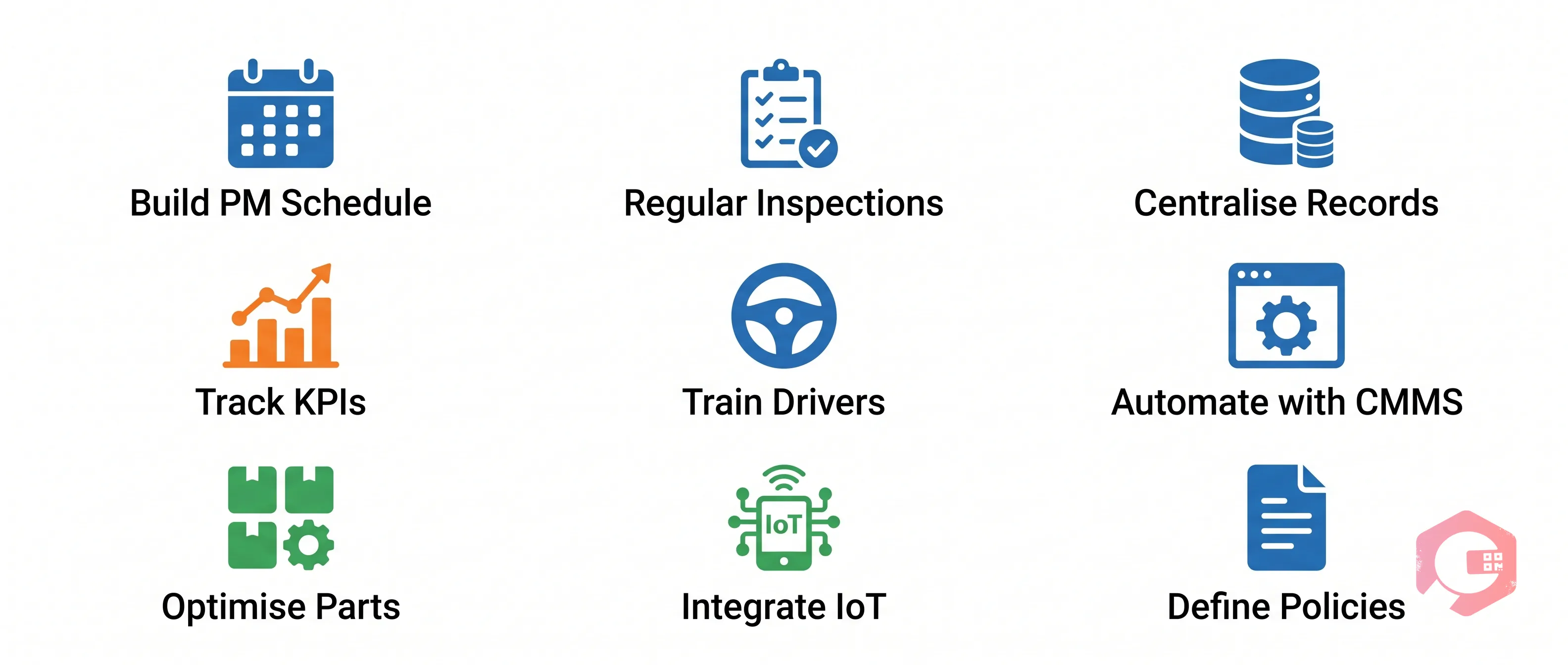
9 Fleet Maintenance Best Practices You Should Follow

Fleet Maintenance Best Practices — scenario

1. Build a Preventive Maintenance Schedule

Your PM schedule is the backbone of your fleet maintenance program. Set service intervals based on OEM recommendations and actual vehicle usage - not just calendar time. A delivery van clocking 400 miles a day needs different intervals than a facilities truck used twice a week.

Use both static PMs (fixed time intervals, e.g., every 90 days) and dynamic PMs (usage-based, e.g., every 5,000 miles) so the schedule reflects real-world wear patterns. Tools like Cryotos preventive maintenance software let you configure both types and send automated alerts before each service is due - so nothing slips through.

2. Conduct Regular Vehicle Inspections

Inspections catch problems before they become failures. Require drivers to complete pre-trip and post-trip inspections using standardized digital forms (eDVIRs). Schedule periodic maintenance inspections every 30, 60, or 90 days depending on usage, and conduct DOT compliance checks for regulated vehicles.

The key is consistency. A missed inspection is an invisible risk. Mobile-based inspection apps allow drivers to submit reports from the cab instantly, triggering work orders the moment an issue is flagged.

3. Centralize Maintenance Records

Every service event, inspection result, repair, warranty claim, and parts replacement should live in one accessible system. Scattered records - paper logs, spreadsheets, email threads - make it impossible to spot recurring faults, support warranty claims, or prove compliance in an audit.

A centralized CMMS platform gives you a complete, searchable service history for every vehicle. When a vehicle repeatedly fails the same component, your data shows it - before that vehicle becomes a liability.

4. Track Fleet KPIs and Downtime Metrics

You cannot manage what you do not measure. Track fleet maintenance performance through a focused set of KPIs:

  • MTTR (Mean Time to Repair): How long it takes to get a vehicle back in service after a breakdown.
  • MTBF (Mean Time Between Failures): How long vehicles run between unplanned breakdowns - a direct measure of PM program effectiveness.
  • Fleet availability %: The proportion of your fleet that is operational and ready to deploy at any given time.
  • PM compliance rate: The percentage of scheduled maintenance tasks completed on time.

Cryotos tracks all these metrics in real time through its downtime tracking module, giving fleet managers drill-down visibility from organization level to individual vehicle.

5. Train and Engage Drivers

Drivers are your first line of defense. Harsh braking, aggressive acceleration, and excessive idling accelerate component wear and increase fuel costs by up to 30%, according to the U.S. Department of Energy. Structured driver training - onboarding programs, refresher sessions, and behavior scorecards - converts this into measurable savings.

Pair training with accountability. Driver scorecards make performance visible and create a culture where safe, vehicle-friendly driving is recognized and rewarded.

6. Use a CMMS to Automate Fleet Maintenance

Managing a fleet manually - through spreadsheets, phone calls, and whiteboards - breaks down at scale. A Computerized Maintenance Management System (CMMS) automates the workflows that keep your fleet running: work order creation, PM scheduling, technician assignment, parts tracking, and reporting.

Cryotos takes this further with AI-driven work order management - generating work orders from voice commands, photo analysis, or sensor alerts. Technicians get mobile notifications, complete jobs on their phones, and close work orders with digital signatures. Fleet managers see everything in real time, with no paperwork required. Fleets using Cryotos report a 30% reduction in downtime and 25% faster repair times.

7. Optimize Your Parts Inventory

A repair that could take two hours takes two days when the right part is not in stock. Effective fleet maintenance requires a well-managed parts inventory - with minimum stock thresholds set for critical components like filters, belts, and brake pads, and automated alerts when levels drop too low.

Track parts usage patterns over time. If three vehicles in your fleet have needed the same water pump in six months, that is a signal - either a quality issue or a PM interval that needs adjusting. Inventory management software gives you this visibility.

8. Integrate IoT and Telematics

Modern fleets generate a continuous stream of vehicle health data through GPS units, engine sensors, and telematics devices. Connecting this data to your maintenance system transforms it from raw readings into actionable alerts - an engine temperature crossing a threshold, a battery voltage drop, or brake pad wear reaching a limit.

Cryotos integrates with IoT sensors, SCADA systems, and PLC devices to pull real-time data directly into the maintenance workflow. When a threshold is breached, the system automatically creates a work order, assigns a technician, and notifies the fleet manager - all before the driver notices anything is wrong. According to a McKinsey analysis, predictive maintenance driven by IoT can reduce maintenance costs by 10-25% and unplanned downtime by 50%.

9. Develop Clear Fleet Policies and Compliance Procedures

Without defined policies, fleet maintenance becomes inconsistent across locations, teams, and vehicles. Document standards for vehicle acquisition, usage rules, inspection protocols, maintenance responsibilities, and end-of-life disposal. Define who can authorize repairs above a certain cost, and what the escalation path looks like when a vehicle needs to be taken off the road.

For regulated environments, build DOT compliance checks, Lockout/Tagout (LOTO) procedures, and Permit to Work workflows directly into your maintenance system so they cannot be skipped.
Fleet Maintenance Checklist

Fleet Maintenance Best Practices — lifecycle

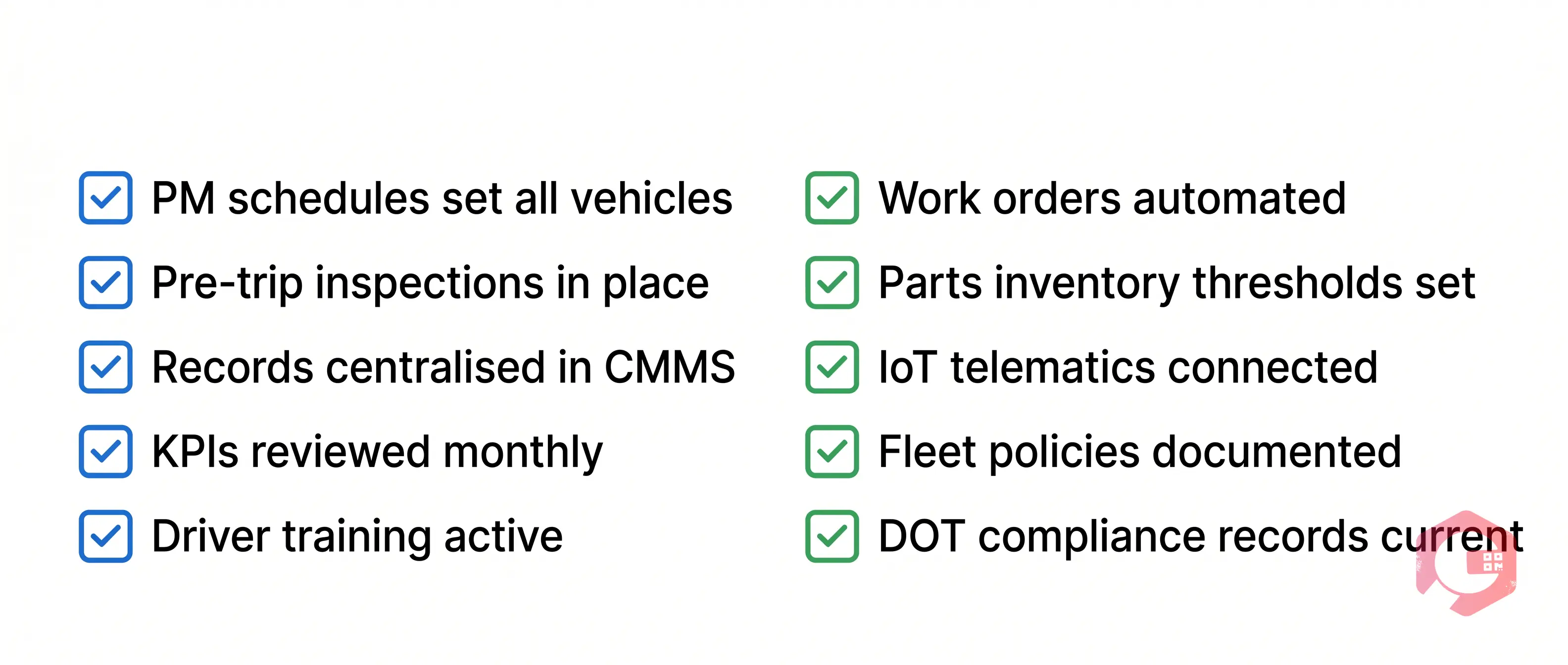
Use this checklist to verify your fleet maintenance program covers the essentials. Run through it quarterly or when onboarding new vehicles:
  • ? PM schedules set for every vehicle (static + dynamic intervals)
  • ? Pre-trip and post-trip inspection process in place for all drivers
  • ? Maintenance records centralized in a CMMS or fleet software
  • ? Fleet KPIs defined and reviewed monthly (MTTR, MTBF, availability %)
  • ? Driver training program active with scorecards and refresher sessions
  • ? Work order workflow automated - no manual paper-based processes
  • ? Parts inventory managed with minimum stock thresholds and alerts
  • ? IoT/telematics data connected to maintenance triggers
  • ? Fleet policies documented and accessible to all drivers and technicians
  • ? DOT compliance records up to date for all regulated vehicles

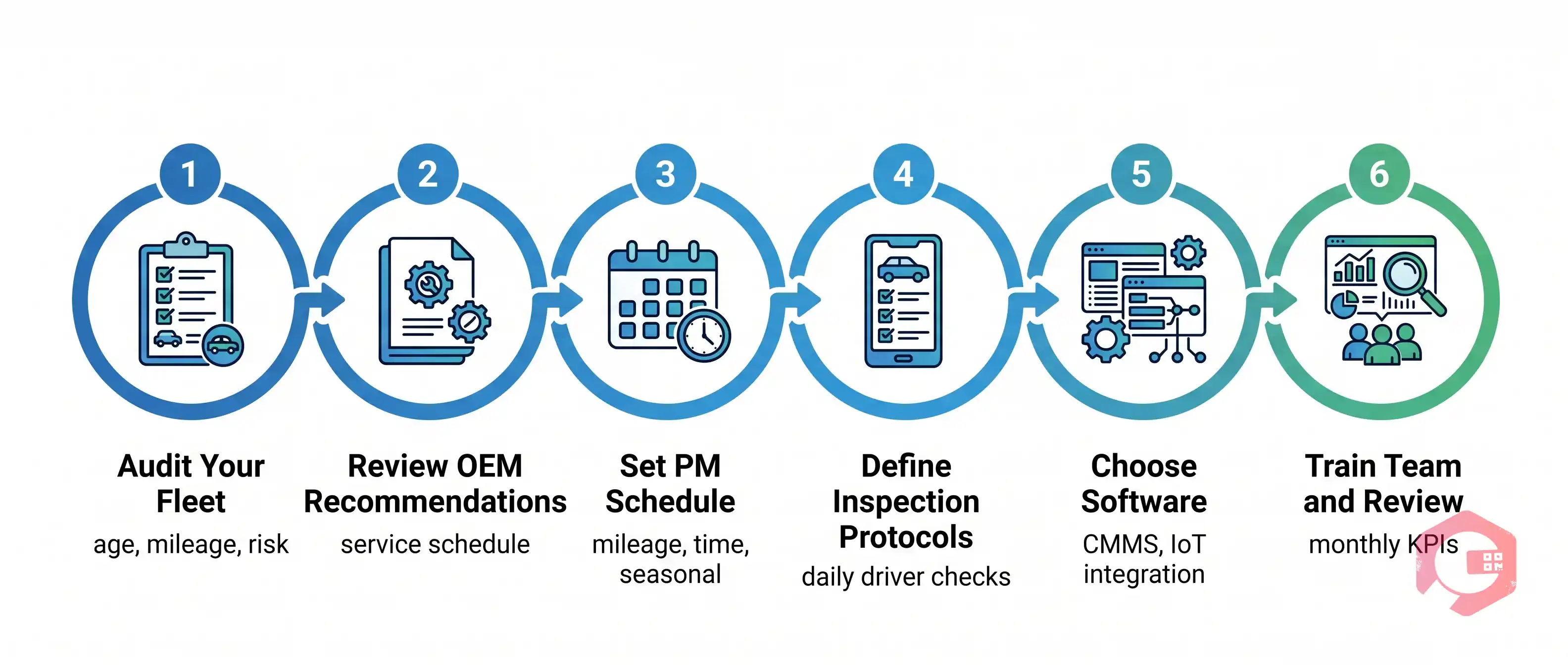
How to Set Up a Fleet Maintenance Program in 6 Steps

Fleet Maintenance Best Practices — workflow

Starting from scratch - or formalizing an informal process - follows a clear sequence:

  • Step 1 - Audit your fleet: List every vehicle with its make, model, age, mileage, and current service history. Identify which assets are highest risk due to age or usage patterns.
  • Step 2 - Review OEM recommendations: Pull the manufacturer's service schedule for each vehicle type. These form the baseline for your PM intervals.
  • Step 3 - Set your PM schedule: Configure service intervals by mileage, engine hours, and calendar time. Account for seasonal needs (winter tire changes, coolant system checks).
  • Step 4 - Define inspection protocols: Create standardized inspection checklists for daily driver checks and periodic maintenance inspections. Make them mobile-accessible.
  • Step 5 - Choose your software: Select a CMMS that supports fleet work orders, mobile access, automated PM alerts, inventory tracking, and real-time reporting. Ensure it integrates with your telematics or IoT devices.
  • Step 6 - Train your team and review regularly: Roll out the program with driver and technician training. Review KPIs monthly for the first quarter, then quarterly once the program stabilizes.

Frequently Asked Questions

What is the most important fleet maintenance best practice?

Preventive maintenance scheduling is the single most impactful practice. Setting service intervals based on mileage and engine hours - and actually sticking to them with automated reminders - prevents the majority of unplanned breakdowns and keeps repair costs predictable.

How often should fleet vehicles be inspected?

Drivers should conduct pre-trip and post-trip inspections daily. Formal maintenance inspections should occur every 30, 60, or 90 days depending on vehicle usage intensity and type. DOT-regulated vehicles follow specific mandated inspection intervals that must be documented and retained.

What KPIs should I track for fleet maintenance?

Focus on MTTR (Mean Time to Repair), MTBF (Mean Time Between Failures), fleet availability percentage, PM compliance rate, and cost per vehicle. These five metrics give you a clear picture of maintenance program health and where to focus improvement efforts.

What is the difference between preventive and predictive maintenance for fleets?

Preventive maintenance follows a set schedule regardless of actual vehicle condition - you change the oil every 5,000 miles whether the vehicle needs it or not. Predictive maintenance uses real-time sensor data to service vehicles only when indicators show they actually need attention, reducing unnecessary servicing while preventing failures.

How does a CMMS help with fleet maintenance?

A CMMS centralizes all fleet maintenance workflows in one system - scheduling PMs, creating and assigning work orders, tracking parts inventory, recording service history, and generating compliance reports. It eliminates manual processes, ensures nothing gets missed, and gives fleet managers real-time visibility into every vehicle's status.

Managing a fleet is complex, but maintaining one does not have to be. Cryotos CMMS gives fleet managers the tools to automate preventive maintenance, track every work order from creation to close, monitor fleet KPIs in real time, and connect IoT sensor data directly to maintenance triggers. Teams using Cryotos reduce downtime by 30% and cut repair times by 25%. If your fleet is still running on spreadsheets or disconnected systems, now is the time to change that. Book a demo with Cryotos and see how your maintenance program can run itself.


Want to Try Cryotos CMMS Today? Lets Connect!
Thank you! Your submission has been received!
Oops! Something went wrong while submitting the form.
Related Post

Fleet Maintenance Best Practices: A Complete Guide

Calendar
Duration:
10 min read
person
calendar today
Published on
April 10, 2026
Featured Image

Fleet maintenance best practices are the structured routines, policies, and systems that keep a fleet of vehicles safe, reliable, and cost-efficient. When applied consistently, they shift your operation from reacting to breakdowns to preventing them - reducing unplanned downtime, extending vehicle life, and protecting your drivers. According to the Federal Motor Carrier Safety Administration (FMCSA), a single truck breakdown can cost a fleet between $448 and $760 per hour in lost productivity. The good news: most of those breakdowns are preventable with the right practices in place.

What Are Fleet Maintenance Best Practices?

Fleet maintenance best practices are the proven methods fleet managers use to plan, schedule, and execute vehicle servicing in a way that maximizes uptime and minimizes cost. They cover everything from setting inspection schedules and tracking repair history to using software to automate reminders and monitor vehicle health in real time.

Following these practices consistently is what separates high-performing fleets from those constantly fighting fires.

Fleet Maintenance vs. Fleet Maintenance Management

Fleet maintenance refers to the hands-on work: oil changes, brake inspections, tire rotations, and repairs that keep vehicles roadworthy. Fleet maintenance management is the strategic layer above that - planning service intervals, controlling costs, assigning technicians, and tracking performance across the entire fleet. You need both. Maintenance without management leads to missed services and surprise breakdowns. Management without execution leads to plans that never get done.

Why Fleet Maintenance Best Practices Matter

The financial case for structured fleet maintenance is straightforward. Fleets that run a proper preventive maintenance program spend 25-35% less per year on repairs than those using a reactive approach, according to Plant Engineering industry benchmarks. That gap widens when you factor in the cost of vehicle downtime, emergency parts sourcing, and overtime labor for rush repairs.

Beyond cost, there are three other reasons fleet maintenance best practices are non-negotiable:

  • Driver safety: A poorly maintained vehicle is a safety liability. Worn brakes, bald tires, and failing lights create accident risk that no organization wants to absorb.
  • Regulatory compliance: DOT regulations require documented inspection and maintenance records. Non-compliance leads to fines, failed audits, and potential operating restrictions.
  • Vehicle lifespan: Regular servicing extends the useful life of your assets. That directly delays capital expenditure on replacements and improves your total cost of ownership (TCO).

Types of Fleet Maintenance

Fleet Maintenance Best Practices — problems grid

Understanding the three types of maintenance helps you design the right strategy for your fleet:

  • Corrective Maintenance: Fixing a vehicle after it breaks down. This is the most expensive approach - emergency parts, rush labor, and full vehicle downtime while repairs are underway. It should be the exception, not the rule.
  • Preventive Maintenance (PM): Scheduled servicing based on time, mileage, or engine hours. Oil changes, tire rotations, brake checks, and fluid inspections fall here. PM is the foundation of an effective fleet maintenance program.
  • Predictive Maintenance: Using real-time sensor data, telematics, and IoT devices to detect failing components before they cause a breakdown. A vehicle's engine temperature or brake pad sensor triggers a work order before the driver even notices an issue.

Most fleets need all three. The goal is to minimize corrective events by maximizing PM discipline and building toward predictive capabilities where the data supports it.

9 Fleet Maintenance Best Practices You Should Follow

Fleet Maintenance Best Practices — scenario

1. Build a Preventive Maintenance Schedule

Your PM schedule is the backbone of your fleet maintenance program. Set service intervals based on OEM recommendations and actual vehicle usage - not just calendar time. A delivery van clocking 400 miles a day needs different intervals than a facilities truck used twice a week.

Use both static PMs (fixed time intervals, e.g., every 90 days) and dynamic PMs (usage-based, e.g., every 5,000 miles) so the schedule reflects real-world wear patterns. Tools like Cryotos preventive maintenance software let you configure both types and send automated alerts before each service is due - so nothing slips through.

2. Conduct Regular Vehicle Inspections

Inspections catch problems before they become failures. Require drivers to complete pre-trip and post-trip inspections using standardized digital forms (eDVIRs). Schedule periodic maintenance inspections every 30, 60, or 90 days depending on usage, and conduct DOT compliance checks for regulated vehicles.

The key is consistency. A missed inspection is an invisible risk. Mobile-based inspection apps allow drivers to submit reports from the cab instantly, triggering work orders the moment an issue is flagged.

3. Centralize Maintenance Records

Every service event, inspection result, repair, warranty claim, and parts replacement should live in one accessible system. Scattered records - paper logs, spreadsheets, email threads - make it impossible to spot recurring faults, support warranty claims, or prove compliance in an audit.

A centralized CMMS platform gives you a complete, searchable service history for every vehicle. When a vehicle repeatedly fails the same component, your data shows it - before that vehicle becomes a liability.

4. Track Fleet KPIs and Downtime Metrics

You cannot manage what you do not measure. Track fleet maintenance performance through a focused set of KPIs:

  • MTTR (Mean Time to Repair): How long it takes to get a vehicle back in service after a breakdown.
  • MTBF (Mean Time Between Failures): How long vehicles run between unplanned breakdowns - a direct measure of PM program effectiveness.
  • Fleet availability %: The proportion of your fleet that is operational and ready to deploy at any given time.
  • PM compliance rate: The percentage of scheduled maintenance tasks completed on time.

Cryotos tracks all these metrics in real time through its downtime tracking module, giving fleet managers drill-down visibility from organization level to individual vehicle.

5. Train and Engage Drivers

Drivers are your first line of defense. Harsh braking, aggressive acceleration, and excessive idling accelerate component wear and increase fuel costs by up to 30%, according to the U.S. Department of Energy. Structured driver training - onboarding programs, refresher sessions, and behavior scorecards - converts this into measurable savings.

Pair training with accountability. Driver scorecards make performance visible and create a culture where safe, vehicle-friendly driving is recognized and rewarded.

6. Use a CMMS to Automate Fleet Maintenance

Managing a fleet manually - through spreadsheets, phone calls, and whiteboards - breaks down at scale. A Computerized Maintenance Management System (CMMS) automates the workflows that keep your fleet running: work order creation, PM scheduling, technician assignment, parts tracking, and reporting.

Cryotos takes this further with AI-driven work order management - generating work orders from voice commands, photo analysis, or sensor alerts. Technicians get mobile notifications, complete jobs on their phones, and close work orders with digital signatures. Fleet managers see everything in real time, with no paperwork required. Fleets using Cryotos report a 30% reduction in downtime and 25% faster repair times.

7. Optimize Your Parts Inventory

A repair that could take two hours takes two days when the right part is not in stock. Effective fleet maintenance requires a well-managed parts inventory - with minimum stock thresholds set for critical components like filters, belts, and brake pads, and automated alerts when levels drop too low.

Track parts usage patterns over time. If three vehicles in your fleet have needed the same water pump in six months, that is a signal - either a quality issue or a PM interval that needs adjusting. Inventory management software gives you this visibility.

8. Integrate IoT and Telematics

Modern fleets generate a continuous stream of vehicle health data through GPS units, engine sensors, and telematics devices. Connecting this data to your maintenance system transforms it from raw readings into actionable alerts - an engine temperature crossing a threshold, a battery voltage drop, or brake pad wear reaching a limit.

Cryotos integrates with IoT sensors, SCADA systems, and PLC devices to pull real-time data directly into the maintenance workflow. When a threshold is breached, the system automatically creates a work order, assigns a technician, and notifies the fleet manager - all before the driver notices anything is wrong. According to a McKinsey analysis, predictive maintenance driven by IoT can reduce maintenance costs by 10-25% and unplanned downtime by 50%.

9. Develop Clear Fleet Policies and Compliance Procedures

Without defined policies, fleet maintenance becomes inconsistent across locations, teams, and vehicles. Document standards for vehicle acquisition, usage rules, inspection protocols, maintenance responsibilities, and end-of-life disposal. Define who can authorize repairs above a certain cost, and what the escalation path looks like when a vehicle needs to be taken off the road.

For regulated environments, build DOT compliance checks, Lockout/Tagout (LOTO) procedures, and Permit to Work workflows directly into your maintenance system so they cannot be skipped.

Fleet Maintenance Checklist

Fleet Maintenance Best Practices — lifecycle

Use this checklist to verify your fleet maintenance program covers the essentials. Run through it quarterly or when onboarding new vehicles:

  • ? PM schedules set for every vehicle (static + dynamic intervals)
  • ? Pre-trip and post-trip inspection process in place for all drivers
  • ? Maintenance records centralized in a CMMS or fleet software
  • ? Fleet KPIs defined and reviewed monthly (MTTR, MTBF, availability %)
  • ? Driver training program active with scorecards and refresher sessions
  • ? Work order workflow automated - no manual paper-based processes
  • ? Parts inventory managed with minimum stock thresholds and alerts
  • ? IoT/telematics data connected to maintenance triggers
  • ? Fleet policies documented and accessible to all drivers and technicians
  • ? DOT compliance records up to date for all regulated vehicles

How to Set Up a Fleet Maintenance Program in 6 Steps

Fleet Maintenance Best Practices — workflow

Starting from scratch - or formalizing an informal process - follows a clear sequence:

  • Step 1 - Audit your fleet: List every vehicle with its make, model, age, mileage, and current service history. Identify which assets are highest risk due to age or usage patterns.
  • Step 2 - Review OEM recommendations: Pull the manufacturer's service schedule for each vehicle type. These form the baseline for your PM intervals.
  • Step 3 - Set your PM schedule: Configure service intervals by mileage, engine hours, and calendar time. Account for seasonal needs (winter tire changes, coolant system checks).
  • Step 4 - Define inspection protocols: Create standardized inspection checklists for daily driver checks and periodic maintenance inspections. Make them mobile-accessible.
  • Step 5 - Choose your software: Select a CMMS that supports fleet work orders, mobile access, automated PM alerts, inventory tracking, and real-time reporting. Ensure it integrates with your telematics or IoT devices.
  • Step 6 - Train your team and review regularly: Roll out the program with driver and technician training. Review KPIs monthly for the first quarter, then quarterly once the program stabilizes.

Frequently Asked Questions

What is the most important fleet maintenance best practice?

Preventive maintenance scheduling is the single most impactful practice. Setting service intervals based on mileage and engine hours - and actually sticking to them with automated reminders - prevents the majority of unplanned breakdowns and keeps repair costs predictable.

How often should fleet vehicles be inspected?

Drivers should conduct pre-trip and post-trip inspections daily. Formal maintenance inspections should occur every 30, 60, or 90 days depending on vehicle usage intensity and type. DOT-regulated vehicles follow specific mandated inspection intervals that must be documented and retained.

What KPIs should I track for fleet maintenance?

Focus on MTTR (Mean Time to Repair), MTBF (Mean Time Between Failures), fleet availability percentage, PM compliance rate, and cost per vehicle. These five metrics give you a clear picture of maintenance program health and where to focus improvement efforts.

What is the difference between preventive and predictive maintenance for fleets?

Preventive maintenance follows a set schedule regardless of actual vehicle condition - you change the oil every 5,000 miles whether the vehicle needs it or not. Predictive maintenance uses real-time sensor data to service vehicles only when indicators show they actually need attention, reducing unnecessary servicing while preventing failures.

How does a CMMS help with fleet maintenance?

A CMMS centralizes all fleet maintenance workflows in one system - scheduling PMs, creating and assigning work orders, tracking parts inventory, recording service history, and generating compliance reports. It eliminates manual processes, ensures nothing gets missed, and gives fleet managers real-time visibility into every vehicle's status.

Managing a fleet is complex, but maintaining one does not have to be. Cryotos CMMS gives fleet managers the tools to automate preventive maintenance, track every work order from creation to close, monitor fleet KPIs in real time, and connect IoT sensor data directly to maintenance triggers. Teams using Cryotos reduce downtime by 30% and cut repair times by 25%. If your fleet is still running on spreadsheets or disconnected systems, now is the time to change that. Book a demo with Cryotos and see how your maintenance program can run itself.

Want to Try Cryotos CMMS Today?

Get Free Demo

Let AI Take Control of Your Maintenance

Cryotos AI predicts failures, automates work orders, and simplifies maintenance—before problems slow you down.

Try AI-Powered CMMS
🡢