Lean vs. Six Sigma: What's the Difference and When to Use Each

Article Written by:

Ganesh Veerappan

Created On:

March 31, 2026

Lean vs. Six Sigma: What's the Difference and When to Use Each

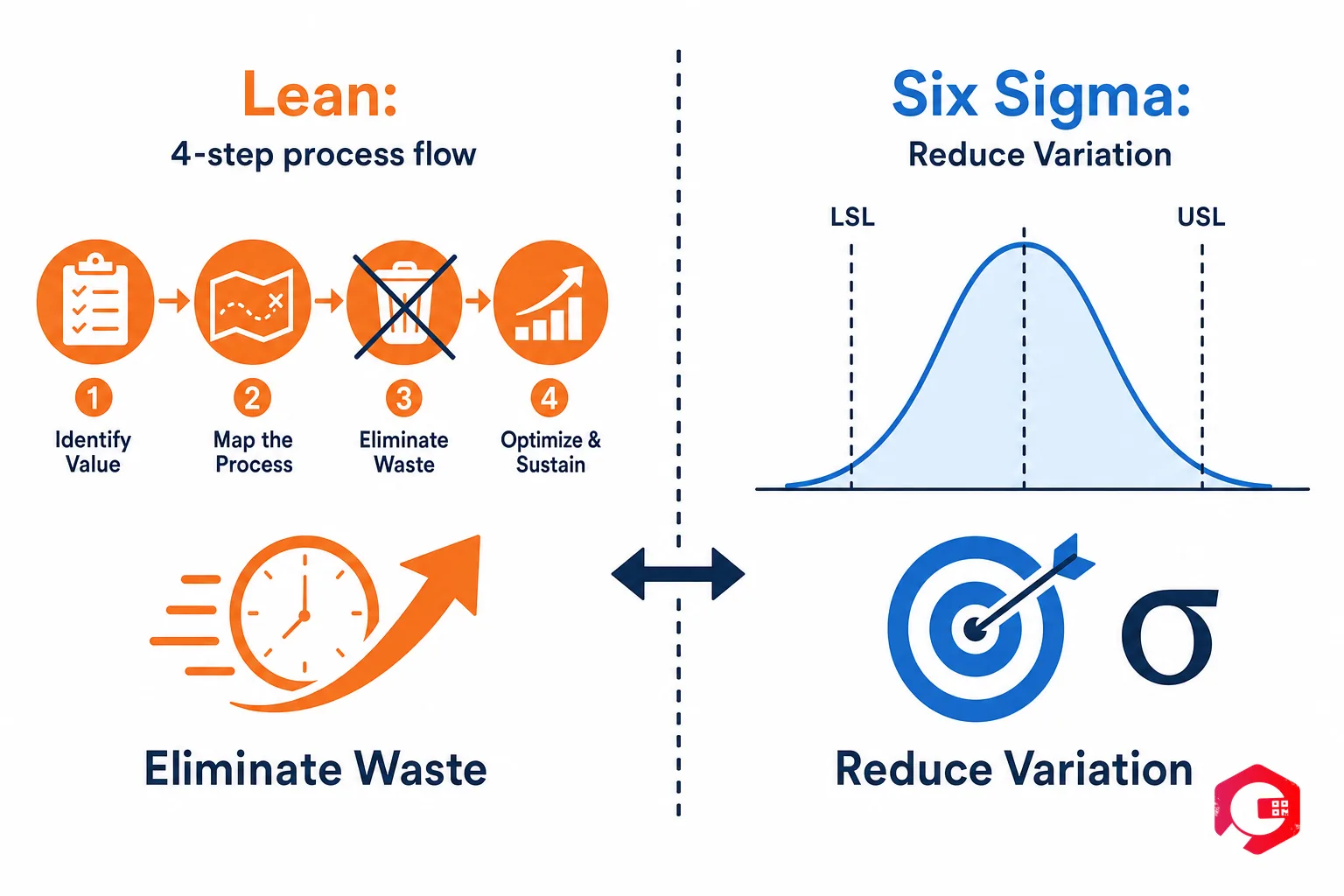
The difference between Lean and Six Sigma is in what they target: Lean eliminates waste from process flow to speed things up, while Six Sigma eliminates variation in process output to improve quality and consistency. Both methodologies reduce inefficiency - they just attack it from opposite ends.

In a Six Sigma process, defects fall below 3.4 per million opportunities (DPMO). Lean, by contrast, does not measure defects statistically - it identifies and removes the seven categories of non-value-adding activity that slow processes down.


What Is Lean? (A Plain-English Definition)

Lean is a management methodology built on one core principle: eliminate any activity that does not add value for the customer. If a step in your process does not move the product or service closer to what the customer pays for, it is waste - and waste should be removed.

The roots of Lean go back further than most people realise. Henry Ford laid the groundwork in the early 1900s when he designed assembly lines where each step flowed directly into the next. Taiichi Ohno at Toyota took that thinking and built the Toyota Production System - widely considered the most efficient manufacturing system ever created. The term "Lean" itself wasn't coined until 1987. MIT researcher John Krafcik introduced it to describe an approach that needs "less of everything to create value."

A detail that surprises most people: when Toyota executives visited the United States in the 1950s, the operation that changed their thinking was not a car factory - it was a Piggly Wiggly supermarket. Watching shelves get restocked only when items were taken sparked the entire just-in-time philosophy. That grocery store observation became the foundation of what we now call Lean manufacturing.

The 7 Wastes of Lean (TIMWOOD)

Lean identifies seven categories of waste, often remembered with the acronym TIMWOOD:


Some practitioners add an eighth waste: non-utilised talent - failing to use the skills and knowledge of your workforce. The updated acronym becomes DOWNTIME (Defects, Overproduction, Waiting, Non-utilised talent, Transport, Inventory, Motion, Extra-processing).

What Is Six Sigma? (A Plain-English Definition)

Six Sigma is a data-driven methodology that uses statistical analysis to reduce variation in business processes until defects become statistically near-impossible. Engineer Bill Smith introduced it in 1986 at Motorola, and it helped the company save over $16 billion in the following decade. 2026 marks the 40th anniversary of Six Sigma - and far from slowing down, ASQ estimates that roughly 70% of Fortune 500 companies have adopted Six Sigma principles in some form.

The name comes from statistics. Sigma (?) is the symbol for standard deviation - a measure of how much a process output varies. Achieving "Six Sigma" means your process operates at a quality level where only 3.4 defects occur per million opportunities. To put that in perspective, a Three Sigma process - which many organisations consider "good" - produces 66,807 defects per million opportunities. The gap is enormous.

The Sigma Level Table: From 1? to 6?

Sigma LevelDefects Per Million Opportunities (DPMO)Process YieldTypical Example1?691,46230.9%Highly unreliable process2?308,53869.2%Poor quality manufacturing3?66,80793.3%Average industry performance4?6,21099.4%Good manufacturing standard5?23399.98%World-class manufacturing6?3.499.9997%Near-perfect (aerospace, pharma)

Most organisations start at Three or Four Sigma. Moving from 3? to 4? alone can eliminate more than 60,000 defects per million - which, in a high-volume production environment, translates directly to significant cost savings and improved customer satisfaction.
Lean vs. Six Sigma: The Core Differences

Lean vs. Six Sigma — problems grid

Here is the clearest way to hold both methodologies in your head at once: Lean asks "where is time being wasted?" and Six Sigma asks "where is quality being lost?" Both questions matter. They just call for different tools and different mindsets.


DimensionLeanSix SigmaPrimary FocusEliminate waste, improve flowReduce variation, improve qualityRoot Cause of WasteNon-value-adding steps in the processStatistical variation in process outputCore FrameworkValue Stream Mapping, 5S, Kaizen, KanbanDMAIC (Define, Measure, Analyze, Improve, Control)ApproachObserve the process; remove what slows it downMeasure the process; analyse data to find root causesSpeed of ResultsFaster - visible improvements within weeksSlower - data collection and analysis takes timeData IntensityLow to moderate - visual observation drives actionHigh - statistical tools are central to the methodBest ForSlow, bloated, inefficient processesInconsistent, defect-prone, variable processesOrganisational StructureFlat - works best embedded across all levelsHierarchical - belt system defines roles and authorityCertificationNo formal belt system (Lean Practitioner training exists)White Belt ? Yellow Belt ? Green Belt ? Black Belt ? Master Black BeltOriginToyota Production System, Japan (1950s-1980s)Motorola, USA (1986)

How They Define "Waste" Differently

This is the deepest conceptual difference between the two methodologies - and the one that most guides which you should choose.

In Lean, waste is anything a customer would not pay for if they knew it was there. Consider a maintenance work order that takes four hours to complete. If you map the activity, you might find that only 45 minutes involved actual repair work. The remaining three hours and fifteen minutes were spent waiting for parts to arrive from the storeroom, searching for the correct torque specification in a paper-based manual, and waiting for a supervisor to approve the job closure. All of that waiting is Lean waste. The fix is to redesign the process - digitise the work order, connect it to live inventory, and remove the approvals bottleneck.

In Six Sigma, waste results from variation - the same pump failing unpredictably at different intervals even though the maintenance schedule looks identical on paper. The pump fails at 1,200 hours in January, at 900 hours in March, and at 1,500 hours in June. The process looks consistent, but the output is not. That unpredictability is Six Sigma waste. The fix is statistical: collect data across a large sample, identify which variable (lubricant type, temperature, load profile) drives the variation, and control it.

Lean as a Mindset vs. Six Sigma as a Program

Lean is a philosophy first and a set of tools second. Anyone in the organisation - from a floor technician to a plant manager - can think in Lean terms, and the best implementations happen when it's embedded into daily culture. Teams that get it right are constantly asking: "Is this step necessary?" and "What's slowing us down?"

Six Sigma is a structured programme with defined roles, a certification hierarchy, and project-based execution. A Black Belt leads a project team. A Green Belt assists with data collection. A Master Black Belt coaches the programme. This structure suits highly complex problems that require statistical rigour - but it also demands more resources and time to deploy.

The Belt System: Six Sigma's Structured Hierarchy

Six Sigma uses a belt-ranking system similar to martial arts to define roles and expertise levels:


According to Purdue University's Six Sigma programme data, Black Belt certified professionals in the United States earn a median salary approximately 15-20% higher than non-certified peers in equivalent roles - making certification a meaningful career investment beyond the process improvement benefits.

Lean vs. Six Sigma in Manufacturing and Maintenance

Manufacturing and maintenance environments are where both methodologies prove their value most clearly - and where the choice between them matters most.

Consider two plants with different problems. Plant A has a maintenance team that responds to breakdowns quickly and fixes equipment correctly almost every time - but the process to raise a work order, source a part, assign a technician, and close the job takes 6 hours on average when it should take 90 minutes. That is a Lean problem: the process works, it is just full of non-value-adding steps. Value stream mapping will surface where the delays live, and redesigning the workflow - digitising work orders, connecting them to live parts inventory, removing redundant approval steps - can cut cycle time dramatically.

Plant B has the opposite problem. Work orders move through quickly, but the same pieces of equipment keep breaking down unpredictably. MTBF (Mean Time Between Failures) for the conveyor line should be 1,400 hours based on the manufacturer's specification, but in practice it ranges from 600 to 2,100 hours. The maintenance team cannot predict failures, which means they cannot prevent them. That is a Six Sigma problem: the variation in failure timing is the waste, and only statistical root-cause analysis - examining lubricant batch data, operating temperature logs, load profiles, and technician completion records - will identify the controllable variable driving the inconsistency.

A food and beverage manufacturer in Southeast Asia applied exactly this two-phase approach. They used Lean's 5S methodology to reorganise their maintenance storeroom and standardise technician workflows, reducing average work order cycle time from 5.2 hours to 2.1 hours. They then used Six Sigma's DMAIC framework to analyse conveyor belt failure patterns, identifying that inconsistent belt tension settings during installation (a training gap, not an equipment issue) was responsible for 68% of unplanned stoppages. After correcting the installation procedure and adding a tension verification checkpoint, unplanned downtime on that line fell by 41% over the following six months.

A CMMS platform like Cryotos provides the operational backbone for both approaches. For Lean implementation, digital work order management eliminates the waiting and searching waste that inflates maintenance cycle times. For Six Sigma, the downtime tracking module and built-in reporting give teams the clean, time-stamped data that DMAIC's Measure and Analyze phases require. Without reliable data, Six Sigma projects stall at the analysis stage.
The DMAIC Framework Explained (Step-by-Step)

Lean vs. Six Sigma — workflow

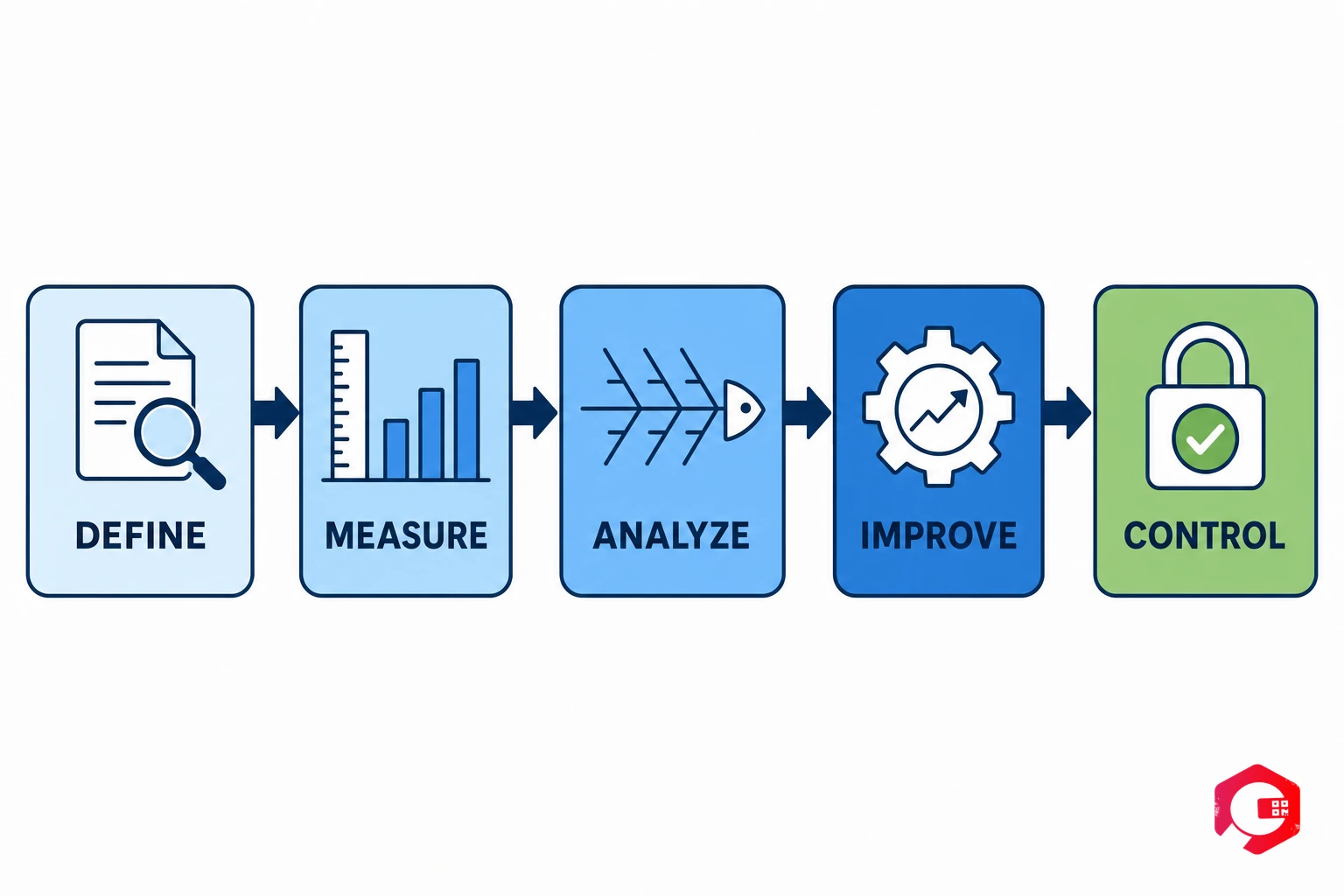
DMAIC is the backbone of Six Sigma. It stands for Define, Measure, Analyze, Improve, and Control - a five-phase structured approach for solving any quality or variation problem. Here is what each phase involves in practice, using a real maintenance scenario throughout.

Scenario: A chemical plant is experiencing an unacceptable number of pump seal failures. Each failure costs approximately $4,200 in parts, labour, and lost production. The target is to reduce failures by at least 50% within six months.

Define - Pin Down the Problem

The team defines the problem precisely, identifies who is affected, and sets a measurable goal. A Project Charter is created that specifies scope, stakeholders, timeline, and the metric of success. In our scenario: "Reduce pump seal failure rate from 14 failures per quarter to 7 or fewer, saving an estimated $37,800 per quarter." Vague problem statements are the most common reason DMAIC projects fail before they start.

Measure - Establish Your Baseline

The team collects data on the current state of the process. How often do failures occur? When? Which pumps? Which shifts? What are the conditions at time of failure? In our scenario, the team pulls 18 months of work order history from the CMMS, cataloguing each seal failure by pump ID, shift, lubricant batch, operating temperature, and time since last PM. This baseline data is what makes the Analyze phase possible.

Analyze - Find the Root Cause (Not the Symptom)

Using statistical tools - Pareto charts, fishbone (Ishikawa) diagrams, regression analysis, hypothesis testing - the team identifies the true root cause of the variation. In our scenario, analysis reveals that 71% of seal failures occur within 30 days of a preventive maintenance visit, and specifically on pumps maintained by two of the twelve technicians on shift. The root cause is not equipment quality - it is inconsistent torque application during reassembly after PM.

Improve - Test and Implement Solutions

The team designs and pilots a solution, tests it, and refines before full deployment. In our scenario: torque specifications are added to the PM checklist with mandatory digital sign-off, and a calibrated torque wrench is assigned to each pump circuit. A 60-day pilot on two pump circuits shows zero seal failures, down from an average of 3.8 per circuit per quarter.

Control - Lock In the Gains

The team creates control mechanisms to ensure the improvement does not erode once the project ends. This is where most organisations fail - they improve the process but do not control it. In our scenario: the updated PM checklist is locked in the CMMS, torque verification becomes a mandatory checkpoint before a work order can be closed, and a monthly dashboard alert triggers if seal failure rate rises above 2 per circuit per quarter. The improvement becomes self-sustaining.

Lean vs. Six Sigma vs. Lean Six Sigma: What's the Relationship?

Lean vs. Six Sigma — scenario

Lean Six Sigma is not a compromise between the two methodologies - it is a deliberate sequence. You use Lean first to eliminate obvious waste and simplify the process, then apply Six Sigma to reduce the variation that remains in the streamlined process.

The logic is sound: if you apply Six Sigma statistical tools to a bloated, wasteful process, you spend enormous effort analysing variation in steps that should not exist. Similarly, if you use Lean to streamline a process but skip the statistical control phase, the same defects and inconsistencies will creep back. Each method fills the other's blind spot.

General Electric's adoption under Jack Welch is often cited as the landmark case. GE reported saving over $10 billion in the first five years of deploying Six Sigma and Lean principles together across its manufacturing and service divisions. Ventura County, California, credited Lean Six Sigma for $33 million in government savings after training more than 5,000 employees in the methodology.

Most organisations find they naturally gravitate toward the hybrid. If you are starting from scratch, begin with Lean - it is faster, more visible, and builds the team buy-in you need before asking people to collect data for a Six Sigma project. Once the waste is removed and the process is stable, the statistical work of Six Sigma becomes far more productive.

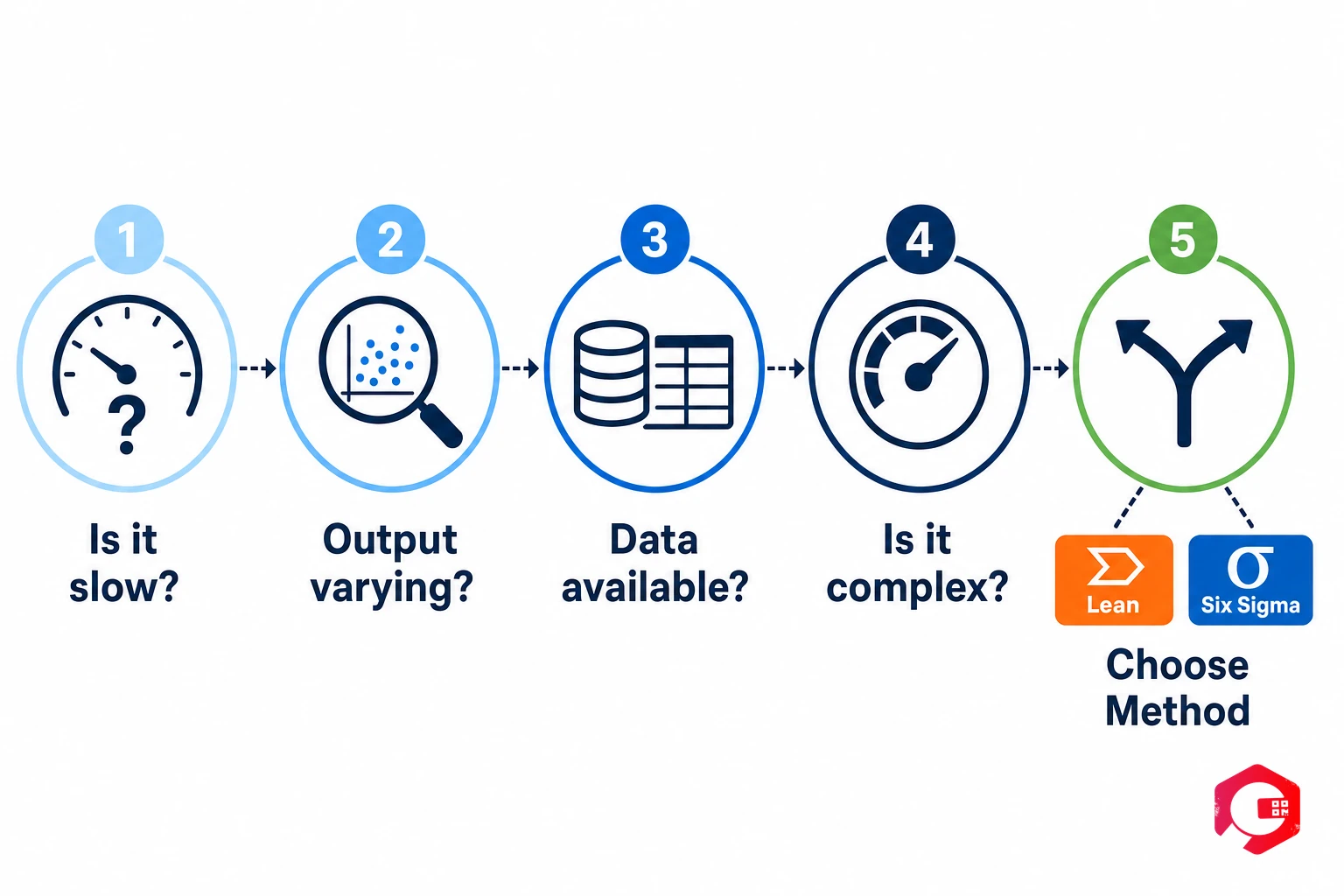
Which Should You Choose? A 5-Question Decision Framework

Rather than picking based on what others use, answer these five diagnostic questions. Your answers will point you toward the right starting methodology.


If your answers split across both columns - or if you answered "Six Sigma" to most questions but know your data quality is poor - that is the classic signal to deploy Lean Six Sigma in sequence.

Why Lean and Six Sigma Projects Fail (And How to Prevent It)

Lean vs. Six Sigma — problem causes

The statistics are sobering. Research cited across the industry suggests that 60% of Six Sigma projects don't deliver their intended results, and between 40-60% of Lean projects miss their targets. Given how well-documented both methodologies are, why do so many implementations fall short?

Four root causes account for the majority of failures:


Frequently Asked Questions

What is the main difference between Lean and Six Sigma?

Lean and Six Sigma both aim to eliminate waste and improve business processes, but they identify the root cause of waste differently. Lean defines waste as any process step that does not add value for the customer - the fix is to remove or redesign those steps. Six Sigma defines waste as variation in process output - the fix is to use statistical analysis to identify and control the variables that cause that variation. In short: Lean makes processes faster; Six Sigma makes them more consistent.

Which comes first - Lean or Six Sigma?

Most practitioners recommend starting with Lean. Lean's waste-elimination tools are faster to deploy, produce visible results within weeks, and build the team engagement you need before asking people to invest in a longer Six Sigma data project. Lean also produces cleaner, simpler processes - which makes the statistical work of Six Sigma significantly more productive. Trying to apply Six Sigma to a bloated, wasteful process is like trying to tune an engine that still has dirt in the fuel line.

Is Lean Six Sigma still relevant in 2026?

Yes - and arguably more relevant than ever. 2026 marks the 40th anniversary of Six Sigma, and the methodology has evolved rather than stagnated. What practitioners now call Lean Six Sigma 4.0 incorporates AI-driven root-cause analysis, IoT sensor data for real-time statistical process control, and digital CMMS platforms that automate the data collection that once required weeks of manual effort. The principles remain identical; the tools have become dramatically more powerful.

What is the difference between Lean and Six Sigma in manufacturing?

In manufacturing, Lean typically addresses flow problems: slow cycle times, excessive material handling, large work-in-progress queues, and unresponsive maintenance workflows. Six Sigma addresses quality problems: inconsistent product yield, unpredictable equipment failures, high defect rates, and process outputs that vary batch-to-batch. Many manufacturing facilities need both - Lean to streamline the maintenance and production process, Six Sigma to eliminate the variation that causes failures and defects.

Can Lean and Six Sigma be used together?

Absolutely - and most successful organisations end up doing exactly that. Lean Six Sigma is a formal hybrid methodology that applies Lean's waste-reduction tools first to simplify and accelerate processes, then overlays Six Sigma's statistical rigour to reduce the variation that remains. The combination is more effective than either method alone: Lean shows you what to fix, and Six Sigma gives you the discipline to make those fixes permanent.

What is DMAIC in Six Sigma?

DMAIC stands for Define, Measure, Analyze, Improve, and Control. It is the five-phase problem-solving framework at the core of Six Sigma. Define pins down the problem and sets measurable goals. Measure establishes the current state with reliable data. Analyze uses statistical tools to find the true root cause. Improve designs and tests solutions. Control locks in the improvements so the process does not revert. DMAIC is designed for improving existing processes; Six Sigma uses a separate framework called DMADV for designing new ones.

Whether your team is working to eliminate waste with Lean principles or reduce equipment failure variation with Six Sigma's DMAIC framework, both methodologies depend on one thing: reliable, real-time operational data. Cryotos CMMS gives maintenance teams the digital foundation both approaches require - from structured work order workflows that remove Lean waste, to the downtime tracking and reporting that feeds Six Sigma's Measure and Analyze phases. See how Cryotos supports Lean and Six Sigma initiatives and find out how purpose-built maintenance software turns methodology into measurable results.


Want to Try Cryotos CMMS Today? Lets Connect!
Thank you! Your submission has been received!
Oops! Something went wrong while submitting the form.
Related Post

Lean vs. Six Sigma: What's the Difference and When to Use Each

Calendar
Duration:
15 min read
calendar today
Published on
March 31, 2026
Featured Image

The difference between Lean and Six Sigma is in what they target: Lean eliminates waste from process flow to speed things up, while Six Sigma eliminates variation in process output to improve quality and consistency. Both methodologies reduce inefficiency - they just attack it from opposite ends.

In a Six Sigma process, defects fall below 3.4 per million opportunities (DPMO). Lean, by contrast, does not measure defects statistically - it identifies and removes the seven categories of non-value-adding activity that slow processes down.


What Is Lean? (A Plain-English Definition)

Lean is a management methodology built on one core principle: eliminate any activity that does not add value for the customer. If a step in your process does not move the product or service closer to what the customer pays for, it is waste - and waste should be removed.

The roots of Lean go back further than most people realise. Henry Ford laid the groundwork in the early 1900s when he designed assembly lines where each step flowed directly into the next. Taiichi Ohno at Toyota took that thinking and built the Toyota Production System - widely considered the most efficient manufacturing system ever created. The term "Lean" itself wasn't coined until 1987. MIT researcher John Krafcik introduced it to describe an approach that needs "less of everything to create value."

A detail that surprises most people: when Toyota executives visited the United States in the 1950s, the operation that changed their thinking was not a car factory - it was a Piggly Wiggly supermarket. Watching shelves get restocked only when items were taken sparked the entire just-in-time philosophy. That grocery store observation became the foundation of what we now call Lean manufacturing.

The 7 Wastes of Lean (TIMWOOD)

Lean identifies seven categories of waste, often remembered with the acronym TIMWOOD:


Some practitioners add an eighth waste: non-utilised talent - failing to use the skills and knowledge of your workforce. The updated acronym becomes DOWNTIME (Defects, Overproduction, Waiting, Non-utilised talent, Transport, Inventory, Motion, Extra-processing).

What Is Six Sigma? (A Plain-English Definition)

Six Sigma is a data-driven methodology that uses statistical analysis to reduce variation in business processes until defects become statistically near-impossible. Engineer Bill Smith introduced it in 1986 at Motorola, and it helped the company save over $16 billion in the following decade. 2026 marks the 40th anniversary of Six Sigma - and far from slowing down, ASQ estimates that roughly 70% of Fortune 500 companies have adopted Six Sigma principles in some form.

The name comes from statistics. Sigma (?) is the symbol for standard deviation - a measure of how much a process output varies. Achieving "Six Sigma" means your process operates at a quality level where only 3.4 defects occur per million opportunities. To put that in perspective, a Three Sigma process - which many organisations consider "good" - produces 66,807 defects per million opportunities. The gap is enormous.

The Sigma Level Table: From 1? to 6?

Sigma LevelDefects Per Million Opportunities (DPMO)Process YieldTypical Example1?691,46230.9%Highly unreliable process2?308,53869.2%Poor quality manufacturing3?66,80793.3%Average industry performance4?6,21099.4%Good manufacturing standard5?23399.98%World-class manufacturing6?3.499.9997%Near-perfect (aerospace, pharma)

Most organisations start at Three or Four Sigma. Moving from 3? to 4? alone can eliminate more than 60,000 defects per million - which, in a high-volume production environment, translates directly to significant cost savings and improved customer satisfaction.

Lean vs. Six Sigma: The Core Differences

Lean vs. Six Sigma — problems grid

Here is the clearest way to hold both methodologies in your head at once: Lean asks "where is time being wasted?" and Six Sigma asks "where is quality being lost?" Both questions matter. They just call for different tools and different mindsets.


DimensionLeanSix SigmaPrimary FocusEliminate waste, improve flowReduce variation, improve qualityRoot Cause of WasteNon-value-adding steps in the processStatistical variation in process outputCore FrameworkValue Stream Mapping, 5S, Kaizen, KanbanDMAIC (Define, Measure, Analyze, Improve, Control)ApproachObserve the process; remove what slows it downMeasure the process; analyse data to find root causesSpeed of ResultsFaster - visible improvements within weeksSlower - data collection and analysis takes timeData IntensityLow to moderate - visual observation drives actionHigh - statistical tools are central to the methodBest ForSlow, bloated, inefficient processesInconsistent, defect-prone, variable processesOrganisational StructureFlat - works best embedded across all levelsHierarchical - belt system defines roles and authorityCertificationNo formal belt system (Lean Practitioner training exists)White Belt ? Yellow Belt ? Green Belt ? Black Belt ? Master Black BeltOriginToyota Production System, Japan (1950s-1980s)Motorola, USA (1986)

How They Define "Waste" Differently

This is the deepest conceptual difference between the two methodologies - and the one that most guides which you should choose.

In Lean, waste is anything a customer would not pay for if they knew it was there. Consider a maintenance work order that takes four hours to complete. If you map the activity, you might find that only 45 minutes involved actual repair work. The remaining three hours and fifteen minutes were spent waiting for parts to arrive from the storeroom, searching for the correct torque specification in a paper-based manual, and waiting for a supervisor to approve the job closure. All of that waiting is Lean waste. The fix is to redesign the process - digitise the work order, connect it to live inventory, and remove the approvals bottleneck.

In Six Sigma, waste results from variation - the same pump failing unpredictably at different intervals even though the maintenance schedule looks identical on paper. The pump fails at 1,200 hours in January, at 900 hours in March, and at 1,500 hours in June. The process looks consistent, but the output is not. That unpredictability is Six Sigma waste. The fix is statistical: collect data across a large sample, identify which variable (lubricant type, temperature, load profile) drives the variation, and control it.

Lean as a Mindset vs. Six Sigma as a Program

Lean is a philosophy first and a set of tools second. Anyone in the organisation - from a floor technician to a plant manager - can think in Lean terms, and the best implementations happen when it's embedded into daily culture. Teams that get it right are constantly asking: "Is this step necessary?" and "What's slowing us down?"

Six Sigma is a structured programme with defined roles, a certification hierarchy, and project-based execution. A Black Belt leads a project team. A Green Belt assists with data collection. A Master Black Belt coaches the programme. This structure suits highly complex problems that require statistical rigour - but it also demands more resources and time to deploy.

The Belt System: Six Sigma's Structured Hierarchy

Six Sigma uses a belt-ranking system similar to martial arts to define roles and expertise levels:


According to Purdue University's Six Sigma programme data, Black Belt certified professionals in the United States earn a median salary approximately 15-20% higher than non-certified peers in equivalent roles - making certification a meaningful career investment beyond the process improvement benefits.

Lean vs. Six Sigma in Manufacturing and Maintenance

Manufacturing and maintenance environments are where both methodologies prove their value most clearly - and where the choice between them matters most.

Consider two plants with different problems. Plant A has a maintenance team that responds to breakdowns quickly and fixes equipment correctly almost every time - but the process to raise a work order, source a part, assign a technician, and close the job takes 6 hours on average when it should take 90 minutes. That is a Lean problem: the process works, it is just full of non-value-adding steps. Value stream mapping will surface where the delays live, and redesigning the workflow - digitising work orders, connecting them to live parts inventory, removing redundant approval steps - can cut cycle time dramatically.

Plant B has the opposite problem. Work orders move through quickly, but the same pieces of equipment keep breaking down unpredictably. MTBF (Mean Time Between Failures) for the conveyor line should be 1,400 hours based on the manufacturer's specification, but in practice it ranges from 600 to 2,100 hours. The maintenance team cannot predict failures, which means they cannot prevent them. That is a Six Sigma problem: the variation in failure timing is the waste, and only statistical root-cause analysis - examining lubricant batch data, operating temperature logs, load profiles, and technician completion records - will identify the controllable variable driving the inconsistency.

A food and beverage manufacturer in Southeast Asia applied exactly this two-phase approach. They used Lean's 5S methodology to reorganise their maintenance storeroom and standardise technician workflows, reducing average work order cycle time from 5.2 hours to 2.1 hours. They then used Six Sigma's DMAIC framework to analyse conveyor belt failure patterns, identifying that inconsistent belt tension settings during installation (a training gap, not an equipment issue) was responsible for 68% of unplanned stoppages. After correcting the installation procedure and adding a tension verification checkpoint, unplanned downtime on that line fell by 41% over the following six months.

A CMMS platform like Cryotos provides the operational backbone for both approaches. For Lean implementation, digital work order management eliminates the waiting and searching waste that inflates maintenance cycle times. For Six Sigma, the downtime tracking module and built-in reporting give teams the clean, time-stamped data that DMAIC's Measure and Analyze phases require. Without reliable data, Six Sigma projects stall at the analysis stage.

The DMAIC Framework Explained (Step-by-Step)

Lean vs. Six Sigma — workflow

DMAIC is the backbone of Six Sigma. It stands for Define, Measure, Analyze, Improve, and Control - a five-phase structured approach for solving any quality or variation problem. Here is what each phase involves in practice, using a real maintenance scenario throughout.

Scenario: A chemical plant is experiencing an unacceptable number of pump seal failures. Each failure costs approximately $4,200 in parts, labour, and lost production. The target is to reduce failures by at least 50% within six months.

Define - Pin Down the Problem

The team defines the problem precisely, identifies who is affected, and sets a measurable goal. A Project Charter is created that specifies scope, stakeholders, timeline, and the metric of success. In our scenario: "Reduce pump seal failure rate from 14 failures per quarter to 7 or fewer, saving an estimated $37,800 per quarter." Vague problem statements are the most common reason DMAIC projects fail before they start.

Measure - Establish Your Baseline

The team collects data on the current state of the process. How often do failures occur? When? Which pumps? Which shifts? What are the conditions at time of failure? In our scenario, the team pulls 18 months of work order history from the CMMS, cataloguing each seal failure by pump ID, shift, lubricant batch, operating temperature, and time since last PM. This baseline data is what makes the Analyze phase possible.

Analyze - Find the Root Cause (Not the Symptom)

Using statistical tools - Pareto charts, fishbone (Ishikawa) diagrams, regression analysis, hypothesis testing - the team identifies the true root cause of the variation. In our scenario, analysis reveals that 71% of seal failures occur within 30 days of a preventive maintenance visit, and specifically on pumps maintained by two of the twelve technicians on shift. The root cause is not equipment quality - it is inconsistent torque application during reassembly after PM.

Improve - Test and Implement Solutions

The team designs and pilots a solution, tests it, and refines before full deployment. In our scenario: torque specifications are added to the PM checklist with mandatory digital sign-off, and a calibrated torque wrench is assigned to each pump circuit. A 60-day pilot on two pump circuits shows zero seal failures, down from an average of 3.8 per circuit per quarter.

Control - Lock In the Gains

The team creates control mechanisms to ensure the improvement does not erode once the project ends. This is where most organisations fail - they improve the process but do not control it. In our scenario: the updated PM checklist is locked in the CMMS, torque verification becomes a mandatory checkpoint before a work order can be closed, and a monthly dashboard alert triggers if seal failure rate rises above 2 per circuit per quarter. The improvement becomes self-sustaining.

Lean vs. Six Sigma vs. Lean Six Sigma: What's the Relationship?

Lean vs. Six Sigma — scenario

Lean Six Sigma is not a compromise between the two methodologies - it is a deliberate sequence. You use Lean first to eliminate obvious waste and simplify the process, then apply Six Sigma to reduce the variation that remains in the streamlined process.

The logic is sound: if you apply Six Sigma statistical tools to a bloated, wasteful process, you spend enormous effort analysing variation in steps that should not exist. Similarly, if you use Lean to streamline a process but skip the statistical control phase, the same defects and inconsistencies will creep back. Each method fills the other's blind spot.

General Electric's adoption under Jack Welch is often cited as the landmark case. GE reported saving over $10 billion in the first five years of deploying Six Sigma and Lean principles together across its manufacturing and service divisions. Ventura County, California, credited Lean Six Sigma for $33 million in government savings after training more than 5,000 employees in the methodology.

Most organisations find they naturally gravitate toward the hybrid. If you are starting from scratch, begin with Lean - it is faster, more visible, and builds the team buy-in you need before asking people to collect data for a Six Sigma project. Once the waste is removed and the process is stable, the statistical work of Six Sigma becomes far more productive.

Which Should You Choose? A 5-Question Decision Framework

Rather than picking based on what others use, answer these five diagnostic questions. Your answers will point you toward the right starting methodology.


If your answers split across both columns - or if you answered "Six Sigma" to most questions but know your data quality is poor - that is the classic signal to deploy Lean Six Sigma in sequence.

Why Lean and Six Sigma Projects Fail (And How to Prevent It)

Lean vs. Six Sigma — problem causes

The statistics are sobering. Research cited across the industry suggests that 60% of Six Sigma projects don't deliver their intended results, and between 40-60% of Lean projects miss their targets. Given how well-documented both methodologies are, why do so many implementations fall short?

Four root causes account for the majority of failures:


Frequently Asked Questions

What is the main difference between Lean and Six Sigma?

Lean and Six Sigma both aim to eliminate waste and improve business processes, but they identify the root cause of waste differently. Lean defines waste as any process step that does not add value for the customer - the fix is to remove or redesign those steps. Six Sigma defines waste as variation in process output - the fix is to use statistical analysis to identify and control the variables that cause that variation. In short: Lean makes processes faster; Six Sigma makes them more consistent.

Which comes first - Lean or Six Sigma?

Most practitioners recommend starting with Lean. Lean's waste-elimination tools are faster to deploy, produce visible results within weeks, and build the team engagement you need before asking people to invest in a longer Six Sigma data project. Lean also produces cleaner, simpler processes - which makes the statistical work of Six Sigma significantly more productive. Trying to apply Six Sigma to a bloated, wasteful process is like trying to tune an engine that still has dirt in the fuel line.

Is Lean Six Sigma still relevant in 2026?

Yes - and arguably more relevant than ever. 2026 marks the 40th anniversary of Six Sigma, and the methodology has evolved rather than stagnated. What practitioners now call Lean Six Sigma 4.0 incorporates AI-driven root-cause analysis, IoT sensor data for real-time statistical process control, and digital CMMS platforms that automate the data collection that once required weeks of manual effort. The principles remain identical; the tools have become dramatically more powerful.

What is the difference between Lean and Six Sigma in manufacturing?

In manufacturing, Lean typically addresses flow problems: slow cycle times, excessive material handling, large work-in-progress queues, and unresponsive maintenance workflows. Six Sigma addresses quality problems: inconsistent product yield, unpredictable equipment failures, high defect rates, and process outputs that vary batch-to-batch. Many manufacturing facilities need both - Lean to streamline the maintenance and production process, Six Sigma to eliminate the variation that causes failures and defects.

Can Lean and Six Sigma be used together?

Absolutely - and most successful organisations end up doing exactly that. Lean Six Sigma is a formal hybrid methodology that applies Lean's waste-reduction tools first to simplify and accelerate processes, then overlays Six Sigma's statistical rigour to reduce the variation that remains. The combination is more effective than either method alone: Lean shows you what to fix, and Six Sigma gives you the discipline to make those fixes permanent.

What is DMAIC in Six Sigma?

DMAIC stands for Define, Measure, Analyze, Improve, and Control. It is the five-phase problem-solving framework at the core of Six Sigma. Define pins down the problem and sets measurable goals. Measure establishes the current state with reliable data. Analyze uses statistical tools to find the true root cause. Improve designs and tests solutions. Control locks in the improvements so the process does not revert. DMAIC is designed for improving existing processes; Six Sigma uses a separate framework called DMADV for designing new ones.

Whether your team is working to eliminate waste with Lean principles or reduce equipment failure variation with Six Sigma's DMAIC framework, both methodologies depend on one thing: reliable, real-time operational data. Cryotos CMMS gives maintenance teams the digital foundation both approaches require - from structured work order workflows that remove Lean waste, to the downtime tracking and reporting that feeds Six Sigma's Measure and Analyze phases. See how Cryotos supports Lean and Six Sigma initiatives and find out how purpose-built maintenance software turns methodology into measurable results.

Want to Try Cryotos CMMS Today?

Get Free Demo

Let AI Take Control of Your Maintenance

Cryotos AI predicts failures, automates work orders, and simplifies maintenance—before problems slow you down.

Try AI-Powered CMMS
🡢