Integrating Cryotos CMMS with IoT: Unlocking Predictive Maintenance

Article Written by:

Ganesh Veerappan

Created On:

April 27, 2026

Integrating Cryotos CMMS with IoT: Unlocking Predictive Maintenance

Integrating CMMS with IoT means connecting your Computerized Maintenance Management System to real-time sensor data - enabling it to automatically detect equipment anomalies, trigger work orders, and schedule maintenance based on actual machine condition rather than fixed calendar intervals. When Cryotos CMMS connects with IoT devices, you stop guessing when something will fail and start knowing. According to McKinsey, predictive maintenance enabled by IoT can reduce equipment breakdowns by 30 to 50 percent. This guide explains how the integration works, what it delivers, and how to implement it.


What Is CMMS-IoT Integration?

CMMS-IoT integration is the technical bridge between your maintenance management platform and the physical sensors monitoring your assets. The IoT layer - sensors, PLCs, SCADA systems, and edge devices - continuously measures equipment health indicators like vibration, temperature, pressure, and energy consumption. That data flows into your CMMS, which applies logic rules to interpret it and trigger the right maintenance response.

This is a fundamental departure from traditional preventive maintenance, where a technician services equipment every 30 days regardless of whether the machine has been running flat out or sitting idle. IoT-connected maintenance replaces calendar guesswork with condition-based truth.


How the Data Flow Works

The data flow follows a clear sequence. Sensors attached to your assets continuously capture operational readings. Those readings are transmitted - either via wired protocols like Modbus and OPC UA, or wirelessly through MQTT - to an edge computing device or directly to the cloud. The CMMS receives the processed data stream, compares incoming readings against pre-defined thresholds, and takes automated action when a threshold is breached.

In Cryotos, that automated action can mean creating a high-priority work order, alerting a technician via mobile or WhatsApp, logging the anomaly against the asset's health record, and updating your maintenance BI dashboard - all without anyone manually intervening. The sensor detected the problem; the CMMS handled the response.


Why Traditional Maintenance Falls Short

Most industrial facilities still run on one of two outdated strategies: reactive maintenance, where you wait for something to break, or time-based preventive maintenance, where you service equipment on a fixed schedule whether it needs it or not. Both strategies are expensive in different ways.


The Cost of Reactive Maintenance

Reactive maintenance feels cheaper on paper - you only spend money when something breaks. In practice, it is the most expensive way to run a facility. Emergency repairs cost three to five times more than planned ones because of overtime labor, expedited parts shipping, and cascading production losses. According to a Plant Engineering industry survey, 82 percent of companies have experienced at least one unplanned downtime event in the past three years, with most caused by failures that had detectable warning signs days or weeks earlier.

Time-based preventive maintenance solves the surprise breakdown problem but introduces its own waste. A machine running at half its typical load doesn't need the same service intervals as one working double shifts. Replacing perfectly functional components on a calendar schedule burns maintenance budget unnecessarily. IoT changes this by triggering maintenance based on what the machine is actually telling you.


How IoT Sensors Enable Predictive Maintenance

Integrating Cryotos CMMS with IoT — problems grid

Predictive maintenance (PdM) uses real-time sensor data to detect the early signs of equipment degradation - what engineers call the P-F interval, the window between when a potential failure becomes detectable and when it becomes an actual functional failure. Catching problems inside this window means you fix a bearing before it seizes a motor, replace a seal before it causes a chemical spill, or service a pump before it drops offline mid-shift.


Key Sensor Types Used in CMMS Integration

Different failure modes require different sensors. The most commonly integrated sensor types in CMMS-IoT deployments are:


  • Vibration sensors - Monitor rotating equipment like motors, pumps, and compressors. Abnormal vibration patterns indicate bearing wear, shaft misalignment, or rotor imbalance weeks before failure.
  • Temperature sensors - Detect overheating in electrical panels, gearboxes, and HVAC systems. A rising temperature trend on a motor often precedes a winding failure.
  • Pressure sensors - Track hydraulic and pneumatic systems. Pressure drops can indicate seal degradation, blocked filters, or pump wear.
  • Energy meters - Measure current and voltage draw. A motor consuming 15 percent more power than baseline without increased output signals mechanical friction or misalignment.
  • Flow meters - Monitor coolant, lubricant, and fluid systems. Reduced flow rates can precede pump cavitation or clogged lines.

Each of these sensors generates a stream of data that, on its own, is just numbers. Connected to Cryotos CMMS, those numbers become decisions.


How Cryotos CMMS Connects with IoT Devices

Integrating Cryotos CMMS with IoT — lifecycle

Cryotos is designed to receive real-time sensor data from SCADA systems, PLCs, and edge computing devices. The integration does not require ripping out existing infrastructure. In most deployments, Cryotos connects to the operational technology layer your facility already runs, reading data through standard industrial protocols.


SCADA, PLC, and Edge Device Integration

SCADA (Supervisory Control and Data Acquisition) systems are the most common source of real-time operational data in industrial environments. Cryotos can receive data feeds from SCADA platforms, pulling equipment status, meter readings, and alarm states directly into the asset record. PLCs (Programmable Logic Controllers) - the embedded computers controlling individual machines - can similarly push data to Cryotos through edge gateways that translate proprietary PLC protocols into standard data formats the CMMS can consume.

Edge devices play a critical role in high-speed environments. Rather than sending every millisecond of raw sensor data to the cloud, edge computing processes data locally and transmits only significant events: threshold breaches, anomaly detections, or status changes. This reduces bandwidth requirements and response latency, which matters when you need a safety system to respond in seconds rather than waiting for a cloud round trip.


Threshold Alerts and Automated Work Orders

The core operational mechanism in Cryotos IoT integration is the threshold alert. Maintenance managers define acceptable operating ranges for each monitored parameter - for example, a motor bearing should not exceed 75�C, or a compressor vibration reading should stay below 4 mm/s. When an incoming sensor reading crosses that threshold, Cryotos triggers an automated response.

That response is configurable. For a warning-level reading, Cryotos can log the event, update the asset health record, and send an alert to the maintenance supervisor. For a critical threshold breach, it can automatically create a high-priority work order, assign it to the nearest available qualified technician, and push a mobile notification and WhatsApp alert simultaneously. The asset's BI dashboard updates in real time, giving plant management immediate visibility into the situation without anyone having to make a phone call.
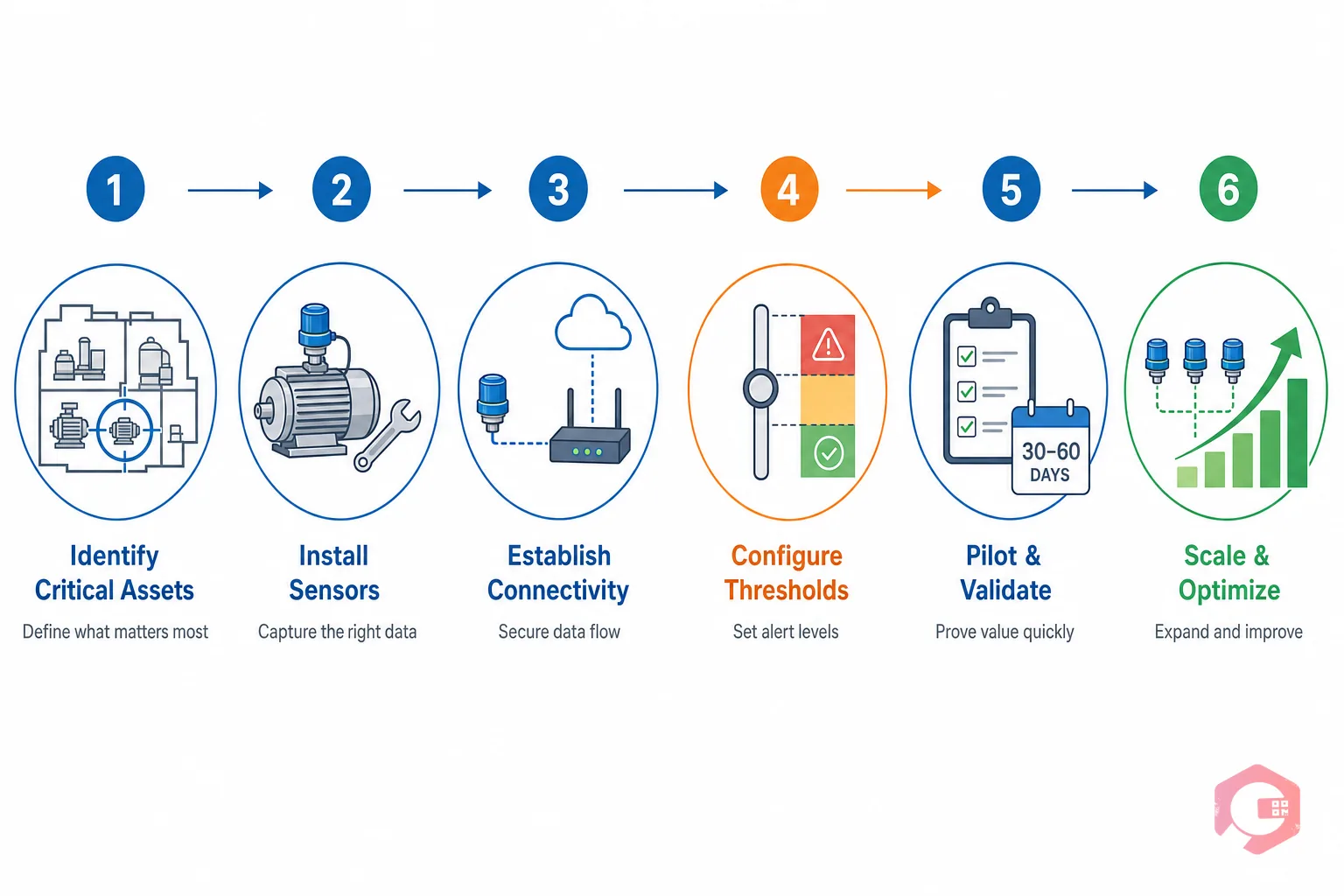


Step-by-Step: Implementing IoT with Cryotos CMMS

Integrating Cryotos CMMS with IoT — workflow

Successful CMMS-IoT integration follows a structured sequence. Trying to connect everything at once is a common mistake that leads to data overload and low adoption. A phased approach focused on your highest-risk assets delivers faster ROI and builds team confidence in the system.


  • Step 1 - Identify your critical assets. Start with the ten to fifteen assets where unplanned failure creates the highest cost in downtime, safety risk, or quality impact. These are your pilot candidates for IoT connectivity. Connecting lower-criticality equipment can come later once the data workflows are proven.
  • Step 2 - Select and install sensors. Match sensor type to the specific failure mode you are trying to detect. Vibration sensors on rotating equipment, temperature sensors on electrical systems, pressure sensors on hydraulic circuits. Work with your equipment manufacturer documentation to understand baseline operating ranges before installation.
  • Step 3 - Establish connectivity. Determine whether your sensors will connect to an existing SCADA system, push data through an edge gateway, or communicate directly to the cloud. Configure the data transmission protocol and verify that Cryotos is receiving clean, consistent data before configuring any automation rules.
  • Step 4 - Configure thresholds in Cryotos. Set warning and critical thresholds for each monitored parameter based on manufacturer specifications and your historical failure data. Start conservative - you can always tighten thresholds as you build confidence in the data. Define what automated action each threshold should trigger.
  • Step 5 - Run a pilot and validate. Monitor your pilot assets for 30 to 60 days. Validate that threshold alerts are firing correctly, that auto-generated work orders are reaching the right technicians, and that the maintenance data being captured is accurate. Review false positive rates and adjust thresholds if needed.
  • Step 6 - Scale and optimize. Once the pilot proves out, extend IoT connectivity to additional asset groups. Use Cryotos BI dashboards to track MTBF improvements, analyze which assets are generating the most threshold events, and refine your maintenance strategy based on real condition data rather than manufacturer-recommended schedules.


Real-World Results: What to Expect

Integrating Cryotos CMMS with IoT — scenario

The business case for CMMS-IoT integration is well established, but the timeline matters. Most facilities see measurable results within the first six months of a properly implemented predictive maintenance program.

Cryotos customers report a 30 percent reduction in unplanned downtime after connecting their CMMS to IoT sensor feeds. Mean Time to Repair drops by approximately 25 percent because technicians arrive at breakdowns with the full context of the failure - sensor history, asset maintenance record, and recommended parts - already loaded in the mobile app. Work orders generated from threshold alerts have a first-time fix rate significantly higher than those generated from verbal reports, because the diagnostic work is done before the wrench is picked up.

According to Reliable Plant, facilities that successfully implement predictive maintenance programs reduce overall maintenance costs by 12 to 18 percent within the first year. The energy efficiency gains from keeping assets running at optimal condition - rather than compensating for degrading performance - add further financial return that doesn't show up in the maintenance budget line but is felt in the utility bill.

Beyond cost, the operational culture shift matters. Maintenance teams that move from firefighting to monitoring report higher job satisfaction and lower technician turnover. When the system is telling you what to fix before it breaks, every workday is more manageable than when you're reacting to what broke last night.

Cryotos preventive maintenance software and its CMMS platform are built to support this transition. The asset management module provides the historical context IoT data needs to be meaningful, and the work order management system turns sensor alerts into structured maintenance actions your team can execute confidently.


Frequently Asked Questions


What sensors work with Cryotos CMMS?

Cryotos integrates with any sensor or device that can communicate through standard industrial protocols or push data via API. This includes vibration sensors, temperature sensors, pressure transducers, flow meters, energy meters, and smart meters connected through SCADA systems, PLCs, or edge computing devices. If your sensor data is accessible through an existing SCADA platform, Cryotos can receive it without requiring new hardware.


How long does IoT-CMMS integration take to implement?

A focused pilot on five to ten critical assets typically takes four to eight weeks from sensor selection through first threshold alert validation. The timeline depends on sensor installation complexity, connectivity infrastructure, and how clean your existing asset data is in Cryotos. Full facility rollout following a successful pilot typically runs three to six months, depending on the number of assets and operational zones involved.


Can Cryotos integrate with our existing SCADA system?

Yes. Cryotos is designed to receive data from existing SCADA and PLC infrastructure rather than requiring you to replace it. The integration reads data from your operational technology layer through standard protocols, meaning your control systems continue to operate exactly as they do today while Cryotos gains access to the asset health data they generate. This makes the integration non-disruptive to production operations.


What maintenance KPIs improve after IoT integration?

The most consistent improvements are in Mean Time Between Failures (MTBF), which rises as predictive interventions prevent failures that would otherwise occur, and Mean Time to Repair (MTTR), which drops because technicians have diagnostic context before arrival. Planned Maintenance Percentage (PMP) increases as more maintenance shifts from reactive to scheduled. Asset availability percentage and Overall Equipment Effectiveness (OEE) both improve as unplanned downtime declines. Cryotos tracks all of these KPIs automatically through its BI dashboard once IoT data is flowing.


Predictive maintenance powered by IoT is not a distant future capability - it is a present-day operational advantage that facilities of every size are deploying right now. Cryotos CMMS is built to connect your sensor infrastructure to your maintenance workflows without requiring a data science team or a complete infrastructure overhaul. If your equipment is already generating data, the question is whether your CMMS is listening to it. See how Cryotos makes IoT-driven predictive maintenance practical for your operation.


Want to Try Cryotos CMMS Today? Lets Connect!
Thank you! Your submission has been received!
Oops! Something went wrong while submitting the form.
Related Post

Integrating Cryotos CMMS with IoT: Unlocking Predictive Maintenance

Calendar
Duration:
7 min read
calendar today
Published on
April 27, 2026
Featured Image

Integrating CMMS with IoT means connecting your Computerized Maintenance Management System to real-time sensor data - enabling it to automatically detect equipment anomalies, trigger work orders, and schedule maintenance based on actual machine condition rather than fixed calendar intervals. When Cryotos CMMS connects with IoT devices, you stop guessing when something will fail and start knowing. According to McKinsey, predictive maintenance enabled by IoT can reduce equipment breakdowns by 30 to 50 percent. This guide explains how the integration works, what it delivers, and how to implement it.


What Is CMMS-IoT Integration?

CMMS-IoT integration is the technical bridge between your maintenance management platform and the physical sensors monitoring your assets. The IoT layer - sensors, PLCs, SCADA systems, and edge devices - continuously measures equipment health indicators like vibration, temperature, pressure, and energy consumption. That data flows into your CMMS, which applies logic rules to interpret it and trigger the right maintenance response.

This is a fundamental departure from traditional preventive maintenance, where a technician services equipment every 30 days regardless of whether the machine has been running flat out or sitting idle. IoT-connected maintenance replaces calendar guesswork with condition-based truth.


How the Data Flow Works

The data flow follows a clear sequence. Sensors attached to your assets continuously capture operational readings. Those readings are transmitted - either via wired protocols like Modbus and OPC UA, or wirelessly through MQTT - to an edge computing device or directly to the cloud. The CMMS receives the processed data stream, compares incoming readings against pre-defined thresholds, and takes automated action when a threshold is breached.

In Cryotos, that automated action can mean creating a high-priority work order, alerting a technician via mobile or WhatsApp, logging the anomaly against the asset's health record, and updating your maintenance BI dashboard - all without anyone manually intervening. The sensor detected the problem; the CMMS handled the response.


Why Traditional Maintenance Falls Short

Most industrial facilities still run on one of two outdated strategies: reactive maintenance, where you wait for something to break, or time-based preventive maintenance, where you service equipment on a fixed schedule whether it needs it or not. Both strategies are expensive in different ways.


The Cost of Reactive Maintenance

Reactive maintenance feels cheaper on paper - you only spend money when something breaks. In practice, it is the most expensive way to run a facility. Emergency repairs cost three to five times more than planned ones because of overtime labor, expedited parts shipping, and cascading production losses. According to a Plant Engineering industry survey, 82 percent of companies have experienced at least one unplanned downtime event in the past three years, with most caused by failures that had detectable warning signs days or weeks earlier.

Time-based preventive maintenance solves the surprise breakdown problem but introduces its own waste. A machine running at half its typical load doesn't need the same service intervals as one working double shifts. Replacing perfectly functional components on a calendar schedule burns maintenance budget unnecessarily. IoT changes this by triggering maintenance based on what the machine is actually telling you.


How IoT Sensors Enable Predictive Maintenance

Integrating Cryotos CMMS with IoT — problems grid

Predictive maintenance (PdM) uses real-time sensor data to detect the early signs of equipment degradation - what engineers call the P-F interval, the window between when a potential failure becomes detectable and when it becomes an actual functional failure. Catching problems inside this window means you fix a bearing before it seizes a motor, replace a seal before it causes a chemical spill, or service a pump before it drops offline mid-shift.


Key Sensor Types Used in CMMS Integration

Different failure modes require different sensors. The most commonly integrated sensor types in CMMS-IoT deployments are:


  • Vibration sensors - Monitor rotating equipment like motors, pumps, and compressors. Abnormal vibration patterns indicate bearing wear, shaft misalignment, or rotor imbalance weeks before failure.
  • Temperature sensors - Detect overheating in electrical panels, gearboxes, and HVAC systems. A rising temperature trend on a motor often precedes a winding failure.
  • Pressure sensors - Track hydraulic and pneumatic systems. Pressure drops can indicate seal degradation, blocked filters, or pump wear.
  • Energy meters - Measure current and voltage draw. A motor consuming 15 percent more power than baseline without increased output signals mechanical friction or misalignment.
  • Flow meters - Monitor coolant, lubricant, and fluid systems. Reduced flow rates can precede pump cavitation or clogged lines.

Each of these sensors generates a stream of data that, on its own, is just numbers. Connected to Cryotos CMMS, those numbers become decisions.


How Cryotos CMMS Connects with IoT Devices

Integrating Cryotos CMMS with IoT — lifecycle

Cryotos is designed to receive real-time sensor data from SCADA systems, PLCs, and edge computing devices. The integration does not require ripping out existing infrastructure. In most deployments, Cryotos connects to the operational technology layer your facility already runs, reading data through standard industrial protocols.


SCADA, PLC, and Edge Device Integration

SCADA (Supervisory Control and Data Acquisition) systems are the most common source of real-time operational data in industrial environments. Cryotos can receive data feeds from SCADA platforms, pulling equipment status, meter readings, and alarm states directly into the asset record. PLCs (Programmable Logic Controllers) - the embedded computers controlling individual machines - can similarly push data to Cryotos through edge gateways that translate proprietary PLC protocols into standard data formats the CMMS can consume.

Edge devices play a critical role in high-speed environments. Rather than sending every millisecond of raw sensor data to the cloud, edge computing processes data locally and transmits only significant events: threshold breaches, anomaly detections, or status changes. This reduces bandwidth requirements and response latency, which matters when you need a safety system to respond in seconds rather than waiting for a cloud round trip.


Threshold Alerts and Automated Work Orders

The core operational mechanism in Cryotos IoT integration is the threshold alert. Maintenance managers define acceptable operating ranges for each monitored parameter - for example, a motor bearing should not exceed 75�C, or a compressor vibration reading should stay below 4 mm/s. When an incoming sensor reading crosses that threshold, Cryotos triggers an automated response.

That response is configurable. For a warning-level reading, Cryotos can log the event, update the asset health record, and send an alert to the maintenance supervisor. For a critical threshold breach, it can automatically create a high-priority work order, assign it to the nearest available qualified technician, and push a mobile notification and WhatsApp alert simultaneously. The asset's BI dashboard updates in real time, giving plant management immediate visibility into the situation without anyone having to make a phone call.


Step-by-Step: Implementing IoT with Cryotos CMMS

Integrating Cryotos CMMS with IoT — workflow

Successful CMMS-IoT integration follows a structured sequence. Trying to connect everything at once is a common mistake that leads to data overload and low adoption. A phased approach focused on your highest-risk assets delivers faster ROI and builds team confidence in the system.


  • Step 1 - Identify your critical assets. Start with the ten to fifteen assets where unplanned failure creates the highest cost in downtime, safety risk, or quality impact. These are your pilot candidates for IoT connectivity. Connecting lower-criticality equipment can come later once the data workflows are proven.
  • Step 2 - Select and install sensors. Match sensor type to the specific failure mode you are trying to detect. Vibration sensors on rotating equipment, temperature sensors on electrical systems, pressure sensors on hydraulic circuits. Work with your equipment manufacturer documentation to understand baseline operating ranges before installation.
  • Step 3 - Establish connectivity. Determine whether your sensors will connect to an existing SCADA system, push data through an edge gateway, or communicate directly to the cloud. Configure the data transmission protocol and verify that Cryotos is receiving clean, consistent data before configuring any automation rules.
  • Step 4 - Configure thresholds in Cryotos. Set warning and critical thresholds for each monitored parameter based on manufacturer specifications and your historical failure data. Start conservative - you can always tighten thresholds as you build confidence in the data. Define what automated action each threshold should trigger.
  • Step 5 - Run a pilot and validate. Monitor your pilot assets for 30 to 60 days. Validate that threshold alerts are firing correctly, that auto-generated work orders are reaching the right technicians, and that the maintenance data being captured is accurate. Review false positive rates and adjust thresholds if needed.
  • Step 6 - Scale and optimize. Once the pilot proves out, extend IoT connectivity to additional asset groups. Use Cryotos BI dashboards to track MTBF improvements, analyze which assets are generating the most threshold events, and refine your maintenance strategy based on real condition data rather than manufacturer-recommended schedules.


Real-World Results: What to Expect

Integrating Cryotos CMMS with IoT — scenario

The business case for CMMS-IoT integration is well established, but the timeline matters. Most facilities see measurable results within the first six months of a properly implemented predictive maintenance program.

Cryotos customers report a 30 percent reduction in unplanned downtime after connecting their CMMS to IoT sensor feeds. Mean Time to Repair drops by approximately 25 percent because technicians arrive at breakdowns with the full context of the failure - sensor history, asset maintenance record, and recommended parts - already loaded in the mobile app. Work orders generated from threshold alerts have a first-time fix rate significantly higher than those generated from verbal reports, because the diagnostic work is done before the wrench is picked up.

According to Reliable Plant, facilities that successfully implement predictive maintenance programs reduce overall maintenance costs by 12 to 18 percent within the first year. The energy efficiency gains from keeping assets running at optimal condition - rather than compensating for degrading performance - add further financial return that doesn't show up in the maintenance budget line but is felt in the utility bill.

Beyond cost, the operational culture shift matters. Maintenance teams that move from firefighting to monitoring report higher job satisfaction and lower technician turnover. When the system is telling you what to fix before it breaks, every workday is more manageable than when you're reacting to what broke last night.

Cryotos preventive maintenance software and its CMMS platform are built to support this transition. The asset management module provides the historical context IoT data needs to be meaningful, and the work order management system turns sensor alerts into structured maintenance actions your team can execute confidently.


Frequently Asked Questions


What sensors work with Cryotos CMMS?

Cryotos integrates with any sensor or device that can communicate through standard industrial protocols or push data via API. This includes vibration sensors, temperature sensors, pressure transducers, flow meters, energy meters, and smart meters connected through SCADA systems, PLCs, or edge computing devices. If your sensor data is accessible through an existing SCADA platform, Cryotos can receive it without requiring new hardware.


How long does IoT-CMMS integration take to implement?

A focused pilot on five to ten critical assets typically takes four to eight weeks from sensor selection through first threshold alert validation. The timeline depends on sensor installation complexity, connectivity infrastructure, and how clean your existing asset data is in Cryotos. Full facility rollout following a successful pilot typically runs three to six months, depending on the number of assets and operational zones involved.


Can Cryotos integrate with our existing SCADA system?

Yes. Cryotos is designed to receive data from existing SCADA and PLC infrastructure rather than requiring you to replace it. The integration reads data from your operational technology layer through standard protocols, meaning your control systems continue to operate exactly as they do today while Cryotos gains access to the asset health data they generate. This makes the integration non-disruptive to production operations.


What maintenance KPIs improve after IoT integration?

The most consistent improvements are in Mean Time Between Failures (MTBF), which rises as predictive interventions prevent failures that would otherwise occur, and Mean Time to Repair (MTTR), which drops because technicians have diagnostic context before arrival. Planned Maintenance Percentage (PMP) increases as more maintenance shifts from reactive to scheduled. Asset availability percentage and Overall Equipment Effectiveness (OEE) both improve as unplanned downtime declines. Cryotos tracks all of these KPIs automatically through its BI dashboard once IoT data is flowing.


Predictive maintenance powered by IoT is not a distant future capability - it is a present-day operational advantage that facilities of every size are deploying right now. Cryotos CMMS is built to connect your sensor infrastructure to your maintenance workflows without requiring a data science team or a complete infrastructure overhaul. If your equipment is already generating data, the question is whether your CMMS is listening to it. See how Cryotos makes IoT-driven predictive maintenance practical for your operation.

Want to Try Cryotos CMMS Today?

Get Free Demo

Let AI Take Control of Your Maintenance

Cryotos AI predicts failures, automates work orders, and simplifies maintenance—before problems slow you down.

Try AI-Powered CMMS
🡢