
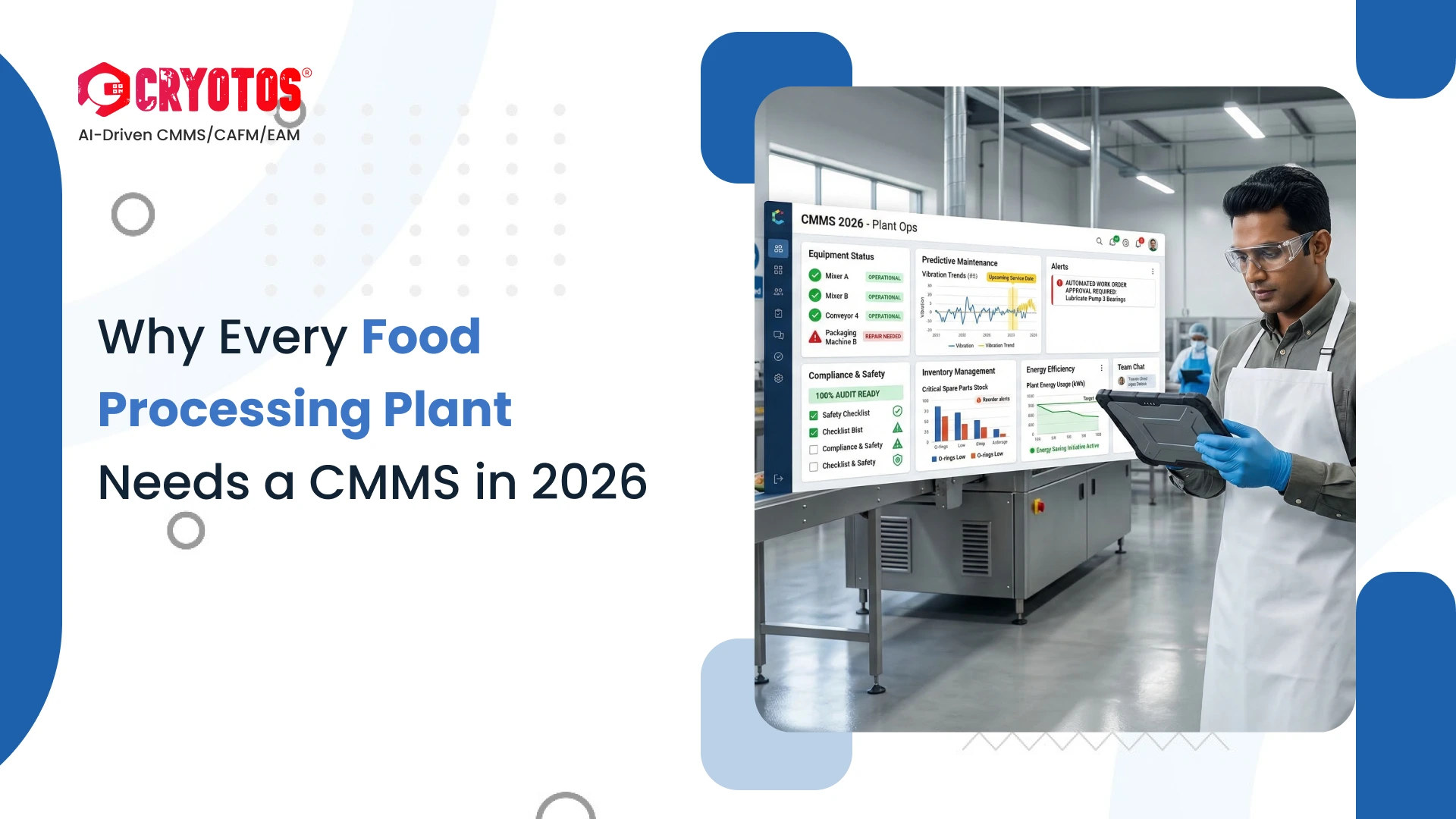
The food manufacturing industry is facing immense pressure in 2026. Unplanned downtime costs industrial manufacturers up to $50 billion annually, with Fortune 500 food companies losing an average of $2.8 billion per year. Despite these staggering financial hits, 58% of food facilities still operate reactively. The strategy of waiting till equipment fails instead of avoiding failures has a direct effect on the bottom line.
The installation of a Computerized Maintenance Management System (CMMS) is no longer an upgrade. Food processing facilities have a paramount need to safeguard production availability, supply regulatory readiness, and address the continuous workforce issues.
A Computerized Maintenance Management System (CMMS) refers to the software that gathers information on maintenance and supports the operations involved in maintenance. Imagine that it is the virtual nervous system of physical assets at your facility.
A dedicated CMMS in food manufacturing conforms to industry-specific pressures. It takes care of the frequent washdowns, sanitation schedules, and production cycles that are high in volume to ensure the safety of the plant. It coordinates all the daily lubrication conveyor routes and complicated thermal processing unit calibration schedules.
Once a mixer has gone offline or there is a failure in one of the refrigeration units, the clock begins to tick on food safety. In this case, downtime cost also involves the loss of production at once, and the likelihood of wasted raw material is high.
Food processing leaders need real-time insight into machine health to successfully cut equipment downtime. The contemporary maintenance management system of food industry operations is based on such an attack on the problem, as well as on a specific downtime management module. The key KPIs, which can be monitored by managers, include Breakdowns (BDO), Breakdown Hours (BDH), Mean Time to Repair (MTTR), and Mean Time Between Failure (MTBF). With this data in the departments or individual assets, the facilities can identify problems that are chronic before leading to crippling stops. The data provided by Cryotos reveals that the facilities have successfully reduced downtime by 30 percent and shortened the time of repair by 25 percent with the help of proactive tracking.
The cost of running equipment until it fails is an expensive method. The shift to the proactive model will involve the need to have powerful preventive maintenance software that will be dependable by the food industry professionals.
The manufacturing plants need to close the divide between the machines and the maintenance teams to enhance the equipment uptime. This is the point at which Industry 4.0 ideas are represented.
By directly connecting your CMMS to the floor of the plant, connecting it to IoT sensors, SCADA systems, and PLCs, you can have the software constantly check the performance of assets. When a bearing begins to vibrate beyond acceptable limits, the system it is attached to will raise a threshold alarm and automatically issue a work request. The maintenance team corrects the anomaly in a predetermined period and does not resort to a crisis shutdown in the middle of production.
Deploying digital maintenance solutions in food plants can yield immediate, tangible benefits across the floor:
Systems like Cryotos simplify work order creation using generative AI, allowing operators to generate requests via voice commands or by uploading annotated photos of faults. Floor staff can also scan QR codes on machines to submit instant public work requests.
Stockouts on critical spare parts keep machines down. A CMMS tracks inventory in real-time, mapping exact warehouse structures down to the specific bin location. Automated alerts notify purchasing when stock falls below minimum thresholds, supporting FIFO valuation and eliminating excess ordering.
Fixing does not occur within the desk. The technicians can read manuals, fill checklists, and take repair notes using mobile apps. Offline modes also provide the facility to make sure that work is recorded and updated later, even in areas of the plant with a slow connection.
Work orders have built-in chat capabilities that enable administration and technicians to communicate in real time. Specified messages distributed through Email or WhatsApp keep all stakeholders informed about changes in the status of the tasks and the schedule.
Regulatory bodies run tight ships. FDA, FSMA, and local audits demand meticulous record-keeping. Using food safety compliance software functionality within your CMMS turns a stressful audit into a simple reporting task.
All the activities related to the maintenance of food processing equipment are recorded. Digital checklists are programs that make the necessary sanitation and safety procedures done by technicians and are easy to import through OCR technology. The system compels root cause analysis (RCA) of delays and puts Lockout-Tagout (LOTO) procedures directly into the process. When a given auditor requests the maintenance history of a particular pasteurizer, the plant managers can retrieve a detailed, chronologically dated report that contains safety certifications and digital signatures within a few seconds.
The critical elements to consider when choosing a platform to operate your business are:
Cloud-based systems do not need much heavy IT to set up and can be scaled fast.
Load your equipment hierarchy into the system and attach printed QR code labels to assets across the plant floor for instant mobile scanning.
Upload your facility's institutional knowledge. Configure the system so tasks cannot be closed without mandatory HACCP compliance steps and digital signatures.
Implement the mobile application for your maintenance team. On-the-job training will be greatly improved with the help of guided workflows and digital checklists.
Specifically, use the standard REST APIs to connect your new plant-floor CMMS with your existing financial software to automatically reconcile parts of usage and labor hours.
Upgrade the essential motors, compressors, and conveyors of an IP69K IoT sensor in a washdown-ready state to continue tracking the data streams and forecasting failures.
The future food processing plant is based on deep data. We will witness the use of maintenance systems playing greater roles in the ability to predict models, whereby historical breakdown data are analyzed together with real-time sensor readings used to predict the lifespan of the various components. With the increase in edge computing availability, CMMS systems will react to multi-dimensional machine telemetry in place, allowing automated reactions to possible mechanical failures in a split second before they affect the quality of food.
The efficiency, strict compliance, and maximum equipment reliability are required to remain a competitive entity in 2026. The adoption of CMMS is no longer a matter of dealing with broken machines, but a form of coordinating a proactive, data-driven process. Centralizing your maintenance strategy helps you to secure the quality of your product, to empower your technicians, and to save a lot of waste in your operations.


Cryotos AI predicts failures, automates work orders, and simplifies maintenance—before problems slow you down.



